Cat Stroller Vs Carrier
Cat Stroller Vs Carrier
Choose a stroller for regular outdoor outings, senior or low-stamina cats, and multi-cat excursions where ride comfort matters most. Choose a carrier for vet visits, flights, and quick transfers where portability and airline compliance come first. The trade-off is simple: strollers give you smoother rides but eat up closet space, while carriers pack small but demand more from your cat’s nerves. TheMeowPicks Team breaks down exactly how to tell which one your routine actually needs.
TL;DR:
- Strollers are best for regular outdoor outings and benefit senior cats with suspension and large wheels for smoother rides.
- Carriers excel at short trips, flight compliance, and bulk storage, making them ideal for vet visits and frequent travel.
- Weather resistance and safety features like secure zippers and tether points are crucial for durability and reliable use.
- Hard-shell carriers and larger, suspension-equipped strollers generally last longer but come at higher upfront costs.
- Matching gear to actual routine frequency and cat temperament ensures safer, more comfortable travel experiences.
Table of Contents
- Cat Stroller vs Traditional Carrier: A Quick Comparison
- When a Cat Stroller Is the Right Choice
- When a Cat Carrier Is the Right Choice
- Safety Features and Comfort Checklist Before You Buy
- How to Introduce and Prepare Your Cat for Either Option
- Special Cases: Seniors, Multi-Cat Homes, and Air Travel
- TheMeowPicks Curation Notes
- Cleaning and Maintenance for Strollers and Carriers
- Comparative Cost Analysis and Price Ranges
- Ease of Use and Setup Convenience
- Material Durability and Weather Resistance
- Our Take: Stop Buying for the Trip You Imagine
- Find Your Cat’s Travel Match at TheMeowPicks
- Sources
- FAQ
Cat Stroller vs Traditional Carrier: A Quick Comparison
Before you commit to either option, it helps to see the differences laid outside by side. Here’s how strollers and carriers stack up on the factors that matter most to real-world use.
- Best for: Strollers suit frequent outdoor walks and errands; carriers suit vet trips, flights, and quick car rides.
- Portability and storage: Carriers fold flat or stack in a closet; strollers need floor space and don’t collapse as small.
- Ride comfort: Strollers with real suspension smooth out cracked sidewalks and gravel paths; carriers rely on your own steady hands.
- Safety features: Both need secure zippers and tether points, but strollers add wheel locks and canopy latches to the list.
- Multi-cat capacity: A single stroller often holds two cats comfortably; most carriers are built for one.
- Price and value: Carriers generally cost less upfront; strollers cost more but replace multiple short carrier trips over years of use.
If you only want one takeaway: match the purchase to how often you’ll actually leave the house with your cat, not to what looks nice in photos.
When a Cat Stroller Is the Right Choice
A stroller earns its price tag when outdoor time is a habit, not an occasion. If you’re heading to the farmers market every Saturday, walking the same loop through the neighborhood most evenings, or just like giving your cat sunshine and fresh air on a schedule, a stroller turns that into an easy routine instead of a wrestling match with a carrier bag.
Senior and arthritic cats benefit the most from a good stroller because ride quality directly affects their joints. Wheel size, suspension, and tire type determine whether a curb or a pothole jolts your cat or barely registers. Experts who cover ride quality in strollers point out that air-filled tires and real suspension protect sensitive joints from jarring impacts far better than the small hard wheels found on cheaper models. That difference matters more with age.
Strollers also free up your hands, which sounds minor until you’re juggling a leash, a coffee, and a squirming carrier at the same time. You push, your cat rides, and there’s usually a basket underneath for your bag or a water bottle.
The trade-offs are real, though. A folded stroller still takes up more space than any carrier, and most models weigh more empty than a soft carrier does loaded. Expect to pay more upfront too. If you’re not leaving the house with your cat at least once a week, that extra weight and cost are hard to justify.
When a Cat Carrier Is the Right Choice
Carriers win when the trip is short, the destination is unpredictable, or air travel is involved. Every airline that allows pets in the cabin has strict under-seat dimensions, and a carrier that doesn’t meet them gets you turned away at the gate, not politely asked to check it. Guides that test airline-compliant carrier sizing consistently find soft-sided carriers perform better in crash scenarios and slide more easily under economy seats than hard-shell alternatives. Before you book anything, check our airline carrier sizing guide so you’re not measuring at the airport.
Vet visits are the other obvious use case. A carrier’s enclosed, den-like shape genuinely calms anxious cats in ways an open stroller cannot. Covering the carrier with a towel in the waiting room, something you can’t do with a stroller’s mesh canopy, cuts down on visual stress triggers from other animals.
You have real choices within the carrier category itself. Soft-sided carriers flex into tight car footwells and compress for storage. Hard carriers offer more structure and are easier to hose down after an accident. Backpack carriers keep your hands free on hikes or stairs, which our backpack carrier guide covers in more depth, and rolling carriers help with heavier cats over long airport walks.
Across the board, carriers win on portability. They store in a closet corner, weigh less, and clean up faster than a stroller ever will.
Safety Features and Comfort Checklist Before You Buy
Whichever format you choose, a handful of features separate a genuinely safe product from one that just looks the part.
- Internal tether points: A leash clip inside the carrier or stroller keeps your cat from bolting the second a zipper opens.
- Locking zippers or latches: Zippers that a paw can’t work open, plus stroller canopy latches that won’t pop loose over bumps.
- Ventilation and interior space: Mesh panels on multiple sides prevent overheating and let your cat see out without feeling exposed on every edge.
- Bedding: Removable, washable padding beats a bare plastic or mesh floor, especially on longer trips.
- Folded dimensions and empty weight: Check both before buying, since a stroller that won’t fit your trunk or a carrier too heavy to carry loaded defeats the purpose.
- Wheel and suspension quality: For strollers, larger wheels with actual suspension travel handle curbs and gravel far better than budget casters.
- Weather protection: Rain covers and shaded canopies matter if you plan to use a stroller outside of ideal weather.
- Stated weight limits: Only rely on the capacity the product listing states; don’t assume a model built for one cat safely holds two.
Consumer guides that evaluate carrier safety features flag multiple entry points, secure tethers, breathable materials, and interiors that wipe clean easily as the non-negotiables, and that list holds up whether you’re comparing $40 soft carriers or premium options.
Pro Tip: Measure your cat’s length and height before shopping, not after. A carrier or stroller compartment that fits your cat curled up but not stretched out will make every trip feel cramped, and cramped cats fight harder to get out.
How to Introduce and Prepare Your Cat for Either Option
Cats don’t take naturally to being enclosed and moved around, so a little groundwork pays off fast. Start by leaving the carrier or stroller open in a room your cat already likes, letting them sniff and explore on their own schedule for a few days before you ask them to get in.
Harness training helps regardless of which format you choose. International Cat Care’s travel guidance recommends a secure harness and tether even inside an enclosed carrier, since it gives you a backup point of control if a zipper or door fails mid-trip. Reward-based conditioning, treats given calmly near and then inside the gear, works better than forcing entry.
When it’s time to load up, move slowly and support your cat’s body rather than pushing from behind, which tends to trigger panic. Pack the basics before you leave: water, a collapsible bowl, a small litter tray for longer outings, extra bedding for padding, and a basic first-aid kit. None of it takes much room, and all of it turns a stressful surprise into a manageable one.
Special Cases: Seniors, Multi-Cat Homes, and Air Travel
Senior and arthritic cats need the smoothest ride you can give them, which usually means prioritizing stroller suspension and wheel size over aesthetics or price. Add extra bedding for joint support and keep outings shorter but more frequent rather than one long trip.
Multi-cat households face a genuine fork in the road: one larger stroller or two separate carriers. Temperament decides it more than budget does. Bonded, calm cats often do fine sharing a stroller compartment, while cats that don’t get along, or one anxious cat paired with a bold one, do better in separate carriers where neither can crowd the other.
Air travel calls for a hybrid approach. Use a carrier that meets your airline’s under-seat dimensions for the flight itself, then switch to a stroller once you’ve landed for sightseeing or daily walks at your destination. Some detachable stroller systems let the carrier shell click out of the stroller frame, giving you both functions in one purchase. Airline pet policies vary widely and change without much notice, so confirm current rules directly with your carrier before booking, and international travel adds another layer of documentation entirely, an issue global pet travel standards discussions have highlighted as inconsistent across borders. If you travel often and walk often, owning both a compact carrier and a stroller usually costs less over time than compromising on one.
TheMeowPicks Curation Notes
TheMeowPicks Team curates carriers, strollers, and travel accessories from independent makers, so every listing states its own materials and dimensions rather than generic marketing copy. Our soft vs hard carrier guide and stroller stability guide match directly to the use cases above: compact carriers for vets and flights, detachable stroller systems for multi-cat outings, and cozy add-ons for cats who prefer an enclosed, den-like ride.
Cleaning and Maintenance for Strollers and Carriers
Soft carriers are the easiest to maintain day to day. Most removable liners and bedding pads go straight into the washing machine, and wiping down the mesh panels with a damp cloth handles the rest. Hard carriers take a bit more effort but reward you for it: a hose-down or a wipe with mild soap gets into every corner, which matters if your cat has an accident mid-trip.
Strollers require more attention simply because they have more parts. Wheels pick up dirt, gravel, and grass clippings that need brushing out regularly so they keep rolling smoothly. Fabric canopies and seating areas usually have zip-out or removable liners, but check the specific listing since not every model offers this. Frames, especially aluminum or steel ones, hold up fine with an occasional wipe, but any exposed metal joints benefit from staying dry to avoid rust over time.
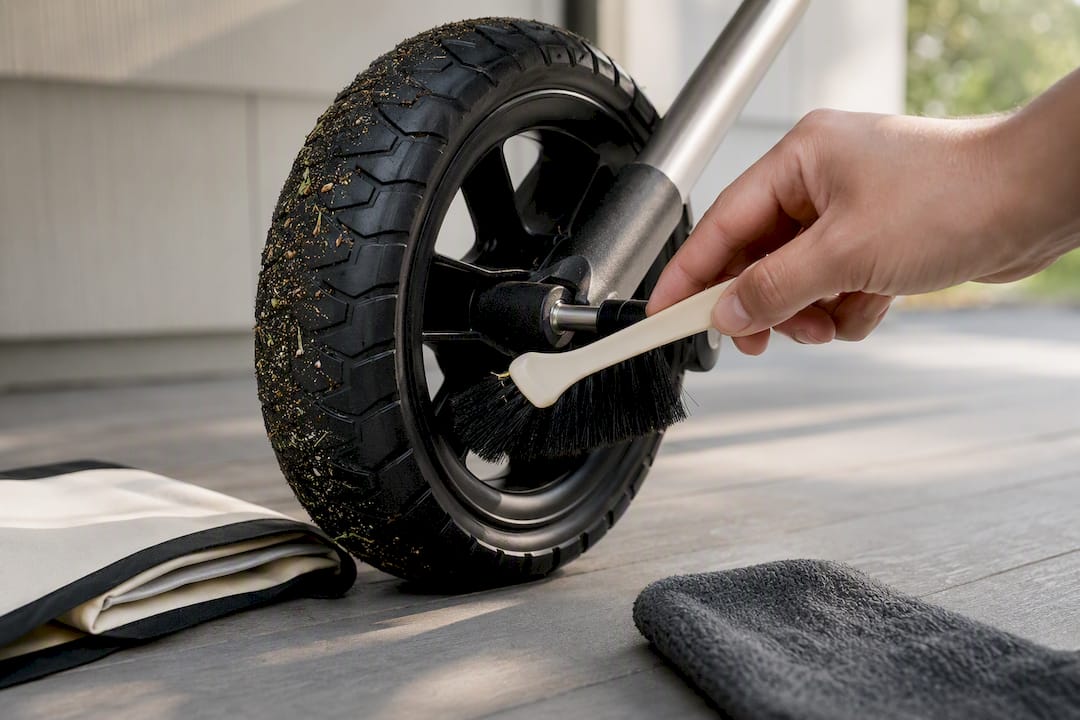
Whichever gear you own, let it fully air dry before folding it away. Damp fabric stored in a closed carrier or folded stroller develops odor and mildew fast, especially in humid climates. A quick once-over after every outdoor trip, shaking out debris and checking zippers or latches for wear, catches small problems before they become safety issues.
Comparative Cost Analysis and Price Ranges
Carriers are the cheaper entry point almost across the board. Basic soft carriers for a single cat typically start well under $50, while backpack and rolling styles with more structure and padding run higher depending on materials and brand. Hard carriers tend to sit in a similar range, sometimes slightly more, because of the molded shell construction.
Strollers cost more from the start. Multi-cat capacity, suspension systems, and larger wheelbases all add to the price, and premium models with detachable carrier components sit at the top of that range. The upfront gap between a basic carrier and a well-built stroller can be significant.
The way to think about value isn’t the sticker price alone, it’s cost per use. A $200 stroller used weekly for two years costs a lot less per outing than a $40 carrier bought for one flight and left in a closet afterward. Conversely, if your only real need is two vet visits a year, a modest carrier is the better spend regardless of how appealing a stroller looks. Match the purchase to your actual frequency, not to the sticker shock of the initial price tag.
Ease of Use and Setup Convenience
Carriers win on simplicity. Most soft carriers need zero assembly: unzip, load your cat, zip up, and go. The learning curve is close to nonexistent, which makes carriers the better pick for anyone who wants gear that works the first time without instructions.
Strollers ask a little more of you upfront. Folding and unfolding the frame takes a few tries to get smooth, and features like canopy latches, brake locks, and detachable baskets add steps that aren’t intuitive on day one. Once you’ve done it a handful of times, though, most owners report the process becomes second nature, closer to folding a stroller for a toddler than assembling furniture.
Loading your cat is where the real skill difference shows up, and it has less to do with the gear and more to do with your cat’s temperament. A calm cat slides into either format easily. An anxious cat will test the weak points of whichever system you use, so the harness and reward training covered earlier matters more for ease of use than any product feature does.
Material Durability and Weather Resistance
Carrier materials range from lightweight nylon to heavier canvas and rigid plastic shells. Nylon soft carriers are light and easy to store but wear at the seams faster under daily use than heavier-duty fabric. Hard-shell carriers resist punctures and hold their shape indefinitely, though they’re bulkier to store when not in use.
Stroller frames are typically aluminum or steel, and the choice affects both weight and rust resistance over years of outdoor use. Aluminum frames stay lighter and shrug off moisture better; steel frames tend to be sturdier but need to stay dry to avoid corrosion at joints and welds. Canopy fabric varies by listing, so check whether a specific model states water resistance rather than assuming it.
Weather exposure is the real durability test for strollers, since they’re built for repeated outdoor use in a way carriers usually aren’t. A stroller left out in rain without a proper cover will show wear on fabric and metal far faster than one stored dry between outings. Carriers, by contrast, rarely see sustained weather exposure since most trips are point-to-point, so their durability concerns are more about daily wear from zippers and paws than from the elements.
Our Take: Stop Buying for the Trip You Imagine
Most advice on this topic treats strollers and carriers as a style choice, dog stroller energy versus practical travel gear. That framing misses the actual decision variable: frequency. A cat who leaves the house twice a year needs a carrier, full stop, no matter how much you’d enjoy pushing a stroller around the block.
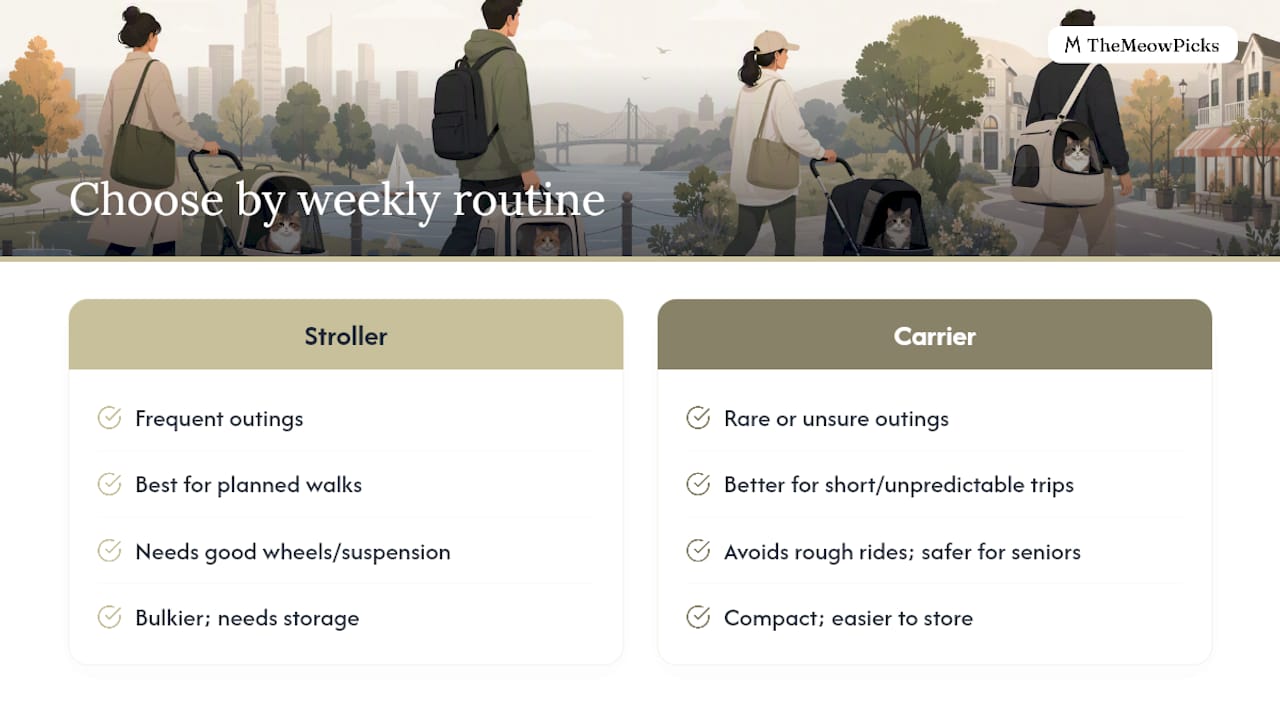
Where conventional advice really falls short is ride quality. Plenty of buying guides treat wheels as an afterthought, a spec buried at the bottom of a comparison chart. It shouldn’t be. For a senior cat, cheap wheels and no suspension can turn a pleasant walk into a rough one, and that’s the difference between a stroller your cat tolerates and one they actually enjoy.
If you take one thing from this guide, prioritize matching gear to your actual weekly routine before you look at colors or price. Buy the carrier first if you’re unsure. It’s cheaper, it’s more versatile, and it’s the one piece of gear every cat owner needs regardless of whether a stroller ever enters the picture.
— TheMeowPicks Team
Find Your Cat’s Travel Match at TheMeowPicks
TheMeowPicks curates designer carriers, strollers, and travel gear from independent makers, so you’re not scrolling through generic mass-market listings to find something that actually fits your cat’s size and your routine.
If frequent outdoor walks are the goal, our wagon-style stroller gives multi-cat households a stable, cushioned ride with room for two. For cats who prefer a cozier hideaway inside their carrier or at home between trips, the Perla Cat Cave offers that same den-like comfort vets recommend for anxious travelers. Pack a Pesce Activity Toy to keep restless cats occupied on longer rides, and check our soft vs hard carrier guide if you’re still deciding between styles. Every purchase also supports cat rescue organizations through our giving program. Browse the current lineup and find the setup that matches how you and your cat actually get around.
Sources
FAQ
Are cat strollers a good idea?
Yes, for cats who go outdoors regularly, especially seniors or low-stamina cats who benefit from a smooth, suspension-cushioned ride instead of walking or being carried.
Do vets recommend cat slings or carriers for stressed cats?
Veterinary and welfare organizations generally recommend enclosed carriers with secure tethers for anxious cats, since the den-like structure reduces visual stress compared to open slings or strollers.
Are cat strollers a good idea for indoor cats?
Yes. A stroller lets indoor cats safely experience fresh air and new sights without the risks of off-leash exploration, as long as they’re introduced to it gradually.
What is the least stressful way to transport a cat?
A well-ventilated carrier with a secure tether, familiar bedding, and gradual acclimation beforehand tends to cause the least stress, particularly for short trips like vet visits.