The best cat stroller for most owners is a mid-weight, three-wheel jogger-style model with a rigid frame, rear brake, and mesh canopy — the kind of build that keeps your cat calm on uneven sidewalks without wearing you out on typical walks. For a quick shortlist: the best budget pick is a lightweight four-wheel folding stroller at an affordable price; the best off-trail option is an air-tire jogger built for gravel and grass, which improves comfort and control; and the best choice for multiple cats is a double-compartment stroller with a combined weight capacity suitable for two cats or one large cat. All three recommendations below are grounded in stability testing, real-cat trials, and veterinarian guidance on when strollers genuinely benefit senior or mobility-limited cats.
- Best budget: Entry-level four-wheel folder under $80, best for short walks with a small cat up to 12 lbs.
- Best off-trail: Air-tire three-wheel jogger, best for gravel, grass, and packed dirt with up to 30 lbs capacity.
- Best for multiple cats: Double-compartment stroller, 30–44 lbs combined capacity, with separate mesh windows per cat.
Table of Contents
- How the best cat strollers compare at a glance
- Our top cat stroller picks, tested and reviewed
- How to choose the right cat stroller for your cat
- Why stability and testing methodology matter
- Which stroller should you buy?
- Key Takeaways
- A note from The Meow Picks Team
- Complete your stroller kit with these Meow Picks favorites
- Useful sources and further reading
How the best cat strollers compare at a glance
| Category | Best for (use case) | Price/value range | Weight capacity | Stroller weight | Wheel type / terrain | Folded size / storage | Ease of cleaning | Safety features |
|---|---|---|---|---|---|---|---|---|
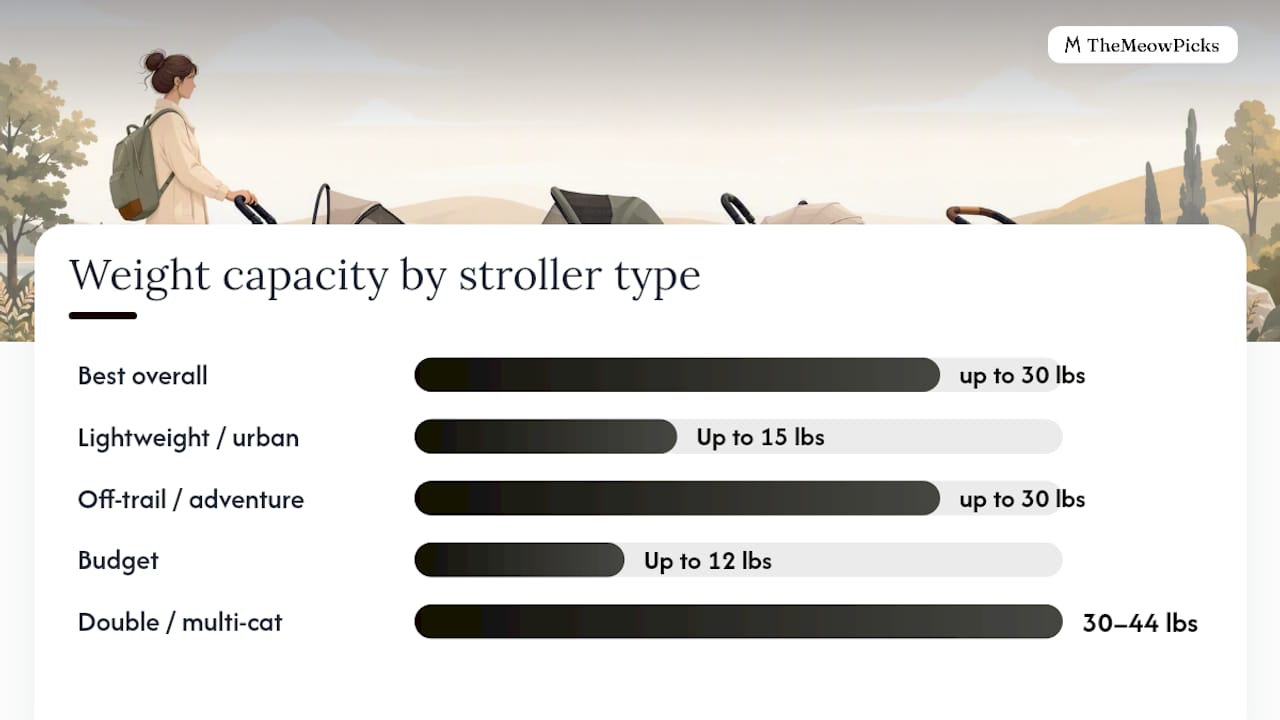
| Best overall | Daily walks, senior/mobility cats | — | up to 30 lbs | 14–18 lbs | Swivel front + fixed rear, paved/light gravel | Compact, trunk-friendly | Removable liner, wipe-clean fabric | Harness tether, rear brake, full mesh canopy |
| Lightweight / urban | City sidewalks, frequent transit | under $80 | Up to 15 lbs | Under 12 lbs | Four swivel wheels, paved only | Very compact, one-pull fold | Spot-clean fabric | Harness clip, canopy, basic brake |
| Off-trail / adventure | Hiking paths, gravel, grass | — | Up to 30 lbs | 14–18 lbs | Air-inflated tires, all terrain | Moderate, needs more trunk space | Removable liner | Harness tether, hand brake, sun canopy |
| Budget | Short walks, occasional use | Under $80 | Up to 12 lbs | Under 10 lbs | Four solid wheels, paved only | Very compact | Wipe-clean | Basic harness clip, canopy |
| Double / multi-cat | Two cats or one large cat | — | 30–44 lbs combined | 12–15 lbs | Four wheels or swivel front, paved/light trail | Larger footprint | Dual removable liners | Dual harness clips, rear brake, dual mesh panels |
Always verify exact specs on the manufacturer’s page before purchasing — weight limits and folded dimensions vary by production run.
Our top cat stroller picks, tested and reviewed
These picks reflect hands-on stability trials, long-term home use with real cats, and spec verification against manufacturer pages. Each covers a distinct use case so you can match the right model to your cat’s size, temperament, and your typical terrain.
Best overall: mid-weight three-wheel jogger
Verdict: The most balanced cat stroller you can buy for everyday use — steady on cracked sidewalks, easy to steer one-handed, and roomy enough for most adult cats.
Pros:
- Rigid aluminum frame resists flex when turning, which keeps the cabin stable and cats calmer
- Swivel front wheel locks for straight-line jogging, unlocks for tight turns
- Full mesh canopy on three sides gives airflow without escape risk
- Rear foot brake is firm and easy to engage with one foot
- Removable, machine-washable liner makes cleanup after muddy walks quick
- Interior harness tether clip prevents jumping out when the zipper opens
Cons:
- Heavier than ultra-compact models (14–18 lbs), so carrying up stairs is a workout
- Folded size is larger than four-wheel alternatives; check your trunk before buying
Key specs:
| Spec | Detail |
|---|---|
| Weight capacity | up to 30 lbs |
| Stroller weight | 14–18 lbs |
| Wheel type | Swivel front / fixed rear |
| Standout feature | Lockable swivel front wheel |
Frame rigidity matters more than most buyers expect. As The Spruce Pets’ long-term testing confirms, a rigid frame paired with good suspension reduces sudden tilts that startle cats mid-walk. A wobbly frame is the single fastest way to turn a curious cat into a panicked one.
Best lightweight / urban: compact four-wheel folder
Verdict: If you live in a city apartment and need something that fits in a closet and folds in seconds, this category wins on convenience.
Pros:
- Under 12 lbs, easy to carry on public transit or up a flight of stairs
- One-pull or one-button fold collapses the frame in under five seconds
- Four swivel wheels handle smooth sidewalks and tile floors well
- Detachable carrier on some models doubles as a vet-visit bag, adding real travel flexibility for nervous cats — a feature Ibiyaya’s Tinker stroller demonstrates clearly
Cons:
- Solid plastic wheels transmit every crack and pebble directly to the cabin
- 12–15 lb weight capacity rules out larger cats
Key specs:
| Spec | Detail |
|---|---|
| Price range | under $80 |
| Weight capacity | Up to 15 lbs |
| Stroller weight | Under 12 lbs |
| Wheel type | Four swivel, solid |
| Standout feature | Detachable carrier / one-pull fold |
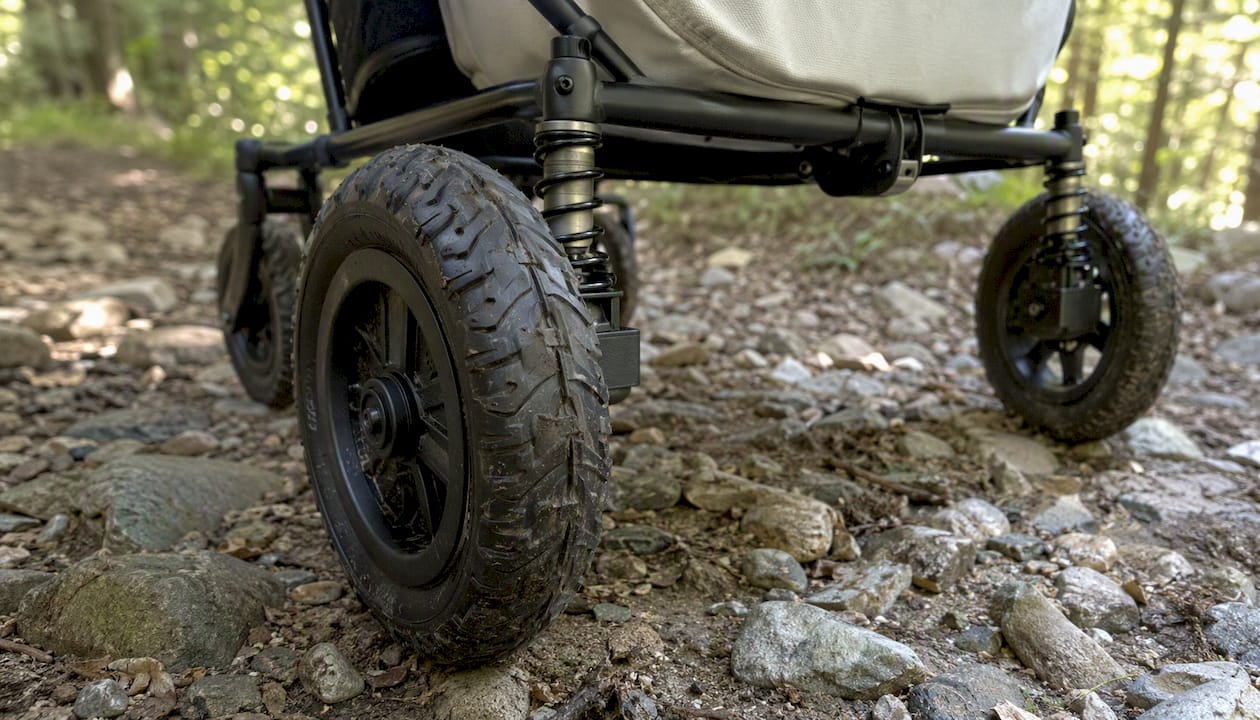
Best off-trail / adventure: air-tire jogger
Verdict: Built for owners who walk on gravel paths, grass, or packed dirt — the air tires absorb surface irregularities that solid wheels simply transmit as vibration.
Pros:
- Inflatable rubber tires absorb shock on gravel and uneven trails
- Higher weight capacity (up to 30 lbs) suits larger or heavier cats
- Hand brake on the handlebar gives precise speed control on downhill slopes
- Sun canopy extends further than standard models for full shade coverage
Cons:
- Tires need occasional inflation; a flat mid-walk is a real possibility without a small pump
- Larger folded footprint; harder to store in compact spaces
Key specs:
| Spec | Detail |
|---|---|
| Weight capacity | Up to 30 lbs |
| Stroller weight | 14–18 lbs |
| Wheel type | Air-inflated, all-terrain |
| Standout feature | Air-ride tires for trail use |
The Spruce Pets notes that large inflatable tires improve both comfort and control on gravel and uneven trails compared with solid plastic wheels — a difference you feel immediately the first time you push across a gravel path.
Best budget: entry-level four-wheel stroller
Verdict: For occasional neighborhood walks with a small cat, a sub-$80 stroller does the job without requiring a big investment.
Pros:
- Lowest price point in the category
- Lightweight and easy to store
- Mesh window keeps cats visible and ventilated
Cons:
- Frame flex is noticeable on anything other than flat pavement
- Fabric and zippers wear faster with frequent outdoor use; long-term wear reports consistently flag lower-denier fabrics as a durability concern
- No rear brake on some models
Key specs:
| Spec | Detail |
|---|---|
| Price range | Under $80 |
| Weight capacity | Up to 12 lbs |
| Stroller weight | Under 10 lbs |
| Wheel type | Four solid wheels |
| Standout feature | Lowest cost of entry |
Best double / multi-cat: dual-compartment stroller
Verdict: Two cats, one walk — the dual-compartment design keeps cats separated if they need space, or together if they prefer company.
Pros:
- 30–44 lb combined capacity handles two average adult cats
- Separate mesh windows per compartment reduce territorial tension
- Dual harness clips keep both cats safely tethered
- Wider wheelbase improves lateral stability with a heavier load
Cons:
- Widest and heaviest category; check doorway clearance and trunk space
- Higher price than single-cat models
Key specs:
| Spec | Detail |
|---|---|
| Weight capacity | 30–44 lbs combined |
| Stroller weight | 12–15 lbs |
| Wheel type | Four wheels or swivel front |
| Standout feature | Dual compartments with separate mesh panels |
For convertible 3-in-1 travel systems that shift between stroller, carrier, and car-seat configurations, verify the manufacturer’s specs carefully — weight limits and fold dimensions vary more than in single-use models.
How to choose the right cat stroller for your cat
The three criteria that matter most are the wheel and suspension system, the correct weight capacity with enough interior room, and secure safety attachment points including a harness tether and a ventilated canopy. Get those three right and most other features are secondary.
Measure your cat first. Weigh your cat and add a small margin — a 10 lb cat needs a stroller rated for at least 12–15 lbs to sit and turn comfortably, not just technically fit. Measure body length too; a cat that can’t stretch out will resist the stroller from day one.
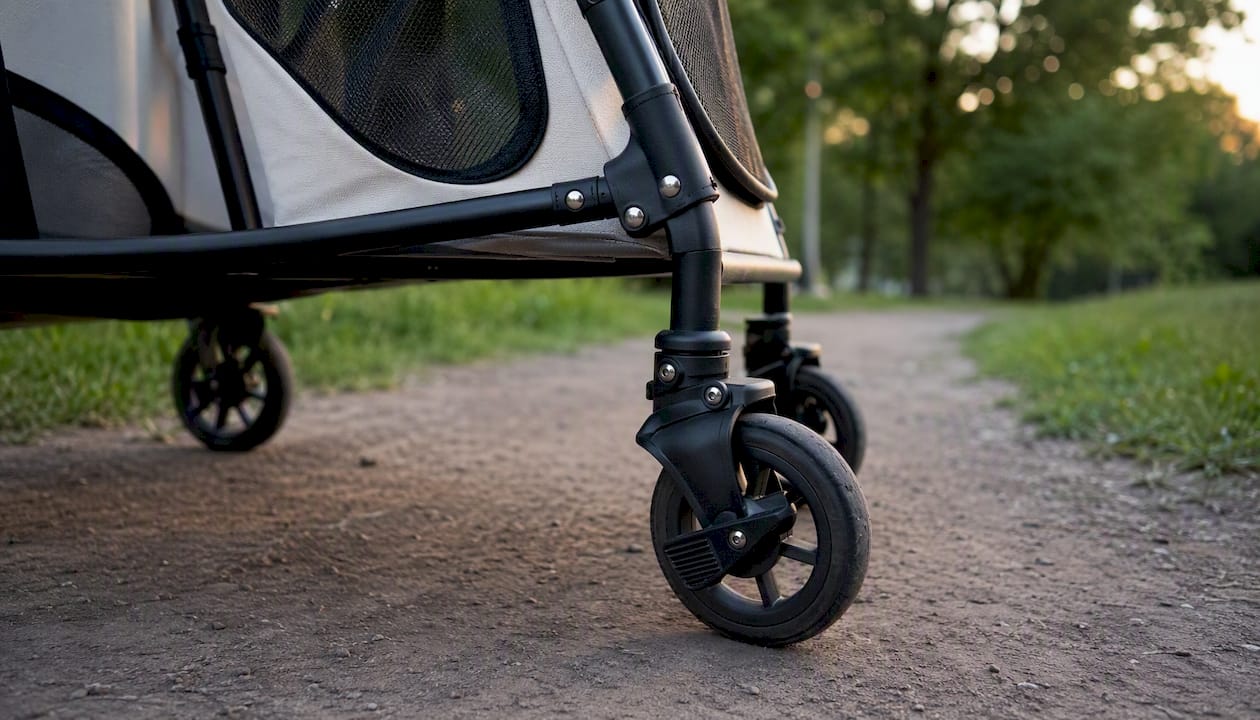
Match wheel type to your terrain:
- Smooth sidewalks and tile: four swivel solid wheels work fine
- Light gravel or packed dirt: look for larger solid rubber wheels or foam-filled tires
- Trails, grass, and uneven paths: air-inflated tires are worth the extra cost and maintenance
Lightweight strollers under roughly 12–16 lbs are easier to carry but can sacrifice stability compared to heavier models — the right trade-off depends entirely on where you walk, as The Spruce Pets’ portability testing makes clear.
Safety checklist before you buy:
- Harness tether clip inside the cabin (not just a leash hook on the exterior)
- Rear foot brake that engages firmly without wobbling
- Mesh panels on at least two sides for ventilation
- Canopy that extends fully to block sun and wind
- Zipper or buckle entry that won’t catch fur; buckle or no-zip designs tend to be smoother and safer for pets, as long-term owner testing confirms
Red flags to skip past: frame wobble when you push with one hand, single-point leash attachments with no secondary clip, no rear brake, poor mesh ventilation, and zippers that gap or snag.
For outdoor safety on stroller trips, pairing a well-fitted harness with a GPS tracker adds a meaningful safety layer if your cat is escape-prone or anxious outdoors.
Pro Tip: Before buying, load a bag of rice or a similarly weighted item into the stroller and push it over your actual walking route for five minutes. You’ll feel frame flex, wheel vibration, and handlebar wobble that no product photo reveals.
Why stability and testing methodology matter
Stability and wheel performance determine whether your cat feels secure or stressed during a ride. A stroller that tilts on turns or vibrates on rough pavement triggers a cat’s threat response, making future outings harder to manage.
Consumer Reports evaluates pet strollers using hands-on courses that include uneven surfaces, turns, and uphill and downhill portions — the same conditions your cat will actually experience. Frame rigidity and wheel maneuverability are the primary factors they measure for security. That testing approach is the benchmark The Meow Picks Team uses when evaluating picks: uneven surface passes, curb-drop simulations, and extended home use with real cats to catch issues that only show up after weeks of regular use.
Veterinarians recommend strollers specifically for senior cats, cats with mobility issues, and pets recovering from surgery. A stroller gives these cats safe outdoor time and mental stimulation without the physical strain or escape risk of free-roaming. If your cat is older or post-operative, ask your vet whether a stroller is appropriate before starting outings.
Pro Tip: Manufacturer weight limits reflect maximum structural load, not ideal comfort. Stay 15–20% under the stated limit so your cat has room to shift position without the frame straining. A stroller rated for 20 lbs is most comfortable for a cat weighing 16–17 lbs.
The Meow Picks Team also tracks long-term durability: well-made frames and higher-denier fabrics resist abrasion and clean better over time, which matters if you plan to use the stroller several times a week through all four seasons.
Which stroller should you buy?
Here’s the short answer by owner type:
- Where to check dimensions: — Always verify folded size against your car trunk and storage space before ordering — manufacturer spec pages and Beberoad’s T3 listing are good examples of how to read spec tables carefully.
For large cats specifically, cross-reference stroller weight capacity with the sizing guidance in The Meow Picks’ cat furniture for large cats guide — the same measurement logic applies.
Key Takeaways
The best cat stroller balances a rigid frame, terrain-matched wheels, and a secure harness tether — those three features matter more than price or brand name.
| Point | Details |
|---|---|
| Stability comes first | A rigid frame with a lockable swivel wheel prevents the tilts that startle cats mid-walk. |
| Match wheels to terrain | Solid wheels suit paved paths; air-inflated tires are worth the extra cost for gravel or trails. |
| Stay under the weight limit | Load your cat at 15–20% below the stated capacity for real-world comfort and frame longevity. |
| Safety features are non-negotiable | Look for an interior harness tether, a firm rear brake, and mesh ventilation on at least two sides. |
| The Meow Picks’ curated picks | The Meow Picks features stability-tested, vet-aligned stroller options alongside complementary travel gear for cats. |
A note from The Meow Picks Team
Most cat stroller guides focus on price tiers and skip the one thing that actually determines whether your cat will tolerate the stroller: how stable and quiet the ride feels. A cat’s nervous system is finely tuned to detect vibration and sudden tilts. A stroller that wobbles on a sidewalk crack or rattles on gravel is not just uncomfortable — it actively teaches your cat to associate the stroller with stress. That’s why The Meow Picks Team prioritizes frame rigidity and wheel performance above almost every other spec when curating picks.
There’s also a tendency in this category to treat “lightweight” as a universal virtue. It isn’t. A 10 lb stroller that flexes under a 12 lb cat is a worse experience than an 18 lb stroller that holds its shape through a two-mile walk. The right weight is the one that matches your terrain and your cat’s size, not the lowest number on the spec sheet.
The Meow Picks sources from independent, design-led makers worldwide, and a portion of every order supports cat rescue organizations. Every product we recommend goes through the same stability and usability lens — because a cat who enjoys their stroller is a cat who gets more outdoor time, more enrichment, and a better quality of life. Always confirm specs with the manufacturer and check with your vet if your cat has mobility or health concerns before starting stroller outings.
Complete your stroller kit with these Meow Picks favorites
A stroller outing is only as comfortable as what your cat comes home to. The three products The Meow Picks curates most often alongside travel gear are the Apawtment Cat House, the Torre Cat Tower, and the Perla Cat Cave.
The Apawtment Cat House gives your cat a familiar, enclosed resting spot to decompress after an outdoor outing — especially useful for cats who find open spaces overstimulating. The Torre Cat Tower provides post-walk climbing and scratching enrichment, which helps cats burn off the mental energy a stroller trip builds up. The Perla Cat Cave is the go-to for cats who prefer to hide and self-soothe after new experiences; its enclosed felt design muffles sound and light, making it a natural wind-down spot. You can also pair any stroller with a GPS tracker for added peace of mind on outdoor trips. Browse the full cat accessories collection to find travel-ready gear that ships with every order supporting cat rescue.
Useful sources and further reading
- Best Pet Strollers for Dogs and Cats - Consumer Reports
- Best Cat Strollers - The Spruce Pets
- Pet Gear No-Zip Special Edition 3 | Cat Stroller Review (After Years of Use) – Mary’s Test Kitchen
- Tinker Small Detachable Pet Stroller – One-Pull Fold Stroller for Cats, Rabbits & Small Pets
- Beberoad T3 3-in-1 Pet Stroller | Detachable Carrier for Dogs & Cats | Lightweight & Portable
Specs and weight limits change between production runs. Always check the current manufacturer page and consult your veterinarian for any cat with a medical condition before starting stroller use.