Cat Bed Size Guide
Cat Bed Size Guide
Measure your cat from nose to the base of the tail, then add 2 to 6 inches depending on whether she curls up or stretches out to sleep. That single measurement, plus your cat’s sleep posture, tells you almost everything about which size category to shop: small, medium, large, or jumbo. Shape and entry height matter just as much as the numbers, since a cat that curls needs different walls than one that sprawls flat.
TL;DR:
- Measure your cat’s nose-to-base-of-tail and add 2 to 6 inches, based on her sleep posture, for the most accurate bed size fit.
- Always check the interior dimensions listed on the product page, not the outer size, to ensure your cat has enough space to turn comfortably.
- Observe whether your cat curls or stretches when sleeping, then choose a round or donut-shaped bed for curlers and a flat one for stretchers.
- For kittens, seniors, or large breeds, select specialized beds: low-entry and supportive for elders, larger or rectangular for big cats, and extra room for growing kittens.
- Avoid relying solely on breed labels; prioritize your cat’s individual measurements and sleep habits for a perfect, comfortable fit.
Table of Contents
- How to Measure Your Cat for a Bed
- What Do Standard Cat Bed Sizes Actually Fit?
- Does Bed Shape Matter as Much as Size?
- Sizing for Kittens, Seniors, and Large Breeds
- How Do You Test a Bed’s Fit at Home?
- How TheMeowPicks Maps Sizes to Real Beds
- Why Measurement Beats Brand Names Every Time
- Find the Right Size in TheMeowPicks Catalog
- Sources
- FAQ
How to Measure Your Cat for a Bed
Skip the guesswork and grab a soft tape measure. Getting this right takes five minutes and saves you from a bed that ends up as floor decoration.
- Let your cat settle in a calm spot, ideally right after a nap when she’s relaxed but not yet curled tight.
- Measure nose-to-base-of-tail (not including the tail itself) while she’s standing or lying naturally.
- Measure shoulder width or hip width at the widest point, whichever is bigger.
- Watch how she actually sleeps: full curl, loose curl, or stretched flat.
- Note all three numbers before you shop.
Tail length gets left out on purpose. Cats tuck or wrap their tails when they sleep, so including it inflates the number and pushes you toward a bed that’s bigger than she needs. If your cat curls tight, measuring for the right dimensions means adding 2 to 4 inches to the nose-to-tail number. Stretchers need 4 to 6 inches of extra length so a front paw or back leg can hang off the edge of the sleep surface without hitting a wall.
Pro Tip: Lay a folded blanket on the floor and fold it to the size you’re considering, then watch your cat use it for a day. If she avoids the edges or can’t fully turn around, size up before you buy.
What Do Standard Cat Bed Sizes Actually Fit?
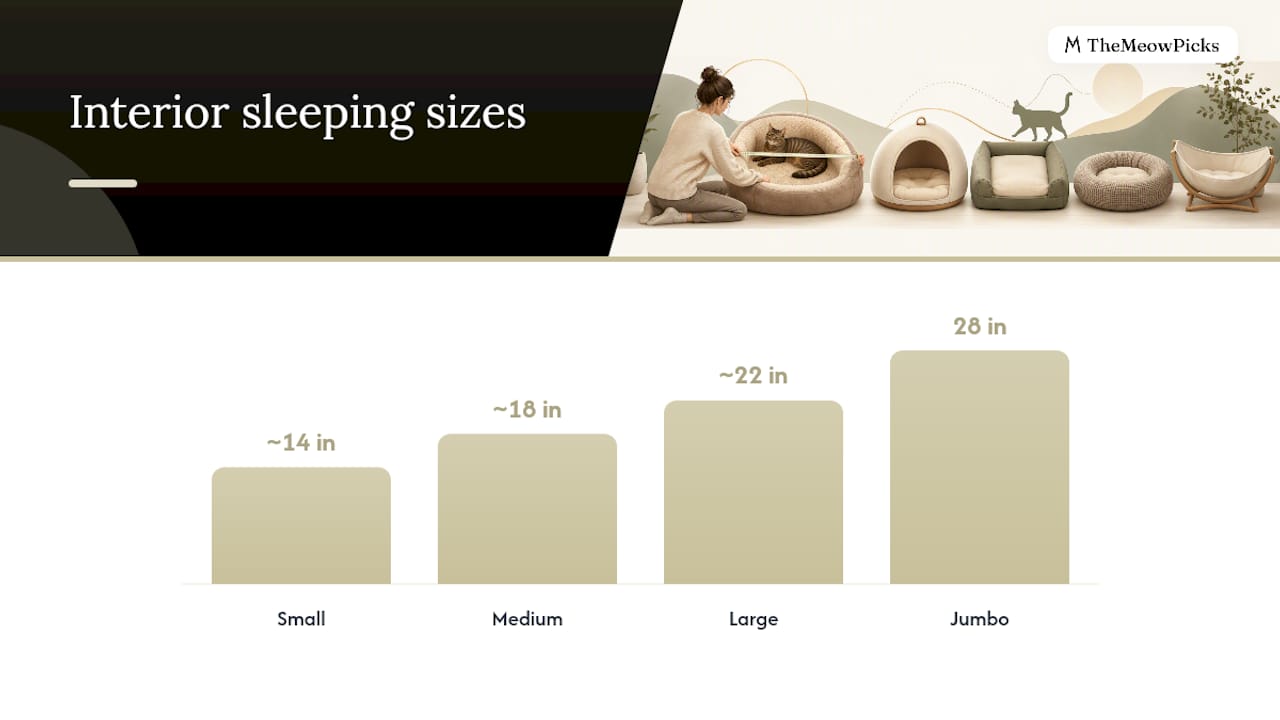
Bed sizing on most product pages is inconsistent, so treat the label as a starting point and check the interior dimensions before adding anything to your cart. A bed marked “large” from one maker might sleep smaller than a “medium” from another.
Here’s how the conventional interior dimension ranges generally break down:
| Size | Interior sleeping area | Typical fit |
|---|---|---|
| Small | ~14 in | Kittens, curled adult cats |
| Medium | ~18 in | Average adult cat, moderate curler |
| Large | ~22 in | Bigger cats, stretchers, loose curlers |
| Jumbo | 28 in | Large-breed cats, multi-cat sharing |
The trap most shoppers fall into is measuring the bed’s outer edge instead of the usable sleep surface. A thick bolster rim adds real comfort, but it also eats into the interior space your cat has to actually lie on. A bed with a 24-inch outer diameter and a 3-inch bolster all around only leaves about 18 inches of flat sleeping surface.
Size up rather than down when any of these apply:
- Your cat’s measurement lands right between two size categories.
- You’re eyeing a bed with a thick, padded bolster wall.
- More than one cat is likely to share the bed at once.
Cats can curl smaller into a bed with room to spare, but a too-small bed just gets abandoned. When measurements sit on the border, the safer call is usually the bigger size.
Does Bed Shape Matter as Much as Size?
Shape decides comfort as much as raw dimensions do, and it starts with how your cat actually sleeps. Watching your cat’s preferred sleeping posture for a few nights tells you more than any size chart.
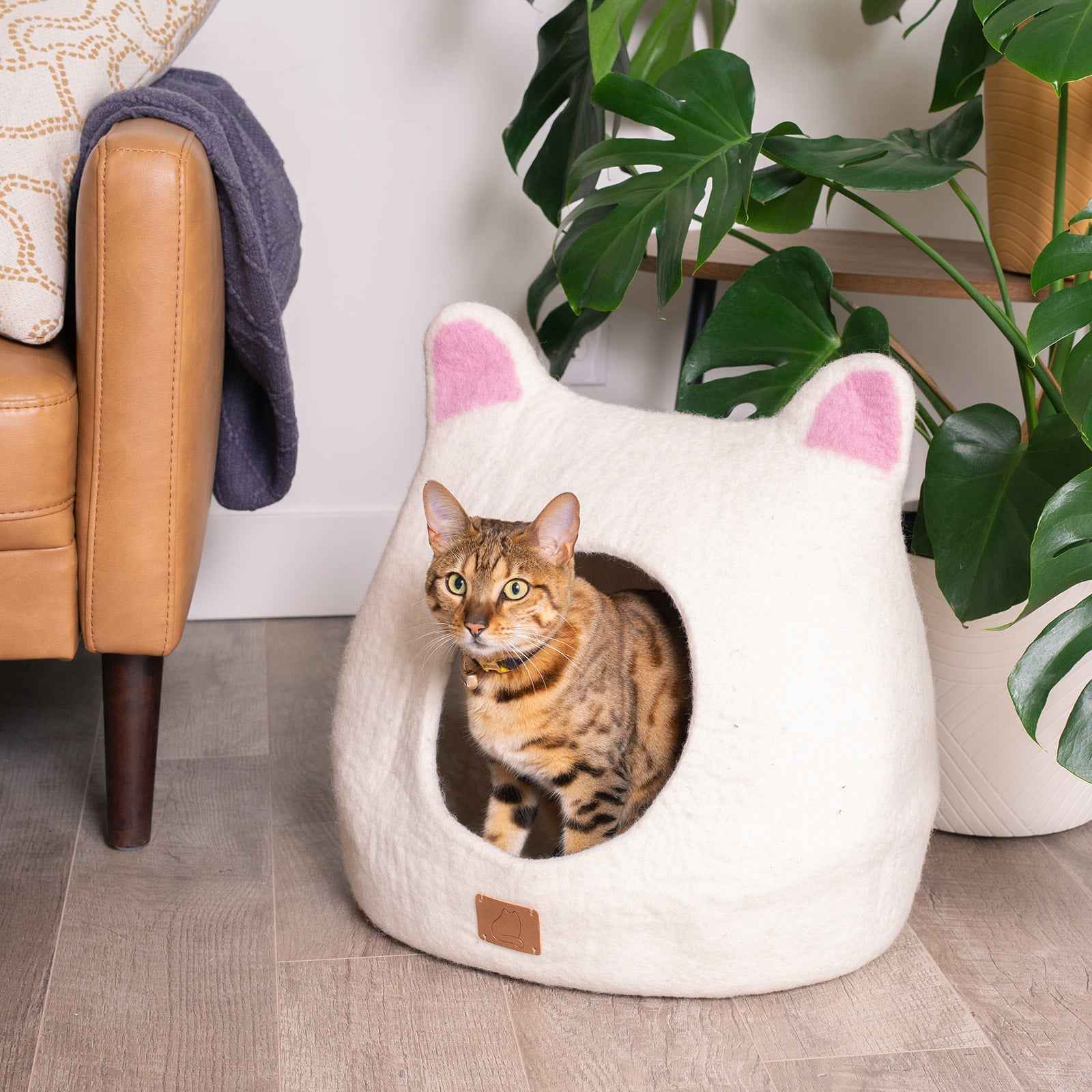
- Curlers do best in round or donut beds with raised walls that feel like a nest.
- Stretchers need a flat, rectangular surface where a leg can extend past the edge without hitting a bolster.
- Senior or arthritic cats need a low entry lip, since a high wall can turn a nap spot into an obstacle.
- Anxious or shy cats often prefer high sides or a covered cave shape that blocks sightlines from the room.
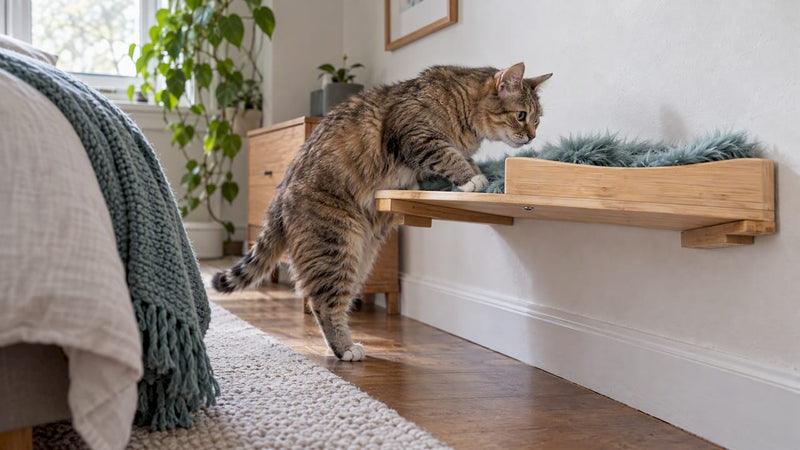
- Elevated options like window perches or wall-mounted beds change the math entirely, since the usable area is often shallower than a floor bed.
Washable covers matter more than they sound like they should, since foam padding compresses over months of daily naps and loses the loft that made the bed comfortable in the first place.
Pro Tip: If your cat sleeps in three different spots around the house, she’s probably telling you no single bed shape fits all her moods. A cave-style bed for security plus a flat mat for stretching covers both.
Sizing for Kittens, Seniors, and Large Breeds
Growth, aging, and breed size each break the standard chart in their own way, so these groups deserve their own rules instead of a generic size pick, with tools like the Dog Age Calculator: Real Dog Years, by Breed Size helping to understand size-related considerations.
- Kittens grow fast, so a medium bed with a little extra interior room is usually smarter than a snug small one you’ll replace in three months. Keep the entry low so a young cat can climb in without effort.
- Senior and arthritic cats benefit from a low-entry bed with firm support and a few extra inches of length, since a soft, sagging bed makes standing up harder on stiff joints.
- Large-breed cats like Maine Coons or Ragdolls often outgrow labeled “large” beds entirely. Measure the individual cat rather than trusting the breed name, and expect to land in large or jumbo, often in a flat rectangular shape rather than a round one. Our guide to furniture for large cats covers this in more depth.
- Multi-cat households do best with one bed per cat plus one spare, spaced in separate rooms or corners so cats aren’t competing for the same spot.
How Do You Test a Bed’s Fit at Home?
A bed can look right on a product photo and still be wrong for your cat. Watch for these signs once she’s had a few days with it.
- Watch her full stretch, not just her resting curl; if a limb consistently hangs off the edge onto the floor, the bed is too small.
- Check whether she can turn a full circle inside the walls without her paws catching the rim.
- Look for avoidance: a cat that sniffs a bed once and never returns is usually telling you something about fit, not style.
- Try the blanket test before buying anything: cut or fold fabric to the exact interior dimensions and see how she settles on it for a day.
If the bed runs slightly small, folding down thick stuffing or swapping in a firmer, flatter cushion can buy some room. Return the bed instead of forcing it to work when the interior sleeping area is clearly undersized, or when high walls block a senior cat’s entry. A ramp-equipped setup solves the entry problem for cats who need help getting up without changing the bed itself.
Pro Tip: If you’re testing fit for an older cat, watch how she gets OUT of the bed as closely as how she gets in. Exit difficulty is often the first sign a low-entry redesign is overdue, before entry ever becomes a problem.
How TheMeowPicks Maps Sizes to Real Beds
TheMeowPicks Team built this guide around the same measurement discipline we’d want any cat owner to use before buying, whether that purchase happens with us or anywhere else. As a curated marketplace, getting the size right the first time matters beyond the sale itself.
When you browse product listings, check for three things: interior dimensions, entry height, and support material. Match those against the numbers you already measured.
- Curlers who want a cozy hideaway fit well in the Apawtment Cat House or Perla Cat Cave.
- Stretchers who need a flat surface tend to do better with the Modern Cat Bed | Flip.
- Small-space households can look at The Grotto for a compact resting option.
- Cats who like height and a change of scenery fit the Torre Cat Tower or Cat Wall Maze.
Why Measurement Beats Brand Names Every Time
The biggest mistake in cat bed shopping isn’t picking the wrong size category. It’s trusting a label instead of a tape measure. “Large” means something different on every product page, and a cat labeled a “big breed” by her species doesn’t always match the size her body actually is.
Conventional advice leans hard on breed averages: buy jumbo for a Maine Coon, buy small for a kitten, buy medium for everyone else. That’s a reasonable starting point, but it skips the two things that actually predict comfort: how your specific cat sleeps and how much interior room a bed truly offers once you account for bolster thickness. A 12-pound cat that stretches flat needs a completely different bed than a 12-pound cat that curls into a tight donut, even though both would get the same size recommendation from a breed chart.
Prioritize the measurement and the posture observation first. Let those two data points, not the size label on the box, decide what you buy. Shape and entry height come second, and brand or price come last. Get the fundamentals right and almost any well-made bed in the right dimensions will work.
— TheMeowPicks Team
Find the Right Size in TheMeowPicks Catalog
Now that you know your cat’s measurements, matching them to the right product is the easy part. This curated marketplace offers designer beds from independent makers with clear interior dimensions listed on product pages, helping avoid guesswork between photos and actual fit.

Before adding anything to your cart, check the interior dimension and entry height listed on the product page against the numbers you measured earlier. If your cat is a tight curler, start with the Perla Cat Cave or Apawtment Cat House. Stretchers do better with the flat surface of the Modern Cat Bed | Flip. If space is tight, The Grotto packs a resting spot into a small footprint.
Every order supports cat rescue organizations, and our Orders & Shipping page lays out return details if a bed doesn’t end up fitting once your cat tries it at home. Browse the current bed selection and check dimensions against your measurements before you check out.
Sources
- Cat Bed Size: How to Choose the Right Dimensions for Your Cat
- Loving care for older cats (Cornell Feline Health Center)
- How to Choose the Right Cat Bed (PawPicks UK)
FAQ
What Is the Ideal Bed Size for a Cat?
The ideal size matches your cat’s nose-to-tail-base measurement plus 2 to 6 inches, depending on whether she curls or stretches to sleep. There’s no single universal size since it depends entirely on your individual cat’s body and sleep posture.
Do Cats Prefer Smaller or Bigger Beds?
Most cats prefer a bed close to their own body size that lets them curl in snugly, though a slightly larger bed is safer than one that’s too small. A bed with too much extra space can feel exposed to a cat that likes to feel enclosed.
Do Cats Prefer Round or Square Beds?
It depends on the cat’s sleep style: curlers generally favor round or donut-shaped beds, while stretchers prefer flat, rectangular surfaces. Watching how your own cat naturally sleeps is a more reliable guide than assuming one shape fits every cat.
Do Cats Prefer Soft or Firm Beds?
Older or arthritic cats do better on firmer support that makes standing up easier, while younger, more mobile cats often show no strong preference between soft and firm surfaces. Firm support with a low entry point is specifically recommended for senior cats to reduce joint strain.
How Do I Know if a Bed Is the Wrong Size for My Cat?
Watch for a cat who avoids the bed after initial sniffing, can’t fully turn around inside it, or consistently sleeps with limbs hanging off the edge. Any of those signs points to a bed that’s too small or shaped wrong for how your cat actually sleeps.