Cat Shelf Spacing
Cat Shelf Spacing
Set vertical spacing at 12 to 18 inches between shelves for healthy adult cats, and tighten that to 8 to 12 inches for kittens or seniors with less spring in their legs. Stagger each shelf horizontally rather than stacking straight up, keeping the offset under about 24 inches so your cat can see the next landing spot. The one rule that overrides every number here: anchor mounting brackets into wall studs, and always adjust spacing to match your own cat’s mobility, not a generic chart.
TL;DR:
- Shelves for adult cats should be spaced between 12 and 18 inches apart, while kittens and seniors require closer spacing of 8 to 12 inches for safety and confidence.
- Leading shelves should be positioned with at least 16 to 18 inches of headroom below the ceiling to allow cats to sit, turn, and stretch comfortably.
- Shelves should have a minimum depth of 10 to 12 inches for steps and 20 to 24 inches for top resting platforms to ensure safety and usability.
- All mounting brackets must be anchored into wall studs, with at least one secure point per bracket to withstand repeated shocks from jumping.
- Testing with a cautious approach and adjustable steps or ramps ensures the route matches the specific mobility and confidence level of each cat.
Table of Contents
- How Much Space Should Be Between Cat Shelves?
- Ladder, Staggered, or Diagonal: Which Layout Fits Your Cat?
- What Shelf Size Actually Changes Your Spacing Options
- How Do You Mount Cat Shelves Safely Into a Wall?
- How Do You Test a New Cat Shelf Route Before Trusting It?
- Which The Meow Picks Products Match These Spacing Rules?
- Balancing Style and Safety in Small Homes
- Shop Cat Shelves and Climbing Furniture Built for Safe Spacing
- Sources
- FAQ
How Much Space Should Be Between Cat Shelves?
The 12 to 18 inch range for adult cats isn’t arbitrary. A healthy cat can comfortably jump up about that distance without straining, but push much past 18 inches and every trip up the wall becomes a maximum-effort leap instead of a casual step. Do that daily and you’re asking for shoulder strain over time, especially in cats over seven or eight years old whose joints are already changing. The tighter 8 to 12 inch spacing for kittens and seniors exists for the same reason a staircase has shorter risers near a nursing home entrance: less muscle, less confidence, smaller margin for error.
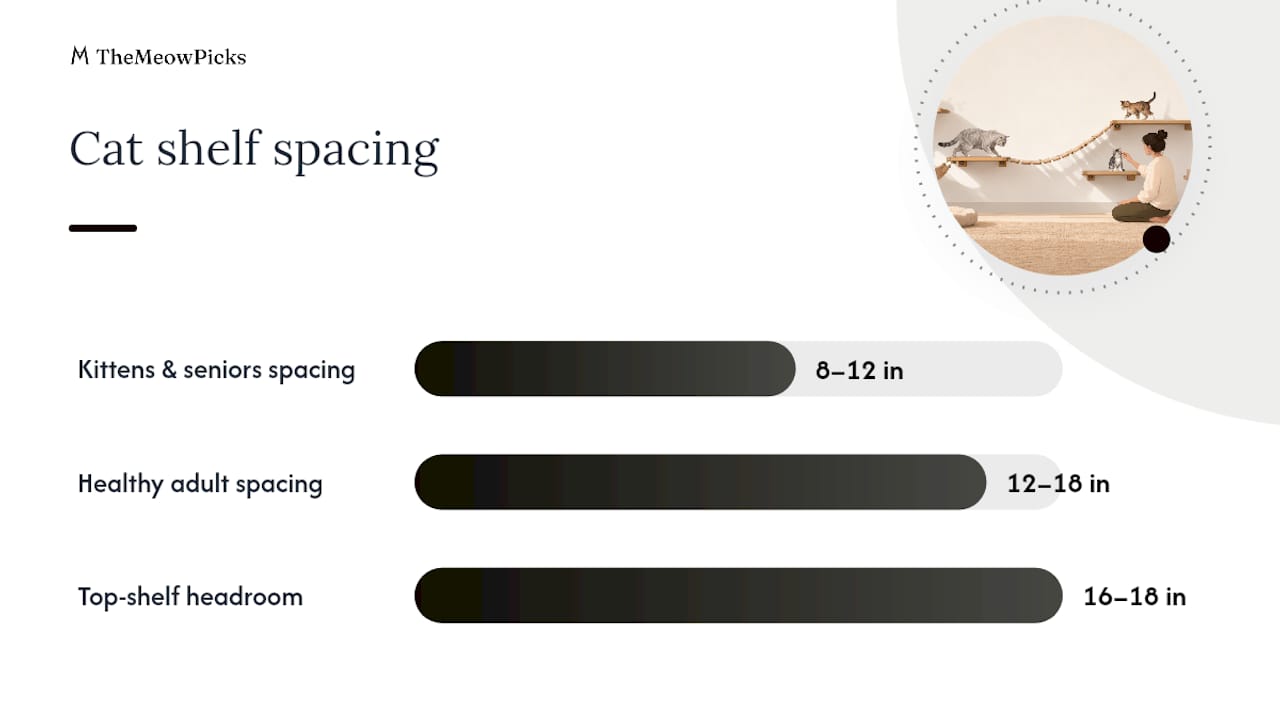
Top-shelf placement deserves its own math. Whatever height your highest shelf lands at, leave at least 16 to 18 inches of headroom to the ceiling so your cat can sit upright, turn around, and stretch without ducking. A cat wedged under a low ceiling on the top perch will usually just stop using it.
Here’s how that translates to real rooms:
- Studio apartment with 8-foot ceilings: three to four shelves total, starting low, topping out with 16 to 18 inches of headroom left over.
- Multi-cat home: more shelves at lower heights rather than one tall column, so cats aren’t forced to pass each other on a narrow step.
- High-ceiling loft or converted space: you can run a full six-shelf climb, but resist the urge to space every gap at the maximum 18 inches just because you have the wall height to spare.
Every one of these scenarios still respects the same core spacing for cat shelves. The room changes; the biomechanics of a cat’s jump don’t.
Ladder, Staggered, or Diagonal: Which Layout Fits Your Cat?
A straight vertical ladder, shelf directly above shelf, asks your cat to jump almost straight up with no forward visibility of the landing. Cats dislike that. A staggered zigzag layout lets your cat see the next shelf as it approaches, turning the climb into a series of forward hops instead of vertical launches. Most experienced installers convert ladder setups into staggered ones within the first year because cats simply use the staggered version more.
Here’s how the three common patterns break down:
- Ladder: vertical spacing of 12 to 18 inches, zero horizontal offset. Easiest to build, hardest for a hesitant cat to trust.
- Staggered zigzag: 12 to 18 inches vertical, paired with a 12 to 18 inch horizontal offset in alternating directions. This is the layout most cat behaviorists and DIY guides default to.
- Diagonal run: similar vertical gaps but a consistent horizontal offset in one direction, often used along a stairwell wall or hallway where a zigzag won’t fit the space.
If you already own a straight ladder run, you don’t need to rebuild it. Move alternating shelves 6 to 12 inches to one side and you’ve converted it into a staggered path with almost no new hardware. Keep total horizontal offset under 24 inches no matter which pattern you pick.
What Shelf Size Actually Changes Your Spacing Options
Depth and width aren’t cosmetic choices. They determine whether your spacing numbers hold up in practice. A shelf that’s too shallow forces a cat to land and immediately balance on a ledge, which makes even a well-spaced 14-inch gap feel risky.
Aim for a minimum shelf depth of 10 to 12 inches on step shelves, enough for a cat to land with all four paws and turn around without a hind leg hanging off the edge. Top platforms, where cats are meant to rest rather than just pass through, should run wider, at least 20 to 24 inches, so a cat can curl up, stretch out, or share the space with a second cat in a multi-cat home.
A few sizing details worth checking before you buy or build:
- Rounded or padded edges reduce the chance of a scraped hip on a tight turn.
- A textured or carpeted surface gives real grip on landing, especially important on any shelf angled for a diagonal layout.
- Cushioned top platforms encourage actual use. A bare wood ledge gets climbed on; a cushioned one gets slept on.
- Depth requirements go up, not down, as you increase vertical spacing. If you’re running 18-inch gaps, don’t also shrink the shelf to save wall space.
Pro Tip: If you’re mixing shelf brands or styles, measure depth at the front edge, not the back. Some designs taper, and a cat landing at full speed uses the front two inches, not the average.
How Do You Mount Cat Shelves Safely Into a Wall?
Spacing only matters if the shelf stays on the wall. At least one mounting point per bracket needs to land in a wood stud, because drywall anchors alone aren’t rated for the repeated, sudden impact of a cat landing at speed, over and over, for years. A shelf that holds a static 20-pound weight can still rip out of drywall under dynamic jumping force. That’s a structural fact, not a brand opinion, and it applies to every layout in this guide.
Before you drill anything, run through this checklist:
- Find studs with a stud finder and mark centers. Standard residential framing typically uses evenly spaced studs for mounting., though older homes sometimes use 24 inches.
- Plan shelf width and bracket placement around where the studs actually fall, not where you’d prefer the shelf to sit.
- Use toggle bolts or heavy-duty masonry anchors only as a secondary support point, never as your only anchor.
- Test each shelf by applying firm downward and outward pressure before letting your cat near it.
- If your wall is plaster, brick, or concrete, or you’re unsure about load ratings, hire a professional installer rather than guessing; for tips on neat and pest-free storage in small spaces, see Dog Food Storage for Small Spaces.
One mounting point in a stud, done correctly, holds more real-world load than four drywall anchors spread across open cavity. If you’re outfitting a wall for a larger or heavier cat, the load math matters even more; our guide to cat wall shelves for large cats covers bracket ratings in more depth.
How Do You Test a New Cat Shelf Route Before Trusting It?
Numbers on a tape measure don’t tell you whether your specific cat will actually use the route. Testing does.
- Install the first shelf low, around 12 to 14 inches off the floor, so a cautious cat can step up rather than jump.
- Do the flat-hand test: reach toward the next shelf with a flat palm. If it feels like an uncomfortable stretch for your arm, it’s likely too far for your cat’s legs.
- Lure with treats or a wand toy to the first shelf for a few days before adding the second.
- Watch how your cat lands. Hesitation, scrambling, or refusing to jump means the gap needs to shrink.
- Add a removable ramp or an intermediary step between two shelves if your cat is older, recovering from an injury, or simply new to climbing.
Observing your cat’s existing climbing habits before finalizing spacing beats any chart. Some cats will confidently clear an 18-inch gap on day one; others need weeks at 10 inches before you add height.
Pro Tip: Removable ramps aren’t just a training crutch. Keep one on hand permanently for a senior cat’s flare-up week or a kitten’s early months, then take it down once confidence builds.
Which The Meow Picks Products Match These Spacing Rules?
Every product on The Meow Picks is checked against the product safety and compliance standards our team maintains, which is where TheMeowPicks Team starts when mapping shelf types to the spacing guidance above.
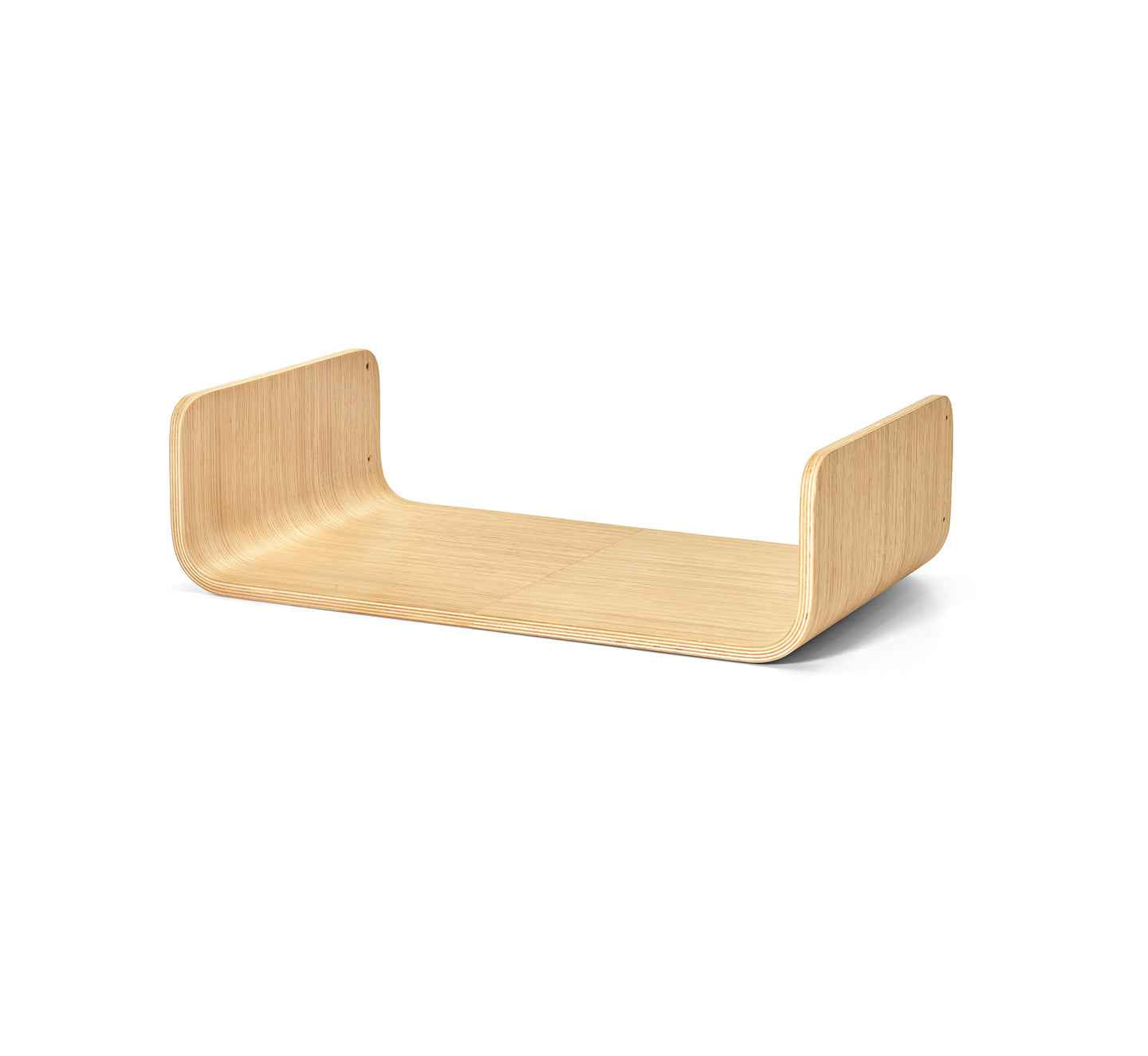
Think in terms of roles, not just products. A “low starter shelf” needs a stable, wide footprint near the floor. A “mid-step shelf” needs the 10 to 12 inch depth this guide recommends. A “wide top perch” needs the 20 to 24 inch width for resting. Our wall climbing steps are built around that mid-step role, while a modular design like the Cat Wall Maze is meant to slot into a staggered layout as a connector piece between taller furniture and wall shelves. Matching the role to the spacing plan, rather than buying shelves at random, is what keeps a climbing wall usable a year later instead of gathering dust.
Balancing Style and Safety in Small Homes
In a small apartment, the instinct is to chase height because floor space is scarce. Resist that. A cat that can’t land safely on a narrow top perch won’t use it no matter how striking it looks on your wall. We’d rather see one wide, well-anchored landing platform than three narrow shelves stacked for visual drama.
In multi-cat households, prioritize platform area over stack height too. Two cats need somewhere to pass each other without a standoff on a six-inch ledge. If you’re unsure how a layout will hold up structurally, check our product safety page or reach out to our support team before you drill.
— TheMeowPicks Team
Shop Cat Shelves and Climbing Furniture Built for Safe Spacing
Once you know your numbers, matching them to the right piece gets a lot easier than eyeballing it in a hardware store aisle.

The Meow Picks is where that translation happens: every listing here comes from independent designers who build for cats first, so you’re not stretching a generic ladder kit to fit the spacing rules in this guide. For a low starter shelf near the floor, the Apawtment Cat House gives you an enclosed resting box at a gentle first-step height. If you’d rather skip wall mounting altogether for part of the run, the Torre Cat Tower works as a floor-to-ceiling anchor point that pairs with wall shelves on either side. For mid-step connectors in a staggered layout, the Cat Wall Maze is built as a modular 3-tier unit sized for exactly that role. And if your cat needs a wide, cushioned landing zone at the top of the run, the Perla Cat Cave gives it a real resting spot instead of a bare ledge. Every purchase also puts a portion toward cat rescue organizations, so the wall you’re building for your own cat helps one still waiting for a home. Browse the current shelf and climbing collection and measure your wall before you check out.
Sources
For deeper measurement breakdowns, Indoor Living Cat’s shelf height guide and Vet Explains Pets’ spacing article both cover the jump-safety math in more detail. For design inspiration once your spacing is set, our own cat climbing wall ideas roundup shows ten layouts built around these same rules.
- How High Should Cat Wall Shelves Be? 5 Exact Measurements
- How to Build a DIY Cat Wall — The Complete Step-by-Step Guide - FunnyVia
- How to Set-Up Cat Shelves: 14 Steps (with Pictures) - wikiHow
FAQ
What is the 3-3-3 rule for cats?
The 3-3-3 rule usually refers to helping a newly adopted cat settle in over three days, three weeks, and three months, not to shelf spacing directly. It’s a helpful mindset for climbing walls too: don’t expect full confidence on a new shelf route in the first few days.
How wide should a shelf be for a cat?
Step shelves should be at least 10 to 12 inches deep for safe landing and turning, while top resting platforms should run 20 to 24 inches wide so a cat can stretch out fully.
What is a good spacing between shelves?
For healthy adult cats, 12 to 18 inches of vertical spacing works well, dropping to 8 to 12 inches for kittens or seniors, with horizontal offsets kept under 24 inches in a staggered layout.
Do cat shelves need to be in studs?
At least one mounting point per bracket should land in a wood stud, since drywall anchors alone aren’t reliable against the repeated impact of a cat jumping on and off the shelf over time.