Best Cat Nail Clippers
Best Cat Nail Clippers
For most cat owners trimming at home, scissor-style clippers are the safest and most practical choice. They give you a clear view of the quick, fit naturally in your hand, and Consumer Reports and grooming experts specifically recommend them for clean cuts with precision blades that won’t split the nail. Before your first session, gather your supplies: clippers, styptic powder, treats, and good lighting.
Here’s what to prioritize when choosing:
- Blade material: Stainless or high-carbon steel holds an edge and cuts cleanly without crushing.
- Visibility: An open cutting window lets you see exactly where the blade lands relative to the quick.
- Ergonomics: A handle that fits your grip reduces hand shake, which is the most common cause of accidental quick cuts.
- Safety stop/guard: A physical guard limits how deep the blade travels, especially helpful for beginners.
- Noise: For anxious cats, quieter tools (manual clippers over grinders) reduce stress from the start.
The Meow Picks curates grooming tools that meet these criteria, sourced from independent makers who prioritize both safety and design.
Table of Contents
- What types of cat nail trimmers should you use?
- How do you choose the right clipper for your cat?
- How to safely trim your cat’s nails at home
- Key features that matter (and the gimmicks to ignore)
- How to care for your clippers so they stay safe
- Why The Meow Picks curates the grooming tools we recommend
- Recommended brands and models worth considering
- Key Takeaways
- Home grooming is a skill, not a test
- The Meow Picks grooming collection
What types of cat nail trimmers should you use?
Not all clippers work the same way, and the right type depends on your cat’s nail thickness, your experience level, and how your cat handles handling. PetSmart’s Learning Center breaks down four main categories worth knowing.
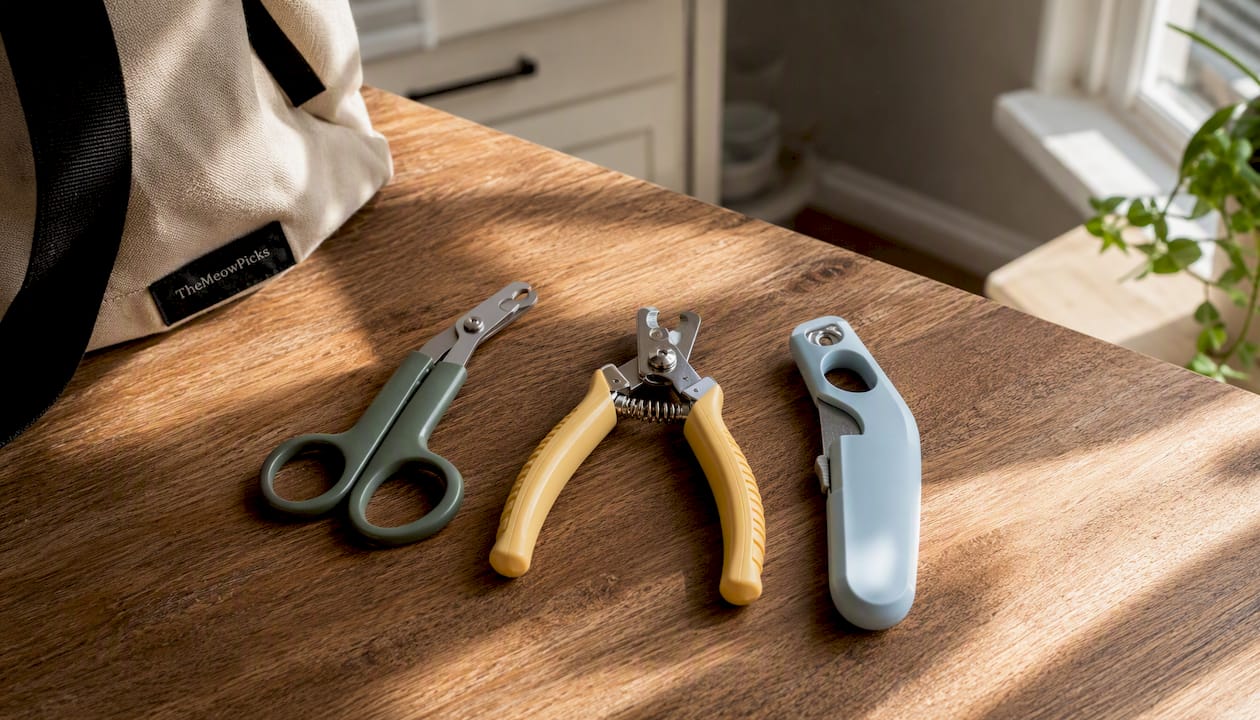
Scissor-style clippers work like small scissors with curved blades. They’re the go-to for beginners because the motion is familiar, the cutting window stays open, and you can see the quick clearly before you cut. Most cats with average nail thickness do perfectly well with these.
Plier-style clippers use a spring-loaded squeezing action and are built for thicker or more brittle nails, common in older cats or large breeds. The extra leverage means less effort per cut, though the bulkier head can reduce visibility slightly.
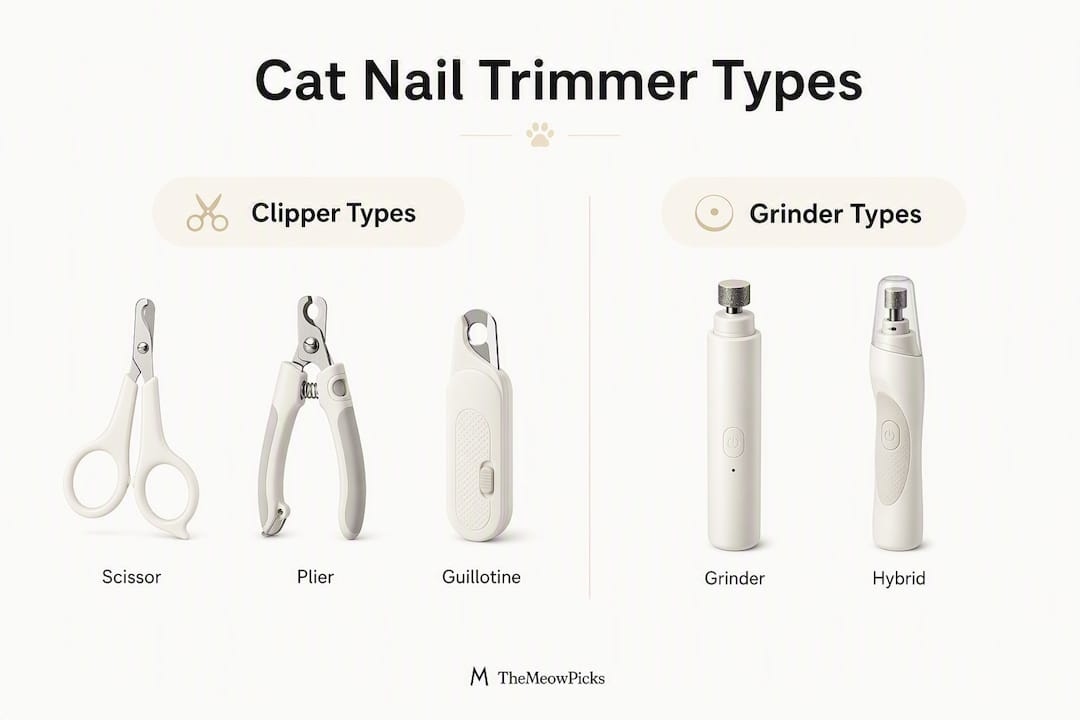
Guillotine-style clippers have a hole you insert the nail into, then squeeze to bring a blade across. They’re fast and efficient, but Business Insider’s grooming guidance notes they require more precision and can obstruct your view of the quick, making them less forgiving for beginners.
Grinders (Dremel-style) rotate a small abrasive head to file the nail down gradually. Low-vibration, quiet motor designs reduce stress for noise-sensitive cats, and grinders produce smooth edges with no sharp tips. That said, they are not a replacement for clipping overgrown nails. Use them for finishing and maintenance after a clip, not as your primary tool when nails are long.
Hybrid clipper-and-grinder tools combine both functions in one device, often adding LED lights and dust traps. They’re convenient, but FurryBasics notes that these extras shouldn’t distract you from evaluating blade quality and ergonomics first.
| Feature | Scissor | Plier | Guillotine | Grinder |
|---|---|---|---|---|
| Best for | Beginners, average nails | Thick/brittle nails | Experienced owners | Smoothing, finishing |
| Quick visibility | Excellent | Good | Limited | N/A (gradual) |
| Noise level | Silent | Silent | Silent | Low–moderate |
| Skill level | Low | Low–medium | Medium | Low–medium |
How do you choose the right clipper for your cat?
The best clipper is the one that feels secure in your hand, with blades sharp enough to cut cleanly on the first try. Grooming experts at The Kitty Inn put it plainly: prioritize ergonomics and blade quality over every other feature.
Match the tool to your cat’s profile
- Kittens or small cats: — A smaller scissor-style clipper gives you more control over tiny nails without over-cutting.
What to expect at each price point
Entry-level clippers ($5–$12) are often made with thinner steel that dulls quickly. They work for occasional use but tend to crush rather than cut cleanly after a few months. Midrange options ($13–$25) typically use higher-carbon stainless blades, better handle materials, and include a safety stop. Premium clippers and grinders ($26–$60+) add rotating heads, rechargeable motors, and ergonomic designs like the Jackson Galaxy Gentle Grooming Cat Clippers, which feature a rotating clipper head for tricky angles and a non-slip grip.
Blade quality and visibility of the quick are the two features that most directly prevent injury. Everything else is secondary. A nail catcher is convenient; a sharp blade is non-negotiable.
Pro Tip: Before buying, hold the clippers (or a similar-sized tool) in your dominant hand and simulate a squeezing motion. If your hand feels strained after five repetitions, the handle is too large or the spring tension is too stiff for a full trimming session.
How to safely trim your cat’s nails at home
Trimming is safe when you follow the steps and stay well clear of the quick. The process takes about five minutes once you and your cat are comfortable with it.
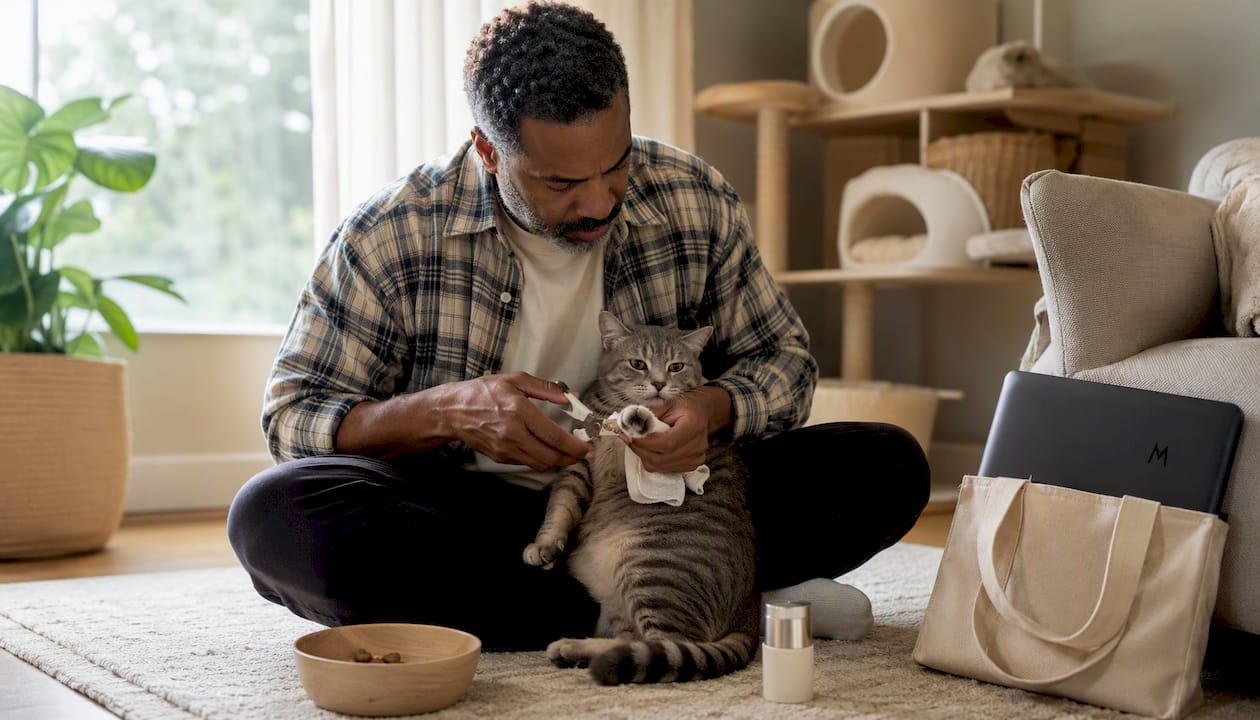
What to have ready
Gather your clippers, styptic powder or cornstarch, a small towel, treats, and a well-lit spot before you bring your cat over. VCA Hospitals recommends using positive reinforcement throughout, so having treats within reach matters as much as having the right tool.
For cats with dark nails, Hartz suggests applying a small amount of baby oil to the nail surface to help reveal the quick before you cut.
Step-by-step trimming
- Settle your cat. Place them on your lap or a stable surface. A calm environment reduces squirming. If your cat is new to handling, spend a few sessions just touching their paws before introducing clippers. A spritz of catnip spray can help ease tension.
- Extend the claw. Gently press the top of the paw and the pad simultaneously. The claw will extend naturally.
- Locate the quick. The quick is the pink vein visible in light-colored nails. For dark nails, trim very small amounts at a time and look for a small dark dot in the center of the cut surface, which signals you’re getting close.
- Position the blade. Cut from top to bottom, not side to side. VCA Hospitals confirms this orientation reduces splintering significantly.
- Trim the tip only. Take off just the sharp, hooked tip, staying at least 2mm from where the quick begins. Several small cuts beat one deep cut.
- Reward immediately. Offer a treat after each paw, or even after each nail if your cat is anxious.
- Stop when needed. If your cat becomes tense or starts pulling away, end the session. You don’t need to finish all four paws in one sitting.
If you cut the quick
Apply styptic powder or cornstarch directly to the nail tip and hold gentle pressure for 30 seconds. Minor bleeding stops quickly. If bleeding continues beyond a few minutes, contact your vet.
Trim your cat’s nails every 3–4 weeks. That’s the frequency VCA Hospitals recommends for most cats. Signs it’s time: you can hear clicking on hard floors, or the tips have curved into a hook shape.
Key features that matter (and the gimmicks to ignore)
Sharp blades are the primary safety feature in any clipper. The Kitty Inn’s grooming guidance makes this clear: dull blades crush and splinter the nail rather than cutting cleanly, which causes more pain and stress than a well-placed cut ever would.
Features worth paying for
- Stainless or high-carbon steel blades: These hold an edge through repeated use and resist corrosion from cleaning.
- Non-slip ergonomic handle: Reduces hand fatigue and keeps your grip stable, especially important for cats who fidget.
- Safety stop/guard: A physical limiter that prevents the blade from traveling too deep. Especially useful for beginners.
- Locking mechanism: Keeps the blade closed during storage so it stays sharp and safe between sessions.
- Open cutting window: Lets you see the nail and the quick before the blade closes.
Secondary features (useful, not essential)
LED lights can help with dark nails in low-light conditions. Nail catchers keep clippings contained. Warranty length signals manufacturer confidence. These are worth having if the blade quality is already there, but not worth trading for a cheaper blade.
What to skip on a budget
Hybrid clipper-grinder combos at the low end often compromise on both functions. An inexpensive grinder with a loud motor and a cheap clipper with a thin blade is worse than a single well-made scissor clipper. Spend your budget on blade quality first.
Pro Tip: Replace clipper blades, or the whole tool, when you notice the cut feels like it’s squeezing before it slices. Most quality clippers stay sharp for 6–12 months with regular use and proper cleaning.
How to care for your clippers so they stay safe
A well-maintained clipper lasts years. A neglected one becomes a safety hazard.
- After every session: Wipe the blades with a dry cloth to remove nail dust and debris. For grinders, use a small brush to clear the grinding head.
- Disinfect weekly (or between cats): Wash blades with mild soap and warm water, then dry thoroughly before storing. Moisture causes rust on lower-grade steel.
- Store locked: Always engage the locking mechanism before putting clippers away. An open blade dulls faster and poses a risk if children or other pets access the storage area.
- Know when blades are dull: If the clipper crushes or bends the nail before cutting, or if you need noticeably more force than usual, the blade needs replacing. Most quality scissor clippers can be resharpened by a professional; cheaper models are better replaced outright.
- Grinder battery care: Avoid running a grinder until the battery is completely dead. Partial charges extend battery life. If the grinding head feels warm to the touch during a session, pause for a minute or two before continuing to prevent heat buildup at the nail surface.
- Replace the grinding band regularly: The abrasive band on most grinders wears down with use. A worn band requires more pressure and generates more heat, both of which stress the nail and the cat.
Why The Meow Picks curates the grooming tools we recommend
The Meow Picks evaluates grooming tools against the same criteria a professional groomer or veterinarian would use: blade material, visibility of the quick, ergonomic control, and noise and vibration levels for grinders. A product that looks good in photos but delivers a crushing cut doesn’t make the cut, so to speak.
When assessing clippers, we focus on how they handle both thin kitten nails and thicker adult cat nails, how well the cutting window stays visible under typical home lighting, and whether a single-handed grip remains stable through a full session. Grinders are evaluated specifically for decibel levels and heat generation, since both affect how a cat tolerates the tool over time.
Product reliability and warranty terms also factor into our selections. A clipper backed by a clear return policy signals that the maker stands behind the blade quality. Our Oak Cat Scratcher with Resin Slice is a good example of the design-and-function standard we apply across every category, grooming included.
Behavior expert Jackson Galaxy reinforces what we see in practice: hand stability and gradual desensitization matter more than the tool itself. A shaky grip with a premium clipper is riskier than a calm, steady hand with a midrange one.
Recommended brands and models worth considering
These are the models and makers that consistently meet the blade quality, ergonomics, and safety criteria outlined above.
Jackson Galaxy Gentle Grooming Cat Clippers
Designed by a well-known cat behaviorist, these clippers feature a rotating head that adjusts to awkward nail angles without requiring you to reposition your cat. The non-slip grip is genuinely comfortable for extended sessions. Best suited for owners who want a premium, vet-aligned tool and are willing to invest in something built to last.
Pet Republique Professional Stainless-Steel Nail Clippers
Made with thick, durable stainless-steel blades that go through strict quality control, these are a strong midrange option for owners who want professional-grade sharpness without a premium price. They work well across cat sizes and nail types, and the blade stays sharp through consistent use. A practical choice for multi-cat households.
Zen Clipper Cat Nail Clippers
The Zen Clipper uses a conical blade opening that only allows the tip of the nail to enter, making it nearly impossible to accidentally cut the quick. This is the clipper to reach for if you’ve had a bad experience cutting too deep, or if you’re trimming a cat with very dark nails where the quick is hard to see. The tradeoff is that it works best on nails that aren’t severely overgrown.
Shiny Pet Nail Clippers
A lightweight, budget-friendly scissor-style option with sharp blades and an easy grip. These are a good starting point for first-time trimmers who want to practice technique without spending much. Blade longevity is shorter than premium options, so plan to replace them after several months of regular use.
When to consider a grinder
If your cat tolerates the sound and vibration, a low-noise grinder (look for models rated under 40 dB) is worth adding as a finishing tool after clipping. It smooths sharp edges and reduces the frequency of full clip sessions. It’s not a standalone solution for long nails, but it pairs well with any of the clippers above.
Key Takeaways
Sharp, well-fitting scissor-style clippers are the safest choice for most home cat owners, used every 3–4 weeks with styptic powder on hand and treats ready.
| Point | Details |
|---|---|
| Scissor-style is the safest start | Beginners get the best quick visibility and control with scissor-style clippers. |
| Blade quality beats extra features | Sharp stainless blades prevent crushing and splintering; LEDs and nail catchers are secondary. |
| Trim every 3–4 weeks | VCA Hospitals recommends this frequency for most cats to keep nails at a safe length. |
| Keep styptic powder nearby | Apply it immediately if you nick the quick; bleeding stops within 30 seconds in most cases. |
| The Meow Picks curates safety-first tools | Browse grooming accessories on The Meow Picks, sourced from independent makers with a portion of every sale supporting cat rescue. |
Home grooming is a skill, not a test
Here’s an honest take: most cat owners approach the first nail trim as a pass/fail event. They set up, the cat squirms, one nail gets done, and the whole thing feels like a failure. It isn’t.
What actually works is treating each session as a five-minute investment in a longer routine. The first few times, you might only trim two nails before your cat decides she’s done. That’s fine. Two nails trimmed calmly is better than ten nails trimmed under stress, for both of you. Behavior experts like Jackson Galaxy have long argued that the relationship you build around grooming matters more than finishing every nail in one go, and that tracks with what we see from the cat owners who report the most success.
The other thing people underestimate is how much the tool matters for their own confidence, not just the cat’s comfort. A clipper that feels wobbly or requires excessive force makes your hand tense, and a tense hand is exactly what causes accidental quick cuts. Spending a little more on a well-balanced, sharp clipper pays off in steadier hands and calmer sessions.
If you want to build a positive routine around handling, our guide on how to keep an indoor cat happy covers the behavioral groundwork that makes grooming easier over time.
The Meow Picks grooming collection
The Meow Picks carries a curated selection of grooming tools chosen for blade quality, ergonomic fit, and low-stress design, sourced from independent makers who care about both function and craft. Every order contributes to cat rescue organizations, so your purchase does double duty.
Pair your grooming kit with a calm, comfortable space for your cat to settle into after a trim. The Perla Cat Cave is a favorite post-grooming retreat, giving anxious cats a cozy, enclosed spot to decompress. For cats who prefer an elevated perch, the Apawtment Cat House and Torre Cat Tower offer beautifully designed spaces that fit a modern home while giving your cat the height and security they love.
Browse the full cat accessories collection to find grooming tools, comfort pieces, and lifestyle accessories that meet The Meow Picks’ safety-first standard.