Cat Room Divider
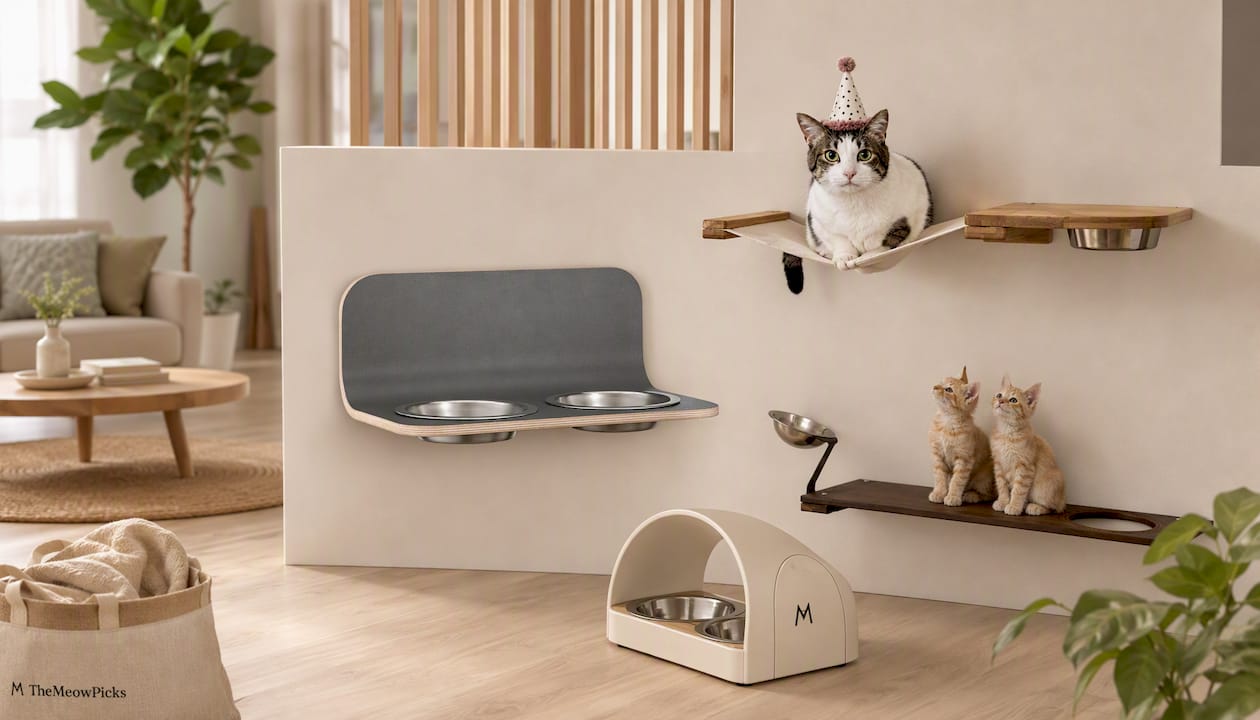
The best cat room divider is a designer piece that combines a stable base, non-toxic finishes, and real vertical territory for your cat. At The Meow Picks, the approach is simple: every piece is sourced from independent makers, built to complement modern interiors, and rated to hold your cat safely. Three pieces stand out as ready-to-buy solutions right now:
- Apawtment Cat House — a compact, architectural cubby that anchors a corner or open-plan zone without overwhelming the room.
- Torre Cat Tower — a tall, sculptural tower that reads as a statement furniture piece and creates a natural visual boundary between spaces.
- Perla Cat Cave — an enclosed designer cave that grounds a divider vignette and gives cats a cozy retreat at floor level.
All three meet the core checklist: freestanding stability, pet-safe materials, and a footprint that works in U.S. apartments and open-plan homes. Modern room dividers with cutouts, textured panels, and integrated perches create cozy cat zones that blend style and function, and that is exactly the brief these pieces answer.
Table of Contents
- Which Meow Picks products work as cat room dividers?
- What should you look for in a cat-friendly room divider?
- How to measure, place, and install a cat room divider
- How to make a cat divider look like real furniture
- Keeping the divider clean and getting your cat to use it
- Why The Meow Picks is a strong choice for designer cat room dividers
- Ready to find your cat’s new favorite piece?
- Sources
Which Meow Picks products work as cat room dividers?
Each of the three featured pieces serves a distinct use case, so the right choice depends on your room size, cat count, and aesthetic.
Apawtment Cat House suits compact apartments and studio layouts where a low-profile, architectural form works better than a tall tower. It is built from solid wood with a natural finish, freestanding, and sized to tuck against a half-wall or bookshelf without blocking light. Price range: mid-tier.
Torre Cat Tower is the statement piece. Its height and sculptural silhouette make it a genuine visual boundary in open-plan living rooms, and the vertical territory satisfies active climbers. Solid wood construction, powder-coated hardware, freestanding. Price range: mid-to-upper tier.
Perla Cat Cave anchors the floor level of a divider vignette. The enclosed form gives shy or anxious cats a retreat, and its rounded design pairs well with organic modern interiors. Freestanding, soft-lined interior, easy to wipe clean. Price range: entry-to-mid tier.
Shipping, returns, and warranty details are listed on each product page. Check those before purchasing, since lead times from independent makers can vary.
What should you look for in a cat-friendly room divider?
Stability is the first filter. A divider that tips under a jumping cat is a hazard, not a feature. Look for a wide base relative to height, and confirm the piece is either freestanding with a low center of gravity or designed for wall anchoring.
Weight rating matters more than most buyers realize. Safe wall-mounted cat furniture needs a weight capacity that exceeds dynamic forces, roughly 3× the cat’s static weight. Quality platforms typically list limits between 50 and 70 pounds per platform. For a typical house cat, platforms should be rated to safely handle dynamic loads several times the cat’s static weight.
The buying checklist:
- Stability and base footprint — wide base, low center of gravity, or wall-anchor points
- Platform weight rating — minimum 3× your cat’s body weight per perch
- Anchoring type — freestanding, semi-permanent (floor plate), or wall-mounted
- Materials and finish — solid wood or powder-coated metal preferred; avoid particleboard with chemical finishes
- Scratch surfaces — sisal wrap or solid wood edges give cats a sanctioned outlet
- Multi-cat capacity — separate perch levels so cats can share without conflict
- Footprint vs. room scale — rooms of various sizes suit cat furniture scaled appropriately from smaller to larger pieces to balance visual weight and function.
Pro Tip: Prefer solid wood or powder-coated metal over particleboard. Design-first cat furniture favors these surfaces because they balance longevity and aesthetics while sidestepping the chemical concerns tied to some composite finishes.
How to measure, place, and install a cat room divider
Good placement is half the job. A well-chosen piece in the wrong spot still disrupts the room.
- Measure the zone. Note the width of the opening or wall segment you want the divider to occupy, plus ceiling height. Cross-reference with the height guidelines above.
- Choose a location for visual balance. Position the piece so it aligns with a nearby furniture edge or architectural feature, not floating mid-room without a visual anchor.
- Confirm the anchoring method. Freestanding pieces need a level floor and enough clearance so the base does not create a trip hazard. For wall-mounted components, locate studs with a stud finder before drilling.
- Test stability before your cat uses it. Apply firm lateral pressure by hand. The piece should not rock or shift.
- Plan escape routes for multi-cat households. Include low entry points, intermediate steps, and a high lookout so paths feel continuous, and make sure no cat can be cornered by another on a single-exit perch.
For freestanding pieces, most setups take under an hour with basic tools: a level, a rubber mallet, and an Allen wrench. Wall-mounted systems add a stud finder and drill to the list, and typically run 1–2 hours. Check the product page for delivery timelines and return windows before you commit, especially for larger pieces shipped by freight.
How to make a cat divider look like real furniture
The gap between “pet gear in the corner” and “intentional design choice” is usually material and scale. Matching the material family, color, and scale to existing furniture is the single most reliable way to make a cat piece read as part of the room.
- Walnut or warm oak finishes pair naturally with warm neutrals, linen textiles, and mid-century modern furniture.
- Powder-coated black steel works in industrial-minimal rooms alongside concrete, dark grout, and matte black fixtures.
- White or light ash suits Scandinavian and coastal interiors with pale woods and soft greens.
Scale matters as much as finish. A tall tower next to a low sofa creates visual tension; a low cave next to a tall bookshelf disappears. Aim to match the visual weight of the nearest large furniture piece.
Pro Tip: Layer the divider with a trailing plant, a small framed print leaned against it, and a textured throw nearby. Neutral palettes and single considered pieces make cat furniture read as interior design rather than an afterthought, and the layering trick reinforces that intention.
For studio apartments, position the divider perpendicular to the longest wall to create a soft boundary between sleeping and living zones. In open-plan spaces, align it with the back of a sofa to reinforce an existing zone boundary.
Keeping the divider clean and getting your cat to use it
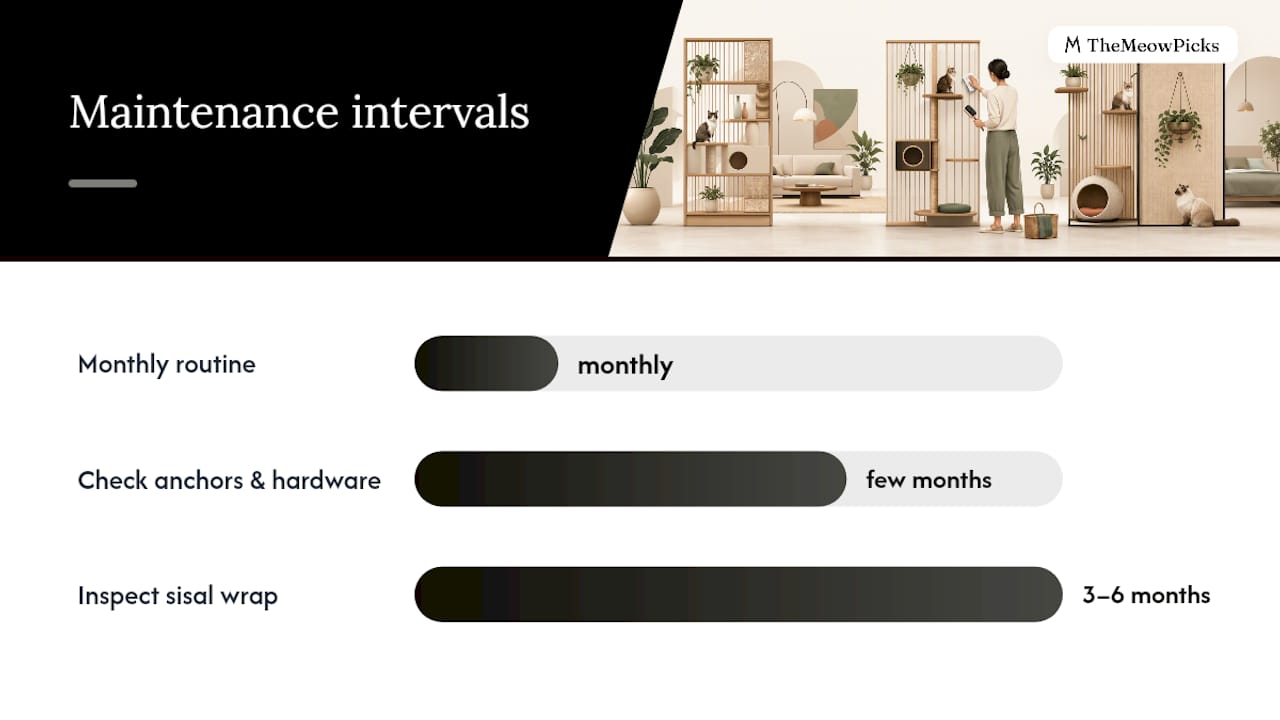
Maintenance is straightforward if you build it into a monthly routine.
- Wipe solid wood and metal surfaces with a damp cloth and mild soap. Avoid harsh solvents that can strip finishes or leave residue cats may ingest during grooming.
- Inspect sisal wrap every 3–6 months. Frayed or compressed sisal loses its appeal and can snag claws. Most makers sell replacement wrap by the yard.
- Check anchors and hardware every few months, especially after a cat has been using the piece heavily. Tighten any loose bolts before they become a wobble.
- Contact the maker for replacement parts before assuming a piece is worn out. Many independent makers stock spare platforms, cushions, and hardware.
For training, start by placing a treat or a small pinch of dried catnip on each perch level. Let your cat explore at their own pace rather than lifting them onto the structure. Cats accept new vertical territory faster when they discover it themselves. If your cat ignores the piece entirely, try rubbing a worn sock along the perch edges to transfer familiar scent.
Why The Meow Picks is a strong choice for designer cat room dividers
The Meow Picks curates every piece against a short list of non-negotiable criteria: solid or engineered materials with verified non-toxic finishes, documented weight ratings, design that integrates with modern interiors, and verified customer reviews. Pieces from mass-market retailers rarely clear all four.
- Independent makers — every product comes from a design-led brand, not a commodity supplier
- Editorial curation — the team reviews materials, load ratings, and aesthetic fit before listing
- Verified reviews and customer photos — real buyer feedback on each product page
- Mission-driven — a portion of every order supports cat rescue organizations
- Modern design focus — pieces are selected to complement contemporary U.S. interiors, not just to satisfy a cat’s functional needs
Browse the full modern cat furniture collection to see how each piece is presented with dimensions, materials, and use-case guidance. For apartment-specific sizing, the cat tree for apartment guide walks through scale decisions in detail.
Our honest take on cat room dividers
The conventional wisdom says buy the tallest tower you can fit. We disagree. Height without stability is a liability, and a piece that wobbles under a 10-pound cat is worse than no divider at all. The rule we come back to: choose a divider rated for at least 3× your cat’s weight per platform, and match its visual weight to the nearest large furniture piece in the room. Those two checks eliminate most of the poor options on the market before you even look at price. Design and safety are not competing priorities here. The best pieces get both right from the start, and that is exactly what independent makers tend to deliver when a curator is doing the filtering.
Ready to find your cat’s new favorite piece?
The three pieces featured here — the Apawtment Cat House, the Torre Cat Tower, and the Perla Cat Cave — are available now at The Meow Picks, with full dimensions, materials details, and customer photos on each product page. Shipping timelines and return policies are listed per product, so you know exactly what to expect before you check out. Every order contributes a portion to cat rescue, so your purchase does a little good beyond your own home.
Browse all three, compare footprints against your room measurements, and pick the one that fits your space and your cat’s personality. The product pages have everything you need to decide with confidence.
Key takeaways
The best cat room divider combines a stable base, a platform rated for at least 3× your cat’s weight, non-toxic finishes, and a scale matched to your room size.
Sources
Independent safety and design guidance used in this article:
Safety and load-rating data comes from independent vendor-neutral sources; editorial curation and product selection reflect The Meow Picks’s own standards.