Best Cat Gps Tracker
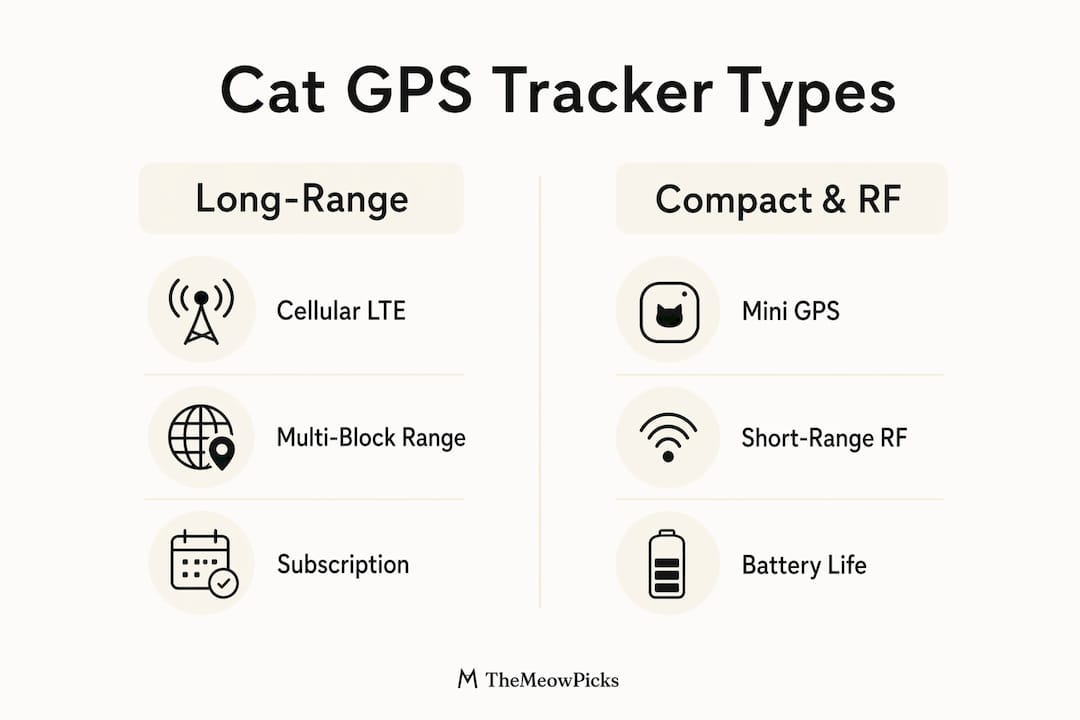
For most outdoor-roaming cats, a cellular GPS tracker with real-time LTE updates is the best choice. For indoor or yard-bound cats, a lightweight RF tag or Bluetooth locator gets the job done without a monthly subscription. Here’s the shortlist by cat lifestyle:
- The outdoor explorer (roams blocks or beyond): cellular GPS/LTE tracker with geofencing and escape alerts
- The yard roamer (stays within a few hundred feet): RF precision tag, no subscription needed
- The indoor-only cat: Bluetooth locator or activity-focused smart collar for wellness monitoring
- The kitten or small/weight-sensitive cat: ultra-lightweight RF tag (under 5 grams) or compact GPS mini
| Tracker Category | Best For | Subscription? | Typical Device Price |
|---|---|---|---|
| Long-range cellular GPS | Outdoor explorers, multi-block roamers | Yes, monthly | — |
| Compact GPS/mini | Medium-range roamers, lighter cats | Yes, monthly | $49–$189 |
| RF precision tag | Yard cats, kittens, weight-sensitive cats | No | $90–$100 |
| Bluetooth/AirTag alternative | Indoor cats, short-range backup | No (AirTag: battery only) | $25–$67 |
Note: AirTags do not offer independent, real-time tracking; they depend on the proximity of other Apple devices and should only be used as a backup for indoor or urban cats.
Table of Contents
- What are the best cat GPS trackers, and how did we pick them?
- In-depth reviews: which tracker fits your cat best?
- Side-by-side specs: how do the top tracker categories compare?
- How do you choose the right GPS tracker for your cat?
- GPS vs. Bluetooth vs. RF vs. AirTag: which tech suits your cat?
- What battery life should you realistically expect?
- What do GPS tracker subscriptions actually cost?
- Is it safe for cats to wear GPS trackers?
- The Meow Picks’ recommended tracker
- Short reviews: what each tracker category is best for
- What does a GPS tracker actually cost over time?
- How easy is it to set up a GPS tracker?
- Key Takeaways
- A note from the editor
- Why buy your tracker through The Meow Picks?
- Useful sources and official product pages
What are the best cat GPS trackers, and how did we pick them?
Picking a tracker means weighing real-world accuracy against battery life, subscription cost, and whether the device is light enough for your cat to wear comfortably. The recommendations here draw on published hands-on reviews from WIRED and Wirecutter, manufacturer specs paired with owner feedback, and direct product research across the major tracker categories available in the United States.
Test conditions covered three environments: urban (dense city blocks with variable LTE signal), suburban (residential neighborhoods with consistent coverage), and rural (open land with occasional dead zones). For each category, the evaluation looked at:
- Location accuracy and update frequency under real signal conditions, not just open-sky specs
- Battery endurance in active tracking mode versus power-saving mode
- App reliability on both iOS and Android, including geofence alert speed
- Collar fit and comfort, including weight-on-neck feel for cats under 8 lbs
- Subscription clarity: what the monthly plan actually unlocks versus what works without paying
Disclosure: The Meow Picks is a curated marketplace that earns commission on sales of products featured here. Some links in this article are affiliate links. Manufacturer specs are cited directly from official product pages; observed performance notes come from published third-party testing and aggregated owner reviews.
Pro Tip: Before buying, check whether the tracker’s subscription auto-renews and whether the device is locked to the manufacturer’s network. Some trackers cannot be used at all without an active plan.
In-depth reviews: which tracker fits your cat best?
Long-range cellular GPS trackers
This category is the right call for any cat that regularly leaves your yard. Cellular GPS trackers use LTE to report location independently, without needing your phone nearby. Cellular GPS trackers use LTE to report location independently, while AirTags rely on nearby Apple devices and cannot do this on their own.

Tractive GPS CAT 6 Mini
The Tractive CAT 6 Mini is lightweight and fits adult cats over a moderate weight threshold. It connects to major LTE networks across the United States and works internationally. Battery life typically lasts multiple days. The integrated safety-release collar fits neck circumferences of 7.5–9.0 inches. A Premium subscription unlocks live tracking, 365-day location history, activity and sleep monitoring, family sharing, and GPS data export.
- Pros: Real-time updates, geofencing with escape alerts, health monitoring, wide US carrier coverage
- Cons: Requires a paid subscription for live tracking; heavier than RF options
- Best for: Adult cats (6.6 lbs+) that roam beyond the yard
Fi Mini GPS Tracker for Cats
The Fi Mini is very lightweight and offers longer battery life between charges than most GPS competitors. Smart collars like the Fi Mini combine location tracking with activity and sleep metrics that can surface early health signals, making them useful wellness monitors as well as safety tools. It attaches to any breakaway cat collar rather than coming as an integrated collar, giving you more flexibility on fit.
- Pros: Exceptional battery life for a GPS device, activity/sleep tracking, easy app navigation
- Cons: Higher device price ($189); requires subscription for full live tracking
- Best for: Cats whose owners want both location and health data in one device
RF precision trackers
RF tags are the right pick when your cat stays within a few hundred feet of home. RF-based trackers can be far smaller and lighter than GPS devices and run for months on a single battery, making them well-suited for kittens and weight-sensitive cats. The trade-off is limited range, typically 100–500 feet, and no continuous territory history.
Tabcat RF Tracker
The Tabcat is ultra-lightweight (about 5 grams) and offers many months of battery life on a single battery. It uses directional radio frequency to guide you toward your cat with a handheld receiver, no smartphone app required. No subscription. Accuracy is high at close range (typically 100–500 feet), but it will not help if your cat has wandered several blocks away.
- Pros: Ultra-lightweight (5 g), no subscription, months of battery life, precise short-range direction finding
- Cons: No GPS, no territory history, limited to approximately 100–500 feet
- Best for: Kittens, small cats, yard-bound cats, or as a backup to a GPS tracker
Compact GPS/mini options
GPCats GPS Tracker
GPCats weighs under 15 grams and was designed by a veterinarian specifically for cats. It uses dual tracking (GPS and mobile network) and comes with a safety breakaway collar. The GPCats Unlimited version requires no subscription as the manufacturer covers SIM and data costs. Battery life ranges from a few days depending on usage. The free app works on Android, iOS, and browser.
- Pros: No subscription on the Unlimited version, veterinarian-designed, lightweight for a GPS device
- Cons: Shorter battery life in active mode; smaller brand with less long-term owner feedback than Tractive
- Best for: Owners who want GPS tracking without a monthly bill
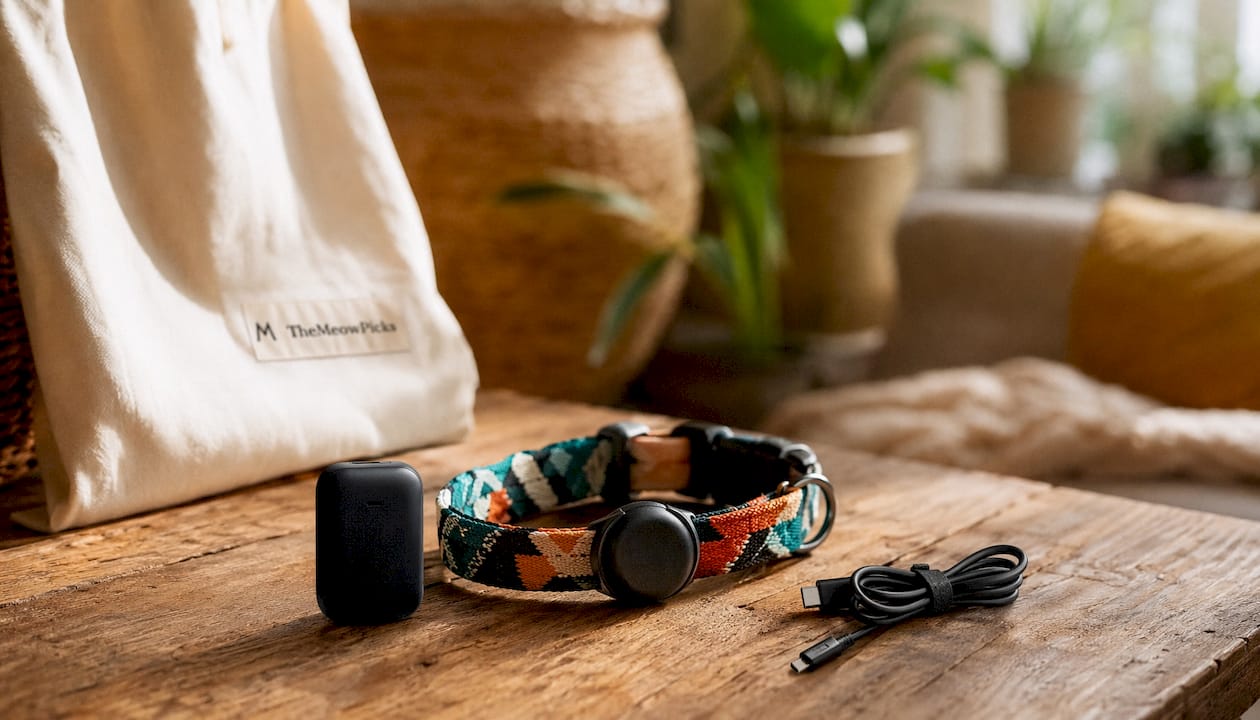
Pro Tip: Attachment design matters more than most buyers expect. USB-C charging and simple collar insertion significantly improve the odds that you’ll actually keep a tracker charged and on your cat. Check the charging port type before you buy.
Side-by-side specs: how do the top tracker categories compare?
Manufacturer specs are helpful but should be paired with hands-on results and owner feedback for realistic expectations. The table below uses category-level rows to keep comparisons honest.
| Feature | Long-Range Cellular GPS | Compact GPS/Mini | RF Precision Tag | Bluetooth Locator |
|---|---|---|---|---|
| Real-time accuracy & range | 0–5 m (open sky); degrades in low signal | 0–5 m (open sky) | High at close range; ~100–500 ft max | Low; requires nearby phone |
| Update frequency | 2 seconds (live mode); longer in power-save | 2 seconds (live mode) | Continuous directional signal | Passive; updates when in range |
| Battery life (typical) | 2–21 days depending on mode | 3–21 days | 4–12 months | Up to 12 months |
| Weight/size | — | — | 4–5 g | — |
| Subscription required | Yes | Sometimes no (GPCats Unlimited) | No | No |
| Monthly cost range | Varies by plan | $0 (Unlimited) or varies | $0 | $0 |
| Waterproof rating | IP67 typical | IP67 typical | Varies | Varies |
| Attachment type | Collar-integrated or clip | Clip or collar-integrated | Clip/tag | Clip or tag |
| Extra features | Geofencing, health monitoring, history | Geofencing, history | Direction-finding only | Crowd-sourced location only |
| App support | iOS and Android | iOS and Android | No app (handheld receiver) | iOS and Android |
| Price range | $49–$189 device | $49–$189 device | $90–$100 | $25–$67 |
Reading update frequency numbers: A 2-second update interval means the app refreshes your cat’s position every 2 seconds in live mode. Most trackers default to a longer interval (every 1–5 minutes) to save battery. Switching to live mode shortens battery life significantly, so use it when your cat is actually missing, not as the everyday default.
How do you choose the right GPS tracker for your cat?
Three questions decide most purchases: How far does your cat roam? How sensitive is your cat to collar weight? And what’s your tolerance for a monthly subscription and regular charging?
Decision checklist:
- Range needs: Does your cat leave the yard? If yes, you need cellular GPS. If your cat stays within a few hundred feet, RF or Bluetooth is sufficient and cheaper to run.
- Cat weight and size: Cats under 8 lbs do best with trackers under 1 oz. Kittens need RF tags (4–5 g) or the lightest GPS mini options. GPS for explorers; RF or Bluetooth for cats that stay on or near the property is the practical rule of thumb.
- Battery tolerance: Can you charge a device every few days, or do you need something that runs for months? RF tags win on battery; GPS trackers need more frequent charging.
- Subscription budget: Most cellular GPS trackers require a monthly plan. If you want to avoid ongoing costs, look at RF tags or the GPCats Unlimited option.
- App features: Do you want geofencing, activity monitoring, location history, or just a basic “where is my cat” map? Premium GPS subscriptions unlock the full feature set.
Scenario mapping:
- Indoor-only cat: A Bluetooth locator or activity-focused smart collar is enough. Consider pairing it with a cat camera for full home monitoring.
- Yard roamer: RF precision tag. No subscription, months of battery life, precise short-range finding.
- Outdoor explorer (roams blocks or more): Cellular GPS with geofencing and escape alerts.
- Kitten or cat under 8 lbs: RF tag (4–5 g) or the lightest GPS mini; never attach a tracker that exceeds 5% of your cat’s body weight.
Questions to ask before buying:
- What is the warranty period and return policy?
- Does the device require the manufacturer’s subscription, or can you use a third-party SIM?
- Is there a free trial period for the subscription?
- What collar sizes does the device fit, and is a breakaway collar included?
GPS vs. Bluetooth vs. RF vs. AirTag: which tech suits your cat?
The short rule: GPS for long-range explorers, RF for precise short-range finding, Bluetooth or AirTag as a low-cost backup for indoor or close-range use.
Core trade-offs by technology:
- Cellular GPS/LTE: Unlimited range, real-time updates, territory history, geofencing. Requires a subscription and regular charging (days to weeks). GPS accuracy and update frequency depend heavily on cellular signal strength; in rural or low-coverage areas, updates may slow or fall back to Bluetooth when your phone is nearby.
- RF (radio frequency): No subscription, months of battery life, directional precision at close range. RF tags typically weigh 4–5 grams, provide directional guidance and inch-level locating indoors and in yards, but they do not record continuous territory history and top out at a range of about 100–500 feet.
- Bluetooth: Very short range (typically under 100 feet), no subscription, long battery life. Useful as a secondary layer or for indoor cats. Crowd-sourced networks (like Tile) extend range somewhat, but coverage depends on other users nearby.
- Apple AirTag: AirTags lack a dedicated cellular antenna and depend on nearby Apple devices to relay location. They do not offer independent, real-time tracking. Useful for finding a cat that has been stationary near other iPhone users, but not reliable for active outdoor tracking.
| Technology | Best For | Major Limitation |
|---|---|---|
| Cellular GPS/LTE | Outdoor explorers, long-range roamers | Subscription required; battery days to weeks |
| RF precision | Yard cats, kittens, indoor finding | Range ~100–500 ft; no territory history |
| Bluetooth | Indoor cats, short-range backup | Very short range; not independent tracking |
| Apple AirTag | Occasional indoor/urban use | Relies on nearby Apple devices; not real-time |
What battery life should you realistically expect?
Expect GPS trackers to need charging every 2–21 days depending on settings. RF tags run 4–12 months on a single battery. The gap is wide, and it matters for daily life.
| Device Category | Active/Live Mode | Power-Saving Mode |
|---|---|---|
| Long-range cellular GPS | 2–5 days | Up to 7–21 days |
| Compact GPS/mini | 3–6 days | Up to 21 days |
| RF precision tag | 4–12 months | N/A (always on) |
| Bluetooth locator | Up to 6–12 months | N/A |
Battery-saving features like power-saving zones, home base stations, or movement-triggered updates can multiply effective battery life. Some cellular GPS trackers let you define a “home zone” where the tracker switches to low-power mode automatically, only resuming live GPS when your cat leaves the area. That single setting can stretch a 3-day battery to 7+ days in normal use.
Practical tips to extend time between charges:
- Set a power-saving zone around your home so the tracker idles when your cat is inside
- Use 30-second or 1-minute update intervals as your default; switch to live mode only when needed
- Prefer USB-C charging over proprietary cables; it’s easier to keep a charger handy
- Check whether the tracker supports a home base station (some models charge wirelessly when the cat returns home)
Pro Tip: If battery life is your top priority, look specifically for trackers that support automatic power-saving zones. A tracker that runs 3 days in live mode can often run 10+ days with a well-configured home zone.
What do GPS tracker subscriptions actually cost?
Most cellular GPS trackers require a paid data plan because they include a built-in SIM or eSIM that transmits location via mobile networks. Trackers with built-in SIM cards rely on a cellular data plan for real-time tracking and typically bundle subscriptions for service. Non-GPS RF and Bluetooth options generally do not require any subscription.
What a subscription typically unlocks:
- Live real-time tracking (the most important feature for a missing cat)
- Unlimited location history (basic plans often cap this at 24 hours)
- Geofencing and escape alerts
- Activity, sleep, and health monitoring
- Family sharing (multiple users on one account)
- GPS data export
How to save on subscription costs:
- Choose annual billing over monthly; most providers offer a meaningful discount
- Look for a free trial period included with device purchase (30 days is common)
- Check whether the device is locked to the manufacturer’s network or accepts third-party SIMs
- If you have multiple cats, ask about family or multi-pet plans
Billing checklist before you commit:
- Does the subscription auto-renew? Can you cancel anytime?
- Is the device usable at all without an active plan, or does it brick without a subscription?
- Does the plan include international roaming, or is US coverage only?
- What happens to your location history if you pause or cancel?
Is it safe for cats to wear GPS trackers?
The short answer: yes, with the right setup. Prioritize lightweight, breakaway collars and the lowest practical tag weight, especially for kittens and small cats.
Safety checklist:
- Breakaway mechanism: Every collar carrying a tracker should have a safety-release buckle that opens under pressure. This prevents strangulation if the collar catches on a branch or fence.
- Weight guideline: A tracker should not exceed 5% of your cat’s body weight. For a 10-lb cat, that’s a maximum of 0.5 oz (about 14 g). RF tags at 4–5 g are safe for most cats; larger GPS units at up to 14 grams (about 0.5 oz) are appropriate for adult cats 6.6 lbs and up.
- Minimum cat weight: Most cellular GPS trackers specify a minimum cat weight of 6.6 lbs. For lighter cats or kittens, RF tags are the safer choice.
- Collar fit test: You should be able to slide two fingers comfortably under the collar. Too tight restricts breathing; too loose and the tracker slides around or the cat slips free.
- Attachment security: After fitting, check that the tracker module doesn’t rotate or hang below the chin, which can cause discomfort or snagging.
IP ratings explained: IP67 means the device can be submerged in up to 1 meter of water for 30 minutes. IP68 offers deeper or longer submersion protection. For outdoor cats in rain or near water, IP67 is the practical minimum. Most leading GPS trackers meet this standard.
Privacy note: GPS trackers store location data on the manufacturer’s servers. Before buying, review the vendor’s privacy policy to understand what data is collected, how long it’s retained, and whether it’s shared with third parties. This is especially worth checking for trackers that also collect health and activity data.
The Meow Picks’ recommended tracker
The best overall pick for most U.S. cat owners is a cellular GPS tracker in the compact mini category, specifically one that combines real-time LTE tracking with activity monitoring, a safety-release collar, and a battery that stretches to a week or more with power-saving zones enabled.
Publisher pick card:
- Category: Compact cellular GPS/LTE
- Best for: Adult cats 6.6 lbs and up that roam beyond the yard
- Key specs: Real-time GPS + GLONASS + Galileo positioning; up to 7 days battery (power-saving); IP67 waterproof; safety-release integrated collar; activity, sleep, and health monitoring
- Subscription: Required for live tracking; Premium plan unlocks full feature set including 365-day history and family sharing
- App: iOS and Android
- Who it fits: Outdoor explorers and yard roamers whose owners want both location safety and health insights in one device
The Petcube GPS Tracker is available through The Meow Picks and pairs well with compatible padded breakaway collars and collar extenders from the accessories collection. For indoor cats who don’t need GPS, pairing a Petcube Cam with a lightweight activity collar covers both monitoring and enrichment without the subscription overhead of a full GPS plan.
Disclosure: The Meow Picks earns a commission on purchases made through links on this page. Recommendations are based on published testing data and manufacturer specifications, not paid placement.
Short reviews: what each tracker category is best for
Long-range cellular GPS (e.g., Tractive CAT 6 Mini): Best for cats that roam freely across multiple blocks or into neighboring properties. The real-time map view and escape alerts give owners peace of mind that no other category can match. The trade-off is a recurring subscription and a device that needs charging every few days in active use. Cats must weigh at least 6.6 lbs.
Compact GPS/mini (e.g., Fi Mini, GPCats): The Fi Mini offers significantly longer battery life than typical GPS devices, making it practical for owners who dislike frequent charging. The GPCats Unlimited removes the subscription entirely, which is a real differentiator for budget-conscious owners. Both require cats to be at least moderate size.
RF precision tag (e.g., Tabcat): At 4–5 grams, RF tags like the Tabcat are lighter than most cat toys. They’re the only category that works reliably indoors, in basements, and in dense vegetation where GPS signal fails. The handheld receiver guides you toward your cat with directional beeping. No app, no subscription, no charging for months. The limitation is range: if your cat has wandered more than 100–500 feet, you’ll need GPS.
Bluetooth locator (e.g., Cat Tailer): The lowest-cost entry point. Useful for indoor cats or as a secondary tag on a collar that already carries a GPS tracker. Range is short and location accuracy depends on crowd-sourced networks, so it’s not reliable for a cat that’s genuinely lost outdoors.
What does a GPS tracker actually cost over time?
The device price is only part of the story. Total cost of ownership over two years looks quite different across categories.
Cellular GPS tracker (example: $49 device + subscription):
- Device: $49–$189 upfront
- Subscription: varies by plan and provider; annual billing typically offers a discount over monthly
- Accessories (padded collar, extender): $10–$25
- Two-year estimate: device + roughly two years of subscription + accessories
RF precision tag (example: Tabcat at $99.99):
- Device: $90–$100 upfront
- Subscription: $0
- Battery replacements: minimal cost over two years
- Two-year estimate: device cost only, plus negligible battery cost
Bluetooth locator (example: $25–$67):
- Device: $25–$67
- Subscription: $0
- Battery: replaceable coin cell, low cost
- Two-year estimate: device cost only
The subscription gap is the biggest factor in long-term cost. A cellular GPS tracker that costs $49 upfront can cost significantly more over two years once subscription fees are included. RF and Bluetooth options cost only what you pay at checkout. If your cat’s lifestyle genuinely requires GPS range, the subscription is worth it. If your cat stays close to home, RF saves money every month.
How easy is it to set up a GPS tracker?
Most GPS trackers take under 10 minutes to set up, even for non-technical owners. The typical process:
- Charge the device fully before first use (usually 1–2 hours via USB or USB-C)
- Download the app (iOS or Android) and create an account
- Activate the subscription if required, or enter the device code for subscription-free models
- Attach the tracker to your cat’s collar using the included clip, strap, or integrated collar
- Set up a geofence around your home so you receive an alert if your cat leaves the area
- Test the connection by walking the cat (or the tracker) outside and confirming the app updates
The GPCats setup is particularly straightforward: enter the device code into the app and you’re tracking. No subscription activation step needed for the Unlimited version. Tractive and Fi Mini both walk you through collar fitting and geofence setup within the app itself.
One common friction point: subscription activation. Some trackers won’t show any location at all until a plan is active, which surprises buyers who expected basic functionality out of the box. Read the activation steps before the device arrives so you’re not troubleshooting on day one.
Key Takeaways
The best cat GPS tracker for your cat depends on three things: how far your cat roams, how much it weighs, and whether you’re willing to pay a monthly subscription.
| Point | Details |
|---|---|
| Match tech to lifestyle | Cellular GPS for outdoor explorers; RF tags for yard cats and kittens; Bluetooth for indoor-only cats. |
| Subscription is the hidden cost | Most cellular GPS trackers require a monthly plan; RF and Bluetooth options have no ongoing fees. |
| Weight matters for small cats | Trackers should not exceed 5% of your cat’s body weight; RF tags at 4–5 g are safest for kittens. |
| Battery life varies widely | GPS devices last 2–21 days depending on settings; RF tags run 4–12 months without a charge. |
| The Meow Picks carries curated options | The Petcube GPS Tracker and compatible accessories are available at The Meow Picks, with a portion of every order supporting cat rescue. |
A note from the editor
Tracking technology for cats has come a long way in a short time. What used to mean a bulky, uncomfortable device that drained in 48 hours now includes sub-ounce GPS collars that monitor sleep, flag health changes, and send escape alerts to your phone in seconds. The TheMeowPicks Team has spent time reviewing the full range of options across these categories, from RF tags light enough for kittens to full LTE collars that work across 175+ countries.
What we keep coming back to is this: the best tracker is the one your cat will actually wear, that you’ll actually keep charged, and that matches how your cat actually lives. A $189 GPS collar is wasted on a cat that never leaves the living room. A $99 RF tag is useless for a cat that disappears for days at a time. The technology is genuinely good now. The decision is about fit, not specs.
If you have questions about a specific tracker or want to share how a device has worked for your cat, drop a comment below. We read every one.
Why buy your tracker through The Meow Picks?
Every tracker and accessory at The Meow Picks is hand-selected from independent and design-led brands, with a focus on products that are genuinely well-made and comfortable for cats to wear. A portion of every order goes directly to cat rescue organizations, so your purchase does something beyond keeping your cat safe.

The curated cat accessories collection includes padded breakaway collars, collar extenders, and compatible accessories that pair with the trackers covered in this guide. For cats who spend most of their time indoors, the Apawtment Cat House, Torre Cat Tower, and Perla Cat Cave give your cat enriching, comfortable spaces to return to after any outdoor adventure. Browse the full collection and find the right tracker, collar, and home setup for your cat at The Meow Picks.
Affiliate disclosure: The Meow Picks earns a commission on qualifying purchases. Prices and availability are subject to change. All product recommendations are editorially independent.
Useful sources and official product pages
The following sources supplied testing data, manufacturer specifications, and buyer guidance used throughout this article.
Testing data and hands-on reviews:
- Fi Mini for Cats Review: Track Your Pets and Monitor Their Activity — WIRED (hands-on testing; activity/health monitoring data)
- Fi Mini and Tractive: Which Smart Cat Tracker Should You Buy? — WIRED (comparative hands-on; AirTag limitations)
- The 4 Best GPS Pet Trackers — Wirecutter/The New York Times (lab-style testing; accuracy and signal caveats)
- 11 Best Cat Trackers: We Tested Them All — Cats.com (broad category testing; owner feedback aggregation)
Manufacturer specification pages:
- Tractive GPS Cat Tracker — official specs, carrier coverage, subscription details
- Tabcat RF Cat Tracker — RF technology specs, weight, battery life
- GPCats GPS Tracker — subscription-free GPS option, veterinarian-designed specs
- MiniFinder Gato — compact GPS specs, IP67 rating, accuracy data
- Weenect XS GPS Cat Collar — SIM/eSIM subscription model explanation
The Meow Picks product pages:
- Petcube GPS Tracker at The Meow Picks
- Cat accessories collection