For most indoor cats, choose a shelf whose mounting hardware is rated for at least 50 pounds per point, with a total shelf rating that comfortably clears your cat’s body weight to absorb landing impact. That margin matters more than the published number on the box. Skip anything mounted with adhesive strips alone or labeled only as “heavy duty” with no hardware specs behind it.
TL;DR:
- Hardware rated for at least 50 pounds per point is essential, and shelves should be mounted into studs or rated toggle bolts, not just adhesive strips.
- Landing impacts can generate forces several times the cat’s body weight, so margins should be based on dynamic impact, not static capacity.
- Mounting into studs with lag screws embedded at least 1.5 inches offers the most reliable support, with toggle bolts as an alternative when studs are unavailable.
- Platform depth and proper spacing—12 to 18 inches vertically and under 24 inches horizontally—are key to safety and daily usability.
Table of Contents
- What published weight limits actually tell you
- Mounting hardware and installation: studs, lag screws, and heavy-duty toggles
- How to measure your cat and pick a safe rating
- Platform size, spacing, and route design
- Spotting deceptive specs on a product page
- Why trust this guidance: The MeowPicks Team and supporting resources
- Editorial perspective: choosing durable routes for active or large indoor cats
- Shelves from our catalog built around this guidance
- FAQ
- Sources
What published weight limits actually tell you
A shelf’s published weight limit usually describes a static load: how much the platform holds while a cat is standing still. Your cat rarely uses it that way. Cats jump up, land, pivot, and sometimes sprint across a route chasing a toy or another cat, and each of those movements adds force well beyond body weight alone.
Peer-reviewed work on jump mechanics shows that landing impacts generate peak forces well above static body weight, which is the reason conservative hardware ratings matter more than the number printed on a shelf’s listing. A 12-pound cat landing from a jump does not apply 12 pounds of force to that mounting point. It applies a brief spike that can be several times higher.
That gap between advertised and real-world capacity is why we recommend treating any published number as a floor, not a target. A few practical habits close that gap:
- Look for a per-point hardware rating, not just a total shelf rating.
- Treat any shelf without a stated capacity as a shelf you cannot verify.
- Add a safety margin rather than mounting to the exact published limit.
A landing cat can generate impact forces several times its standing weight. That single fact is the basis for the rule most mounting guides converge on: each mounting point should meet conservative hardware ratings suitable for dynamic impact forces, allowing a generous safety margin for active cats. A sedentary senior cat needs less margin than a cat who treats the living room like an obstacle course, but building in the extra capacity costs you nothing once the hardware is in the wall.
Mounting hardware and installation: studs, lag screws, and heavy-duty toggles
The shelf itself rarely fails first. The hardware holding it to the wall does. Mounting into a stud with the right screw is the most reliable option you have, and it is worth planning your shelf route around stud locations rather than forcing studs to match a layout you already picked.
Guidance on safe mounting for wall-mounted cat shelves recommends lag screws that embed at least 1.5 inches into solid wood framing, paired with mounting points rated for at least 50 pounds each. When a stud does not line up where you need it, heavy-duty toggle bolts rated for 50 or more pounds per point are the accepted fallback, though they are not quite equal to a lag screw driven into solid timber.
A short checklist before you drill:
- Locate studs with a stud finder and mark their centers, not just an edge.
- Choose lag screws long enough to embed at least 1.5 inches past the wall surface into the stud.
- If no stud is available at that point, select toggle bolts rated for 50 or more pounds each.
- Confirm the shelf’s own mounting plate or bracket lists a per-point rating, not only a total weight.
- Tighten hardware fully and recheck it after the first week of use, since wall anchors can loosen slightly as drywall compresses.
Adhesive strips and picture-frame anchors are built for static, lightweight items hung flat against a wall. They are not designed for the repeated, off-angle impact of a cat landing on a horizontal platform, and that mismatch is exactly where failures happen.
Pro Tip: Buy your lag screws or toggle bolts separately if the shelf only ships with light wall anchors, and size them to your actual wall construction rather than whatever came in the box.
How to measure your cat and pick a safe rating

Before you shop, get an honest number for your cat’s weight. A home scale works: weigh yourself, then weigh yourself holding your cat, and subtract. Vet visit records give you an even more reliable figure if your cat has been in recently.
Once you have that number, work backward into hardware and shelf requirements:
- A 12-pound cat landing on a shelf can generate a brief force well above 12 pounds, which is why per-point ratings matter more than total shelf weight alone.
- Round up, not down. If your cat weighs 14 pounds, shop as if they weigh closer to 18 to 20.
- In a multi-cat household, assume two cats could occupy the same shelf or route segment at once and size hardware for both, not one.
- Favor shelves and brackets with a stated per-point rating of 50 pounds or more, since that number gives you room for growth, guests, or an energetic newcomer.
Platform size, spacing, and route design
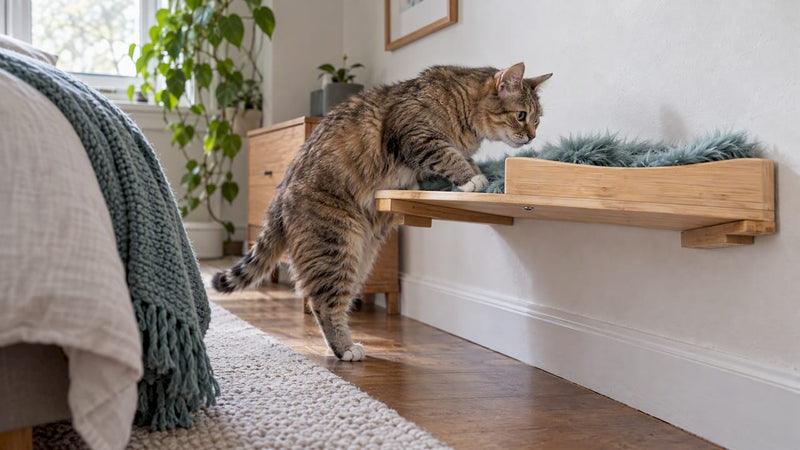
A shelf rated for plenty of weight still fails you if your cat cannot comfortably turn around, settle, or land on it without overshooting the edge. Platform depth matters as much as capacity. A narrow platform forces an awkward landing, which increases the odds of a slip or a fall rather than a clean jump.
Spacing between platforms affects both safety and whether your cat actually uses the route you built. Guidance on cat shelf spacing recommends 12 to 18 inches of vertical spacing for most cats, stretching to 24 inches for younger, more athletic climbers, with horizontal jumps kept under 24 inches so your cat is not forced into a long leap between platforms.
A few more details that affect daily use:
- Leave 12 to 18 inches of clear space around each platform so your cat has room to land, turn, and rest without bumping furniture or a wall corner.
- Avoid dead-end placements where a shelf route ends at a wall with no way down except backtracking across a narrow platform.
- Place the first shelf low enough to reach from the floor or a piece of furniture, rather than demanding a long first jump.
Pro Tip: Walk the route yourself at your cat’s eye level before you commit to final placement. It is easier to spot an awkward jump or a cramped landing from that angle than from standing height.
For more detail on building out a full route, our guide to cat shelf spacing walks through layouts for kittens, adults, and seniors.

Spotting deceptive specs on a product page
Some listings lean on vague language instead of real numbers, and that gap is where corners get cut. A few things worth checking before you add a shelf to your cart:
- Watch for adhesive-only mounting presented as a primary option rather than a backup for very light accessories.
- Treat “heavy duty” as meaningless unless it comes with an actual per-point rating and hardware type listed.
- Be wary of a listing that claims testing or lab verification without naming what was tested, how, or by whom.
- If a seller does not list embedment depth or bolt type, ask directly before buying rather than assuming the hardware will match your wall.
A seller who can answer those questions specifically is one worth buying from, as explained in How to Spot Maine Coon Kitten Scams: A Breeder’s Guide. A seller who deflects or repeats marketing language instead of specs is a signal to keep looking.
Why trust this guidance: The MeowPicks Team and supporting resources
This guidance draws on published engineering context for landing impacts and on practical mounting and spacing standards across the cat furniture industry. Posts on shelf spacing and on furniture for large cats go deeper into layout and sizing for specific households.
Editorial perspective: choosing durable routes for active or large indoor cats
Owners of big or energetic cats tend to shop for looks first and hardware second, and that order should flip. A slim, minimal shelf that cannot handle a confident 15-pound cat landing at speed is not actually the safer choice, even if it photographs better on a feature wall.
Plan for the cat you actually have and the household you actually run, including a second cat who might decide your new shelf looks like a good spot to nap. When a listing gives you a specific per-point rating and solid-wood construction, trust that over a vague promise. When it does not, that absence is the answer.
**
Shelves from our catalog built around this guidance
We carry a small, curated set of wall-mounted pieces, and three fit squarely into the safety approach above. The Double Arch Haven Cat Shelf, 100 cm gives you a wide landing platform at a generous length, suited to cats who like room to stretch out. The Cat Climbing Shelf works well as a mid-route platform in a multi-shelf layout. The Crow’s Nest pairs a scratching surface with a hammock perch, a good option for a route’s resting point rather than a jump-heavy landing spot.

Before you order, check the listing for exact weight rating, platform depth, and mounting hardware requirements. After installation, follow our checklist above: confirm stud or toggle placement, tighten fully, and recheck after the first week.
A few more places to browse:
- Our wall-mounted cat shelf product page for a straightforward single-platform option.
- Our guide to shelves for large cats if your cat runs on the bigger side.
- Our full catalog of furniture, technology, and lifestyle pieces if you are planning a whole route rather than one shelf.
FAQ
What kind of wall shelf can hold 50 lbs?
A shelf built with mounting points rated for at least 50 pounds each, installed into wall studs with lag screws embedded at least 1.5 inches, meets that standard. Heavy-duty toggle bolts rated for the same load work as a fallback where studs are not available.
What is the best cat wall shelf for large cats?
The best choice is one with a documented per-point hardware rating of 50 pounds or more, solid platform construction, and enough depth for a larger cat to land and turn comfortably. Our shelves for large cats guide walks through specific options sized for bigger breeds.
Do cat shelves need to be in studs?
Mounting into studs with lag screws is the most reliable option because it ties the shelf directly to solid wood framing. When a stud is not available at the point you need, heavy-duty toggle bolts rated for 50 or more pounds per point are an accepted substitute.
How big should a cat shelf be?
Platform depth should give your cat enough room to land, turn around, and settle without the edge of the platform forcing an awkward position. Beyond depth, space platforms 12 to 18 inches apart vertically for most cats, with horizontal jumps kept under 24 inches.
Sources
- Wall Mounted Cat Shelves for an Apartment: Safe Mounting, Smart Spacing, and a Look You Can Live With | FetchTested
- DOI reference for dynamic impact forces