Most adult cats need at least 32 inches of continuous scratchable surface to stretch fully from floor to top, and that number matters more than anything printed on the box. This baseline comes from behavior-focused cat tree buying guides that measure what cats actually use, not what looks impressive in a store display. The reason is simple: cats scratch to stretch their spine, tone their shoulder muscles, and mark territory with scent glands in their paws, and none of that happens if the post cuts off short.
Before you buy or build anything, confirm three things:
- Measured scratchable length: at least 32 inches for an average adult cat, more for larger breeds.
- Stability: the post should pass a one-hand wobble test without tipping or swaying.
- Surface material: sisal, cardboard, or carpet, wrapped continuously with no bare gaps.
If you have a Maine Coon, a savannah, a kitten, or a senior cat with joint pain, the standard 32 inch rule needs adjusting. You’ll find those exceptions covered in detail below.
Key Takeaways
The single most reliable predictor of whether a cat will use a scratching post is continuous scratchable surface length matched to that cat’s full stretch, not the tower’s advertised total height.
| Point | Details |
|---|---|
| Measure your own cat | Mark the highest paw point during a natural stretch and add 2 to 3 inches for margin. |
| Use the 32 inch baseline | Average adult cats need roughly 32 inches of continuous scratchable surface as a starting point. |
| Adjust for size and age | Kittens need 18 to 24 inches, large breeds need 36 to 40+ inches, seniors often need shorter or angled options. |
| Test stability before height | A one-hand wobble test matters more than an extra few inches of height. |
| Check listings for scratchable length | Look for product photos and specs that separate total height from actual usable sisal or cardboard. |
| Shop The Meow Picks by measurement | Catalog pieces like the Torre Cat Tower and Apawtment Cat House can be checked against your cat’s measured stretch and base stability needs. |
Table of Contents
- How to Measure Your Cat for the Right Scratching Post Height
- Recommended Scratching Post Sizes by Cat Size, Age, and Breed
- Why Continuous Scratchable Length Beats Total Tower Height
- Stability Matters More Than Height: The One-Hand Wobble Test
- Sisal, Cardboard, or Carpet: Which Material Fits Your Cat?
- Where to Place Scratchers and How Many You Need
- Why The Meow Picks Designs Meet These Height and Stability Standards
- Adjustable and Modular Scratching Posts for Growing or Aging Cats
- Tips for Introducing Your Cat to a New Scratching Post
- What Actually Matters When You’re Choosing a Post Height
- Find Scratching Posts Sized and Built to Match Your Cat
- Sources
- FAQ
How to Measure Your Cat for the Right Scratching Post Height
Skip the guesswork. Measuring your own cat takes about five minutes and gives you a number you can actually shop against.
- Get your cat to stretch naturally. Wait for a real stretch after a nap, or lure them upward with a wand toy or treat held just out of reach.
- Mark the highest point their front paws reach while their back feet stay flat on the floor. A piece of painter’s tape on the wall works well for this.
- Measure from the floor to that mark using a tape measure or yardstick.
- Add 2 to 3 inches as a safety margin so your cat never has to strain or stand on tiptoe to finish the stretch.
This method comes straight from WebVet’s cat tree buying guidance, and it works because it accounts for your actual cat rather than a breed average. A lanky 9 pound cat and a compact 14 pound cat can have wildly different stretch heights despite similar weights.
Watch your cat’s posture during the stretch. Some cats stretch with flat paws pressed against the surface; others rise onto their toes for an extra inch or two. If your cat tends to tiptoe, measure at the tiptoe point, not the flat-paw point, since that’s the height they’re actually reaching for.
Re-measure kittens every few months until they hit adult size, usually around 12 months old. A post sized for a 4 month old kitten will be too short by their first birthday.
Pro Tip: Do this measurement twice on different days. Cats stretch differently depending on mood, and averaging two readings gives you a more honest number than a single lucky (or lazy) stretch.
Recommended Scratching Post Sizes by Cat Size, Age, and Breed
Not every cat needs the same post. Height recommendations shift based on body size, age, and breed, and matching the post to the cat prevents both wasted money and frustrated scratching.
- Kittens (under 1 year): a shorter post keeps kittens confident since a too-tall column can feel unstable to a smaller, less coordinated body.
- Small adult cats: a moderate-height post suitable for most domestic shorthairs and smaller breeds comfortably.
- Average adult cats: a post tall enough to allow a full stretch, which vet-informed guides generally recommend as a practical minimum.
- Large breeds (Maine Coon, Savannah, Norwegian Forest Cat): a taller post paired with a wider, heavier base to ensure stability. These cats require more substantial support due to their size.
- Senior or arthritic cats: shorter or angled posts that allow scratching with less vertical reach to accommodate mobility issues.
These bands echo the size and age breakdown from Cat Scratching Post’s height guide, which pulls together recommendations across breed and life stage. When you’re between two bands, size up rather than down, but only if the base footprint can support the extra height. A tall, wobbly post is worse than a shorter, rock-solid one.
Why Continuous Scratchable Length Beats Total Tower Height
Product listings love to advertise “60 inch cat tower” in big letters, but that number can be misleading. What matters is the length of unbroken, scratchable material your cat can actually use in one continuous motion, and that figure is often much smaller than the total height.
Picture a 60 inch tower with only 18 inches of sisal wrapped around one middle section, the rest covered in fake fur or bare wood. Your cat gets 18 inches of usable scratching surface, not 60. Compare that to a 32 inch post wrapped in sisal from top to bottom. The shorter post actually serves your cat better because the scratchable column, not the overall structure, determines whether a stretch feels complete.
The 32 inch standard: an average adult cat needs roughly 32 inches of continuous scratchable surface to stretch fully, whether that comes from a dedicated post or a tower’s main scratching column.
Before buying, check for these details in the listing or photos:
- Does the description separate “total height” from “scratchable surface length”?
- Do product photos show sisal, cardboard, or carpet running the full column, or just a band in the middle?
- Is there a gap of bare wood or plastic at the base or top that breaks up the surface?
- Does the scratchable length come within 2 to 3 inches of the floor and within 2 to 3 inches of the top?
A tower marketed as tall but wrapped in short, isolated bands is behaviorally inferior to a shorter post with a full sisal wrap, because your cat needs one uninterrupted surface to press into and climb, not a series of disconnected patches.
Stability Matters More Than Height: The One-Hand Wobble Test
A cat will reject a tall, wobbly post faster than almost anything else in your house. Stability isn’t a nice extra, it’s the difference between a post that gets used daily and one that becomes an expensive coat rack.
- Place one hand flat against the top of the post.
- Push gently sideways, the way a cat’s full body weight would when scratching at full extension.
- Watch the base. If the post rocks, tips, or lifts even slightly on one side, it fails the test.
- Repeat from a second angle since some posts wobble front-to-back but not side-to-side.
Wobble is one of the leading reasons cats abandon a scratching post entirely, even when the height and material are otherwise ideal. A shelter-tested DIY build, for comparison, typically pairs a 30 inch post with a 16 by 16 inch plywood base, following the rule that the post should stand as tall as the cat’s full stretch plus a few inches, with a base wide enough to prevent tipping.
As a rule, the taller the post, the wider and heavier the base needs to be. A 40 inch post on a base smaller than 16 inches square is a tipping hazard, full stop. If you’re building or modifying a post yourself, a plywood base, added sandbags, or a wall bracket anchoring the top can all improve stability without changing the height.
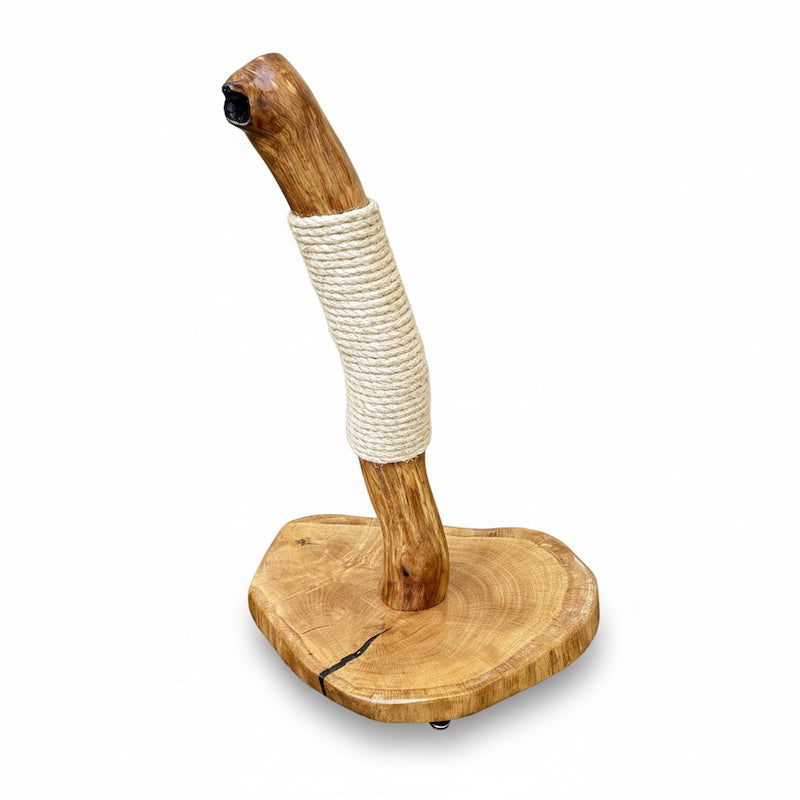
Pro Tip: If a post passes the wobble test empty but fails once your cat is actually leaning into it, the base is too light for the height. Add weight at the bottom rather than shortening the post.
Never place a tall post on a small, narrow, or lightweight base just to save space. It’s one of the fastest ways to end up with an unused (or worse, tipped-over) scratcher.
Sisal, Cardboard, or Carpet: Which Material Fits Your Cat?
Height only solves half the equation. The surface material determines whether your cat actually wants to use the post you’ve measured so carefully for.
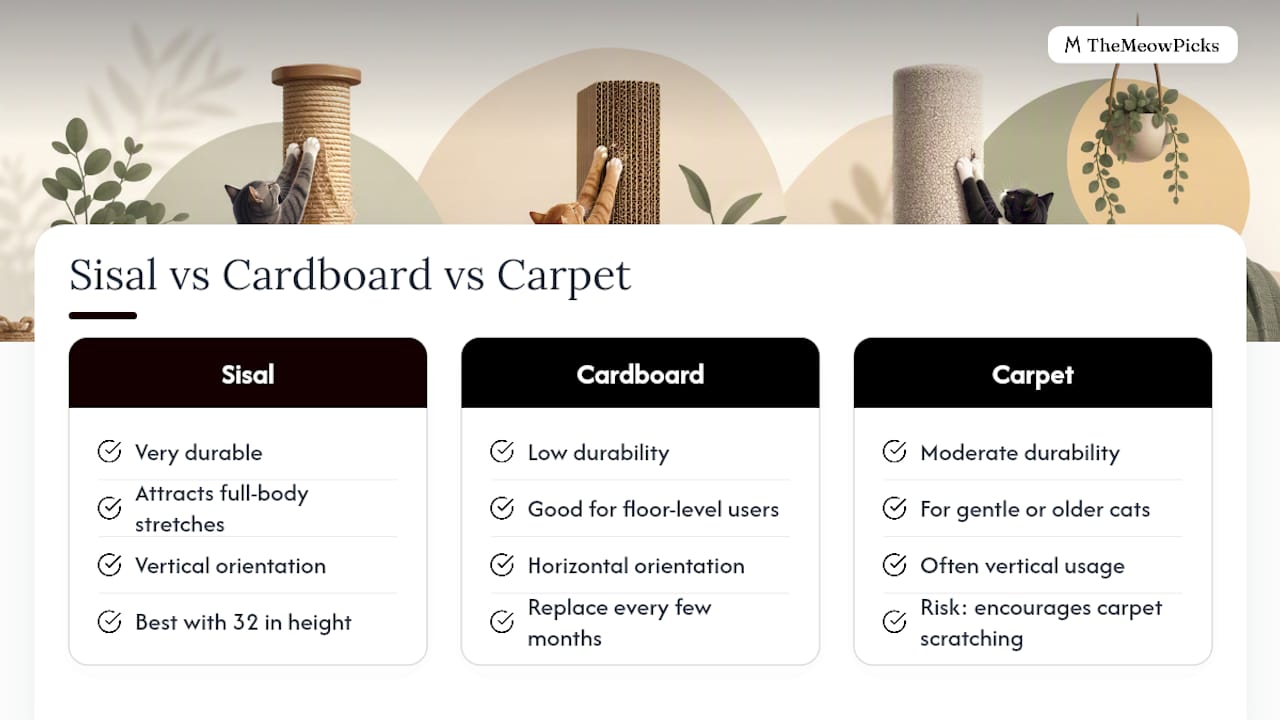
Sisal rope or sisal fabric is the most durable option for vertical posts and the material most cats gravitate toward for full-body stretches. The rough texture holds up to repeated clawing far longer than fabric alternatives, which is why most tall, vertical posts use it.
Corrugated cardboard works well as an affordable horizontal option, especially for cats who prefer floor-level scratching. It wears out faster than sisal, often needing replacement every few months depending on use, but the low cost makes that trade-off easy to accept.
Carpet can work for gentle scratchers and older cats who scratch less aggressively, but it carries a real risk: carpet-covered posts can teach a cat that carpet in general is fair game, which gets complicated fast if you have carpeted floors or stairs.
Since individual cats show strong, sometimes surprising preferences for one orientation over another, offering both a vertical sisal post and a horizontal cardboard scratcher covers more bases than committing to just one. Vertical posts benefit most from hitting that 32 inch minimum; horizontal scratchers don’t need height at all, but they do need enough length (usually 15 to 20 inches) for a full front-to-back stretch. If your cat splits time between a tall post and a flat cardboard scratcher, a horizontal scratching post rounds out the setup nicely.
Where to Place Scratchers and How Many You Need
The right height won’t matter if the post sits in a corner your cat never visits. Placement drives usage as much as the measurements do.
- Start near the furniture your cat already scratches. If the couch arm is the current target, place the new post right beside it rather than across the room.
- Shift the post gradually, a few inches per day, toward your preferred long-term spot once your cat is using it consistently. Sudden relocation often resets the training.
- Follow the one-per-cat-plus-one rule. In a two-cat home, that means at least three scratchers spread across different rooms and heights.
- Mix orientations and heights across your scratchers rather than buying three identical posts. One tall vertical post, one horizontal pad, and maybe one angled option covers most preferences.
- In small apartments, prioritize wall-mounted or corner options that don’t eat floor space, and place at least one scratcher near sleeping areas since cats often stretch and scratch right after waking.
For a deeper look at redirecting a cat away from furniture entirely, this guide to stopping couch scratching walks through the same gradual relocation tactic in more detail. And because placement near sleeping and high-traffic areas measurably increases how often a scratcher gets used, it’s worth treating location with the same seriousness as height and material.
Why The Meow Picks Designs Meet These Height and Stability Standards
The TheMeowPicks Team curates every piece in the catalog with exactly this measurement-first approach in mind: full scratchable length, a base that passes a real wobble test, and materials built to last. We don’t sell furniture that looks tall in a photo but leaves your cat’s stretch cut short.
A few catalog pieces worth checking against your own measurements:
- Apawtment Cat House: a multi-level structure worth reviewing for scratchable column length and base footprint.
- Torre Cat Tower: check the listed height and scratching material against your cat’s measured stretch.
- Perla Cat Cave: pairs well as a resting spot placed near your chosen scratching post.
- The Grotto: a shorter cat tree suited to smaller spaces or senior cats needing a lower profile.
- The Gardens: a designer tree with integrated scratcher elements for owners who want style and function together.
- Cat Wall Maze: a wall-mounted option for apartments where floor space is tight.
When you’re browsing any product page, look for the same details covered above: stated scratchable surface length (not just overall height), base dimensions, and material description. If a listing only gives “overall height” with no mention of scratchable coverage, that’s worth a direct question to the seller before you buy.
Adjustable and Modular Scratching Posts for Growing or Aging Cats
A kitten’s ideal post height changes fast, and so does a senior cat’s, just in the opposite direction. Rather than buying a new post every year, modular and adjustable designs solve both problems with one purchase.
Some scratching posts come in stackable segments, letting you add height as a kitten grows from an 18 inch starter post toward the 32 inch adult standard over their first year. Others use a base unit that accepts interchangeable post attachments, so you can swap a tall sisal column for a shorter, angled one as your cat ages or develops joint stiffness.
Wall-mounted scratcher systems offer a different kind of flexibility. Because the panels mount independently, you can reposition them lower on the wall for a senior cat who no longer jumps as high, without needing to buy a separate product. This also solves a common problem in multi-cat households where cats of different ages and sizes share the same general space.
If you’re outfitting a home with both a kitten and an older cat, modular pieces are worth prioritizing over a single fixed-height tower. You get more use out of one purchase, and you avoid the awkward middle ground where a post is technically usable by both cats but comfortable for neither. Look for product listings that specifically mention adjustable segments, add-on kits, or repositionable wall panels rather than assuming a tall tower will “grow with” your cat automatically. It won’t; only modular hardware does that.
Tips for Introducing Your Cat to a New Scratching Post
Buying the right height solves half the problem. Getting your cat to actually use it solves the rest, and that takes a little patience.
Place the new post somewhere your cat already spends time, ideally near a window, a sleeping spot, or the furniture they currently scratch. Cats are far more likely to try a new object in a familiar space than one dropped into a random corner of the house.
Rub a small amount of catnip into the base or scratching surface, or use a wand toy to draw your cat’s paws toward the post during play. The goal is to get their claws making contact with the material, even briefly. Once they scratch it once, muscle memory and scent marking usually take over from there.
Avoid physically forcing your cat’s paws onto the post. It rarely works and can make cats wary of the object entirely. Instead, reward any voluntary scratching with a treat or verbal praise given immediately, within a second or two, so the connection is clear.
Keep the post in its introductory spot for at least a week or two before relocating it, and only move it gradually as covered in the placement section above. If your cat ignores it entirely after two to three weeks, reconsider the material or orientation before assuming the height is wrong. Sometimes it’s not the number on the tape measure that’s the problem, it’s whether the surface feels right under their claws.
What Actually Matters When You’re Choosing a Post Height
Most advice on scratching posts fixates on a single number, and that number gets treated like gospel. The research doesn’t support that kind of rigidity. A 32 inch baseline is a genuinely useful starting point, but it’s a floor, not a ceiling, and it means nothing if the post wobbles or the sisal wrap stops eight inches short of the top.
Here’s where we think conventional advice falls short: it treats height as the whole conversation. In practice, a shorter, dead-stable post with a full continuous wrap will outperform a taller, shaky one every time, because cats scratch for confidence and release, not to hit an arbitrary inch mark. If your cat abandons a tall post after a week, the height probably isn’t the issue. The wobble test or the material usually is.
Our advice: measure your own cat first, treat the wobble test as non-negotiable, and read past the “total height” number on any listing to find the actual scratchable length. That’s the order of priorities that holds up, not just the tallest box on the shelf.
— TheMeowPicks Team
Find Scratching Posts Sized and Built to Match Your Cat
Once you’ve got your cat’s measurement in hand, shopping gets a lot simpler. The Meow Picks curates furniture from independent designers who build for exactly the criteria covered in this guide: full continuous scratchable length, wide stable bases, and materials that hold up to real daily use, not showroom photos.

A few places to start based on what you measured. If your cat’s stretch comes in around 32 inches, the Torre Cat Tower and pieces like the Apawtment Cat House are worth checking against your number. If you’re outfitting a smaller space or a senior cat, The Grotto offers a lower profile option, while the Cat Wall Maze solves the vertical-scratching problem without eating floor space. Pair any of these with the Perla Cat Cave for a resting spot right beside the scratcher, since cats often stretch immediately after waking.
When you land on a product page, check the listed dimensions against your own measurement plus the 2 to 3 inch margin, and look for any mention of base footprint before adding to cart. Every purchase also puts a portion toward cat rescue organizations, so outfitting your home well does a little good beyond your own living room. Browse the Torre Cat Tower to compare its listed height and base dimensions against your cat’s measurement today.
Sources
- Cat Tree Buying Guide: What Your Cat Actually Needs | WebVet
- How to Choose a Scratching Post Your Cat Will Use | CommuniKitty
- Cat-scratching-post
FAQ
Is 20 inches tall enough for a cat scratching post?
For most kittens, yes, since the recommended kitten range is 18 to 24 inches. For an average adult cat, 20 inches usually falls short of the roughly 32 inch baseline needed for a full stretch.
What is the tallest cat scratching post you’d recommend?
Large breeds like Maine Coons or Savannahs typically do best with posts in the 36 to 40+ inch range, paired with a wide, heavy base to prevent tipping at that height.
Do cats prefer vertical or horizontal scratchers?
It varies by cat. Many prefer vertical sisal posts for a full-body stretch, while others favor horizontal cardboard pads for floor-level scratching, which is why offering both orientations covers more preferences than committing to just one.
What is the best tall scratching post for cats?
The best tall post is one with continuous sisal coverage from near the floor to near the top and a base wide enough to pass a one-hand wobble test without tipping. Catalog options like the Torre Cat Tower are worth checking against these two criteria before buying.