Modern Cat Feeding Station
The best modern cat feeding station uses wide, shallow bowls set on a raised platform about 2 to 4 inches high, sometimes with a gentle 15° tilt built into the stand. This setup keeps whiskers off the bowl walls, eases neck strain, and looks like it belongs in your kitchen instead of a plastic afterthought in the corner.
Three things to check before you buy anything:
- Bowl shape: wide and shallow, never a deep well that traps whiskers against the sides.
- Placement: a quiet spot, away from the litter box, where your cat can see the room.
- Cleanup: removable bowls and a washable mat underneath to catch spills.
The Meow Picks stocks several designer feeding stations built around these exact specs, which makes the shopping part easier once you know what you’re looking for.
Key Takeaways
A modern cat feeding station works when wide, shallow bowls sit on a modest 2 to 4 inch platform with easy-to-clean, non-slip surfaces underneath.
| Point | Details |
|---|---|
| Bowl shape first | Wide and shallow prevents whisker fatigue regardless of the material you choose. |
| Modest height only | 2 to 4 inches with an optional 15° tilt covers most cats’ needs; skip dramatic elevation. |
| Placement protects comfort | Quiet corners with a protected back reduce stress more than any product feature. |
| Multi-cat spacing | Separate stations well apart, oriented away from face-to-face feeding. |
| The Meow Picks matches the checklist | Products like the Desco Cat Feeder and the Dog Proof Cat Feeder cover porcelain bowl and multi-pet needs directly. |
Table of Contents
- Why a Modern Cat Feeding Station Needs Modest Elevation and Tilt
- Which Bowl Materials Work Best for a Contemporary Setup
- Where Should You Put a Cat Feeding Station?
- How to Choose a Modern Cat Feeding Station
- Try Before You Buy: Simple DIY Feeding Setups
- The Meow Picks Feeding Stations That Match This Checklist
- Where to Store Food and Feeding Accessories Nearby
- Safety Features That Stop Tipping and Spills
- Eco-Friendly Materials Worth Looking For
- What the Research Actually Tells Us About Feeding Setups
- Shop Modern Feeding Stations at The Meow Picks
- Sources
- FAQ
Why a Modern Cat Feeding Station Needs Modest Elevation and Tilt
Whisker fatigue is a real sensory issue, not a myth pet blogs invented. A cat’s whiskers are packed with nerve endings, and when they repeatedly brush against the curved walls of a deep, narrow bowl, that constant contact becomes an irritant. Oklahoma State University’s veterinary research explains that wide, shallow bowls with sloped sides reduce this contact significantly because the whiskers never touch the sides at all.
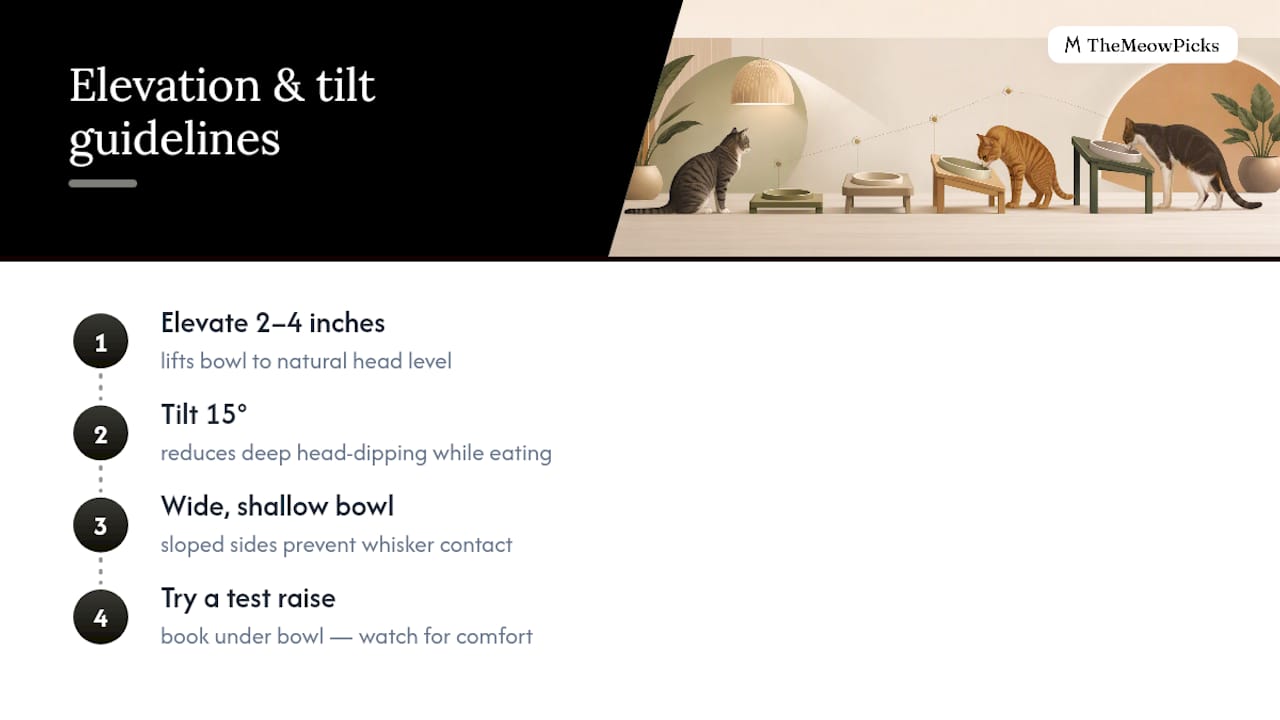
Elevation solves a different problem. Cats built for hunting evolved to eat with their heads level, not tucked down toward the floor. A stand that lifts the bowl 2 to 4 inches, sometimes paired with a 15° tilt, lets your cat approach the food at a more natural angle. That combination is common enough in contemporary feeder design that it’s become close to a standard.
Statistic callout: A 15° tilt is now a defined standard in modern feeder construction, cited specifically for letting cats eat without deep head-dipping.
Elevation isn’t universally necessary. Most healthy adult cats do fine at floor level. Where it helps most is with senior cats, cats with arthritis or mobility issues, and cats prone to vomiting shortly after meals, since a slight incline can ease the angle food travels on the way down.
Pro Tip: Stack a hardcover book or a cutting board under your cat’s current bowl for a few days. If they eat faster, linger longer, or seem more relaxed at mealtime, you’ve got your answer before spending a dime.
Which Bowl Materials Work Best for a Contemporary Setup
Shape matters more than material, so start there regardless of what the bowl is made of. Wide, shallow, low-walled bowls beat anything deep or narrow, full stop.
Once shape is settled, material comes down to trade-offs:
- Ceramic and porcelain: These look the part in a modern kitchen, come in finishes that match matte black hardware or warm wood tones, and many models list dishwasher-safe interiors right on the product page. Check the exact listing since not every glaze is rated the same way.
- Stainless steel: Tougher, harder to chip, and simple to sanitize between meals. It’s the material most likely to hold up in a busy multi-cat home over years of daily washing.
- Silicone: Rarely the bowl itself, but a smart choice for mats and liners underneath. It stays put on tile and hardwood, and it catches drips before they hit the floor.
Before buying, confirm the bowls detach from the stand and are actually dishwasher safe. A feeding station that requires hand washing every awkward angle isn’t one you’ll keep up with.
Our ceramic vs. stainless comparison breaks down the hygiene differences in more detail if you’re torn between the two.
Where Should You Put a Cat Feeding Station?
Placement changes how relaxed your cat feels at every meal, and it’s the part most owners skip straight past. A well-designed feeding station sits in a quiet, low-traffic spot, ideally against a wall or tucked into a corner so your cat’s back is protected while eating. Cats are more vulnerable with their heads down, and a station with an open side facing a doorway or hallway can leave them on edge without you ever noticing why they eat in a hurry.
Keep food and water separated by a few feet when your layout allows it. Cats in the wild rarely drink near a kill site, and that instinct still shapes preferences today.
For multi-cat homes, follow these steps:
- Give each cat a separate room for meals if your space allows it.
- If that’s not possible, space stations well apart.
- Angle bowls so cats aren’t facing each other directly while eating.
- Use a slow feeder for any cat who eats faster than the others, which curbs both competition and vomiting.
Pro Tip: Watch for one cat finishing fast and immediately walking to another cat’s bowl. That’s resource guarding in progress, and it’s solved with distance, not more supervision.
How to Choose a Modern Cat Feeding Station
Run through this checklist at the point of purchase, not after the box arrives.
- Bowl shape and tilt: wide, shallow, with a tilt around 15° if the stand includes one.
- Height: 2 to 4 inches for most adult cats; skip anything dramatically taller unless a vet has flagged a specific mobility issue.
- Footprint: measure the actual floor space, including the mat, before you buy.
- Removable parts: bowls should lift out cleanly for washing.
- Mat compatibility: a silicone mat underneath handles spills better than bare wood or tile.
- Material and finish: pick a finish (matte black, natural wood, white ceramic) that matches the furniture already in the room.
Scale to your household. A single cat rarely needs more than one bowl station. Multi-cat homes usually do better with separate stands per cat rather than one station with multiple bowls crowded together, since that setup can recreate the exact competition problem you’re trying to avoid.
Our elevated bowl guide and stylish cat furniture roundup both go deeper on matching pieces to your existing decor.
| Point | Details |
|---|---|
| Bowl shape rules | Wide and shallow beats deep and narrow every time, regardless of material. |
| Confirm before buying | Ask whether bowls detach and whether they’re dishwasher safe; don’t assume. |
| Match scale to household | One station per cat works better in multi-cat homes than one shared multi-bowl unit. |
Try Before You Buy: Simple DIY Feeding Setups
You don’t need tools or a trip to the hardware store to test whether elevation helps your cat. Purina’s guide to DIY elevated bowls recommends a low-cost trial before committing to anything built or bought.
- Set a shallow dish on a cutting board or thick hardcover book for a few days.
- Add a silicone mat underneath to stop sliding and catch drips.
- If your cat takes to it, consider a small step stool with rubber pads for something sturdier, or a repurposed low tray lined with a non-slip mat.
- For a more finished look, a step-by-step wooden stand plan walks through exact cuts and measurements.
Skip anything with small, loose, or chewable parts, and confirm every DIY piece can be wiped down or run through a dishwasher on top rack.
The Meow Picks Feeding Stations That Match This Checklist
Every product below matches the checklist above in a different way, which makes it easier to pick based on your actual home rather than guesswork.
- Desco Cat Feeder, Powder-Coated, Porcelain Bowls: porcelain bowls in a powder-coated frame, built for readers who want the ceramic look with a sturdier stand underneath. See the Desco feeder product page for full specs.
- Dog Proof Cat Feeder: wall-mounted and raised, designed for homes where a dog shares the space and needs to stay out of the cat’s food. Check the wall-mounted feeder listing for mounting details.
A feeding station that looks good but ignores whisker comfort is just furniture with a bowl on it. The point is a setup your cat actually wants to use every day.
Pro Tip: Pair a feeding station with a nearby perch or cave, like the Perla Cat Cave, so your cat has a place to retreat right after eating instead of wandering off to a busy part of the house.
| Product | Best fit for |
|---|---|
| Desco Cat Feeder, Powder-Coated, Porcelain Bowls | Owners who want a ceramic look with dishwasher-friendly porcelain bowls. |
| Dog Proof Cat Feeder | Multi-pet homes needing a raised, wall-mounted option out of a dog’s reach. |
Where to Store Food and Feeding Accessories Nearby
A feeding station works better when everything it needs is within reach, not scattered across three cabinets. Keep dry food in an airtight container near the station itself, ideally something opaque that blocks light, since exposure to air and light speeds up flavor loss over time.
A small side table or a slim rolling cart works well next to the feeding area. It holds the food container, a scoop, spare bowls, and a stack of clean mats without crowding the floor space your cat needs to approach the bowls comfortably. Look for a cart with a lower shelf specifically for the mat and cleaning supplies, so wipe-downs happen in seconds instead of a trip across the house.
If your cat eats wet food, store unopened cans in the same spot and keep a dedicated lid or cover for opened cans in the fridge nearby. This cuts down on the walk between kitchen and feeding station at every meal, which matters more than it sounds like when you’re juggling a busy schedule.
For homes tight on space, a wall-mounted shelf above or beside the feeding station can hold accessories without taking up floor footprint. Just keep it out of your cat’s direct path to the bowls, since anything overhanging near the head can feel like a threat during a vulnerable moment like eating.
Safety Features That Stop Tipping and Spills
A feeding station that slides across the floor or tips when your cat leans on it defeats the purpose of upgrading in the first place. Weight matters here: a heavier base, often achieved with solid wood or a wide powder-coated metal frame, resists tipping far better than lightweight plastic.
Rubber or silicone feet on the bottom of the stand keep it anchored on hardwood, tile, or laminate. Without them, even a well-built station can creep a few inches with every enthusiastic meal. A silicone mat underneath does double duty, since it catches spilled water and food while also adding friction that keeps the whole setup in place.
Bowl depth plays a safety role too, separate from the whisker fatigue issue. A bowl that’s too shallow relative to its width can tip if your cat pushes food to one side while eating, especially with dry kibble. Look for a slight lip or a recessed base that holds each bowl snugly rather than letting it sit loose on a flat platform.
For multi-cat homes with any roughhousing near mealtime, a stand with a wider footprint than the bowls themselves adds a margin of stability that a narrow pedestal design can’t match. Skip anything on wheels or with folding legs unless the listing specifically states a locking mechanism.
Eco-Friendly Materials Worth Looking For
Sustainability in cat feeding stations usually comes down to what the stand and bowls are made from, and how long the piece lasts before it ends up in a landfill. Solid wood stands, especially those finished with low-VOC or water-based sealants, tend to outlast particleboard alternatives by years, which matters more for the environment than any single material claim.
Stainless steel bowls are inherently durable and recyclable at the end of their life, unlike some plastics that degrade and need replacing every year or two. That durability is also why steel remains a strong hygiene choice, discussed earlier in the materials section.
Some independent makers use reclaimed or FSC-certified wood for feeding stands, though this detail varies by brand and should be confirmed on the specific product listing rather than assumed. If sustainability matters to your purchase, check the materials section of any listing directly instead of relying on marketing language alone.
Buying a feeding station built to last, rather than a flimsy version you’ll replace within a year, is itself a form of sustainability. A well-built stand in solid wood or coated metal can serve multiple cats over multiple years, which keeps more feeding stations out of landfills than any single eco-material choice on its own.
What the Research Actually Tells Us About Feeding Setups
Most advice on cat feeding stations focuses entirely on looks, then treats whisker comfort as an afterthought bullet point at the bottom. That order is backward. The research on whisker fatigue is specific and consistent: bowl shape changes behavior at mealtime, and no amount of nice woodgrain fixes a bowl that’s the wrong shape.
Where conventional advice falls short is height. Plenty of product photos show feeding stands raised 8 or 10 inches off the ground, styled to look dramatic in a living room. Most cats don’t need that. A 2 to 4 inch lift solves the actual postural problem without turning mealtime into a climb, especially for older cats or ones with any joint stiffness.
Prioritize bowl shape and placement first, height and tilt second, and finish and color last. Once the ergonomics are right, picking a stand that matches your kitchen becomes the easy part.
Shop Modern Feeding Stations at The Meow Picks
The Meow Picks skips the plastic bulk-bin feeder entirely and stocks feeding stations from independent makers who design for whisker comfort first, then build the finish around it. That’s the gap most big pet retailers leave open: rows of identical deep plastic bowls, with almost nothing shallow, wide, or built to match a modern home.
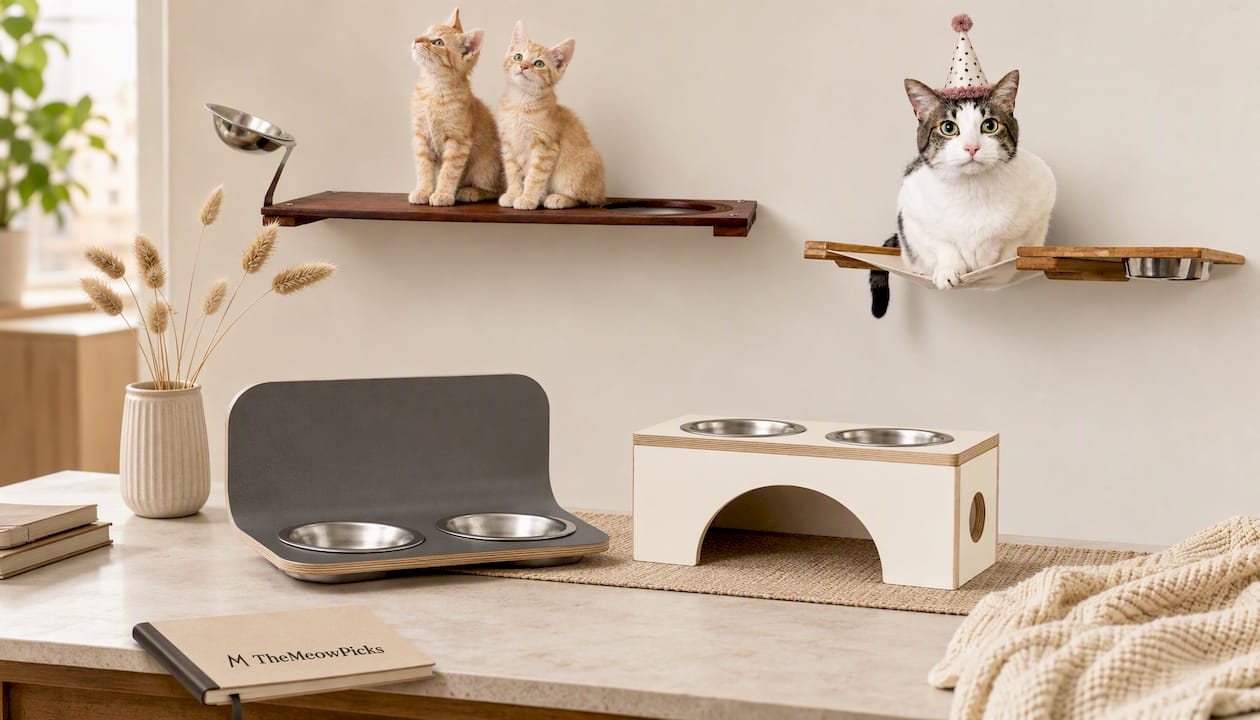
If the Desco Cat Feeder’s porcelain bowls or the wall-mounted Dog Proof Cat Feeder fit what your home needs, both are ready to order now. Every purchase also puts a portion of the sale toward cat rescue organizations, so upgrading your cat’s mealtime setup does a little good beyond your own living room. Browse the Dog Proof Cat Feeder product page to check mounting requirements before you order, or explore the full modern cat furniture collection to plan a matching setup piece by piece.
Sources
- Whisker fatigue in cats, Oklahoma State University news
- Cat Feeding Station: How to Build a Better Setup, HouseCatLiving
- Elevated Cat Feeding Station with Mat – 15° Tilted Wooden Stand & 3 Stainless Steel Bowls, PetzVibes
- How to Make a DIY Elevated Cat Feeding Bowl, Purina
- DIY Modern Cat Feeding Station, Hunker
FAQ
What is the 3-3-3 rule for cats?
The 3-3-3 rule is commonly used for newly adopted cats: expect 3 days to decompress, 3 weeks to settle into a routine, and 3 months to feel fully at home. It’s a general guideline, not a strict timeline, and feeding routine consistency during this period helps cats settle faster.
What is a good platform to feed cats on?
A stand raised 2 to 4 inches with a wide, shallow bowl setup works for most adult cats, sometimes paired with a 15° tilt for easier access. Solid wood or powder-coated metal stands with rubber feet resist tipping better than lightweight plastic versions.
What is the one meat you should never feed your cat?
Raw or undercooked pork carries a higher risk of parasites and bacteria that can make cats sick, so it’s generally avoided even among owners who feed other raw meats. Any specific dietary question about your cat’s food is worth confirming with a veterinarian directly.
Can I leave my cat alone for two days with an automatic feeder?
An automatic feeder can cover meals for a short stretch, but two days alone means no one is checking water levels, litter box conditions, or whether the feeder actually dispensed correctly. Most experienced owners still arrange a check-in visit for anything longer than a single overnight.