TSA requires you to remove your cat from its carrier at the security checkpoint and send the empty carrier through the X-ray machine while you carry or walk your cat through the metal detector. That covers security screening only. Your airline decides carrier size limits, cabin stowage, and how many pets can fly, so you’ll also need to confirm those details plus any health paperwork before you book.
TL;DR:
- Airlines set their own size limits, restrictions on the number of pets allowed, and health documentation requirements, so verify these details before booking.
- TSA requires removing the cat from its carrier at the checkpoint, sending the empty carrier through X-ray, and walking or carrying the cat through the metal detector.
- Properly measuring your carrier against your airline’s under-seat dimensions before purchase is crucial since TSA does not impose a universal size limit.
- Soft-sided carriers are recommended because they can compress to fit under the seat, while hard-sided carriers require precise dimension checks.
- Preparing your cat with gradual exposure to the carrier, leash training, and avoiding sedation enhances travel comfort and reduces checkpoint stress.
Table of Contents
- What Does TSA Require for Cat Carriers at Security?
- Airline Rules: The Part TSA Doesn’t Control
- Choosing a Carrier That Passes Both Checks
- Getting Your Cat Ready for Travel Day
- What Owners Get Wrong Most Often
- Carriers Built for the Checkpoint and the Cabin
- Sources
- FAQ
What Does TSA Require for Cat Carriers at Security?
The checkpoint routine catches a lot of first-time flying cat owners off guard. You cannot leave your cat zipped inside the carrier and send the whole thing through the X-ray tunnel. TSA is explicit about this: the carrier gets X-rayed empty, and your cat goes through the walk-through metal detector in your arms or on a leash.
Here’s how the process typically unfolds:
- Arrive with your cat in a hand-held travel carrier, not a backpack or duffel that’s hard to open quickly.
- Wait until you’re close to the front of the line, then take your cat out of the carrier just before screening starts.
- Place the empty carrier flat on the X-ray conveyor belt.
- Carry your cat through the metal detector, or walk them through on a secure leash if they’re comfortable on the ground.
- Expect a visual inspection of your cat by a TSA officer, and be prepared for a hand swab used for explosive trace detection.
- Move to a re-composure area away from the belt to get your cat back into the carrier, rather than fumbling with zippers in the middle of the checkpoint line.
TSA officers have flagged this exact mistake in press guidance issued in 2022: pets left inside carriers during X-ray screening slow everyone down and create unnecessary risk. If your cat tends to panic in crowds or has a history of bolting, you can request a private screening room. TSA has confirmed this option is available at checkpoints, including in guidance issued at Portland International Airport, and it reiterates that a cat should never be placed inside the X-ray tunnel itself.
Pro Tip: Put a well-fitted harness and leash on your cat before you even reach the checkpoint line, not after. Fumbling with buckles while a TSA officer waits and a line builds behind you is when escapes happen.
Pack an absorbent pad and a small blanket inside the carrier ahead of time. If your cat has an accident from stress, you’ll want a quick fix that doesn’t involve digging through a packed carry-on bag.
Airline Rules: The Part TSA Doesn’t Control
TSA only governs what happens at the checkpoint. Whether your cat can fly with you at all, and under what conditions, comes down to your airline. The FAA confirms that airlines set their own pet policies, including whether pets are allowed in the cabin, what carrier dimensions they’ll accept, and how many pets can travel per flight.
Once you’re on board, your cat’s carrier counts as your carry-on item. The FAA requires that any pet traveling in the cabin stay stowed under the seat in front of you during taxi, takeoff, and landing, the same rule that applies to a laptop bag or purse. That means the carrier has to actually fit in that space, not just fit under the seat at home.
A few things worth confirming with your airline before you book:
- Exact under-seat carrier dimensions, since these vary by airline and sometimes by aircraft type on the same route.
- Whether there’s a cap on the number of pets allowed in the cabin per flight (many airlines limit this, and pet spots can sell out).
- Any pet fee and whether it’s charged per segment or per round trip.
- Species restrictions, since some airlines that allow dogs in-cabin have separate or stricter rules for cats.
Health paperwork adds another layer, and it depends on where you’re headed. Domestic interstate travel can carry state-specific health certificate requirements, and a local veterinarian usually knows what the receiving state expects. International trips generally call for USDA-endorsed paperwork through the APHIS Pet Travel Hub, and some destinations layer on additional requirements tracked through CDC importation guidance. Call your airline 48 to 72 hours before departure to confirm you have everything in order.
Choosing a Carrier That Passes Both Checks
Your carrier has to satisfy two separate systems: TSA’s screening process and your airline’s cabin rules. Getting one right doesn’t guarantee the other.
Start with measurements, not guesswork. Pull up the manufacturer’s listed dimensions for the carrier you’re considering, then compare them directly against your airline’s published under-seat limits. Because the FAA leaves those cabin limits up to individual carriers, the safest move is buying a carrier sized to common U.S. airline requirements and double-checking the exact numbers against your specific flight before you commit to a purchase. The Airline Cat Carrier Size guide from The Meow Picks breaks down what to measure and how to compare it against airline specs.

Soft-sided carriers tend to work better for air travel because they compress slightly to fit under a seat, which gives you a little forgiveness if your measurements are close but not exact. Hard-sided carriers hold their shape, which some cats find more secure, but that same rigidity means you need to check dimensions more carefully since there’s no give. The Soft vs Hard Cat Carrier guide walks through which style fits which travel style.
Beyond size, look for a few practical features:
- Secure closures that won’t pop open under pressure or fidgeting, since a loose zipper pull is a real escape risk.
- Enough ventilation on multiple sides, not just the front, so your cat isn’t staring at fabric mesh with no airflow.
- A leak-resistant base in case of an accident mid-flight.
- A design you can carry and open with one hand, since you’ll need your other hand free at the checkpoint.
Keep the packed carrier light. A bulky travel bed or a heavy water bowl clipped to the outside adds weight and makes the carrier harder to handle through screening. Pack the essentials: an absorbent pad, a small blanket, a harness and leash, and your paperwork somewhere you can reach without unzipping the main compartment.
Getting Your Cat Ready for Travel Day
Preparation matters more than most owners expect, and it starts well before you leave for the airport. A cat who’s only seen their carrier twice a year, both times right before a stressful trip, is going to fight you at the worst possible moment.
Start by leaving the carrier out in your home for a week or two before travel, not zipped in a closet. Feed your cat near it, then inside it, so the carrier stops being a signal that something scary is about to happen. TSA’s own guidance points to this kind of gradual acclimation as one of the simplest ways to lower checkpoint stress.
Once your cat tolerates the carrier at home, practice short carries around the house and yard, then work up to a car ride. Each rehearsal should be a little longer than the last.
- Fit the harness at home first, several days before your flight, so the first time your cat wears it isn’t in a busy terminal.
- Practice short leash sessions indoors before attempting one at the airport.
- Skip sedation unless your veterinarian specifically recommends it, since routine sedation carries real physiological risk during air travel, particularly for flat-faced breeds.
- Talk to your vet about any medical concerns well ahead of your flight date rather than the night before.
Pro Tip: If your cat needs medical equipment or has a chronic condition, talk to your vet about what documentation to carry and how to explain it if a TSA officer asks about it during screening.
For carrier-specific advice, including backpack-style options for cats who do better upright and facing forward, the backpack carrier guide covers acclimation tips suited to that carrier style.
What Owners Get Wrong Most Often
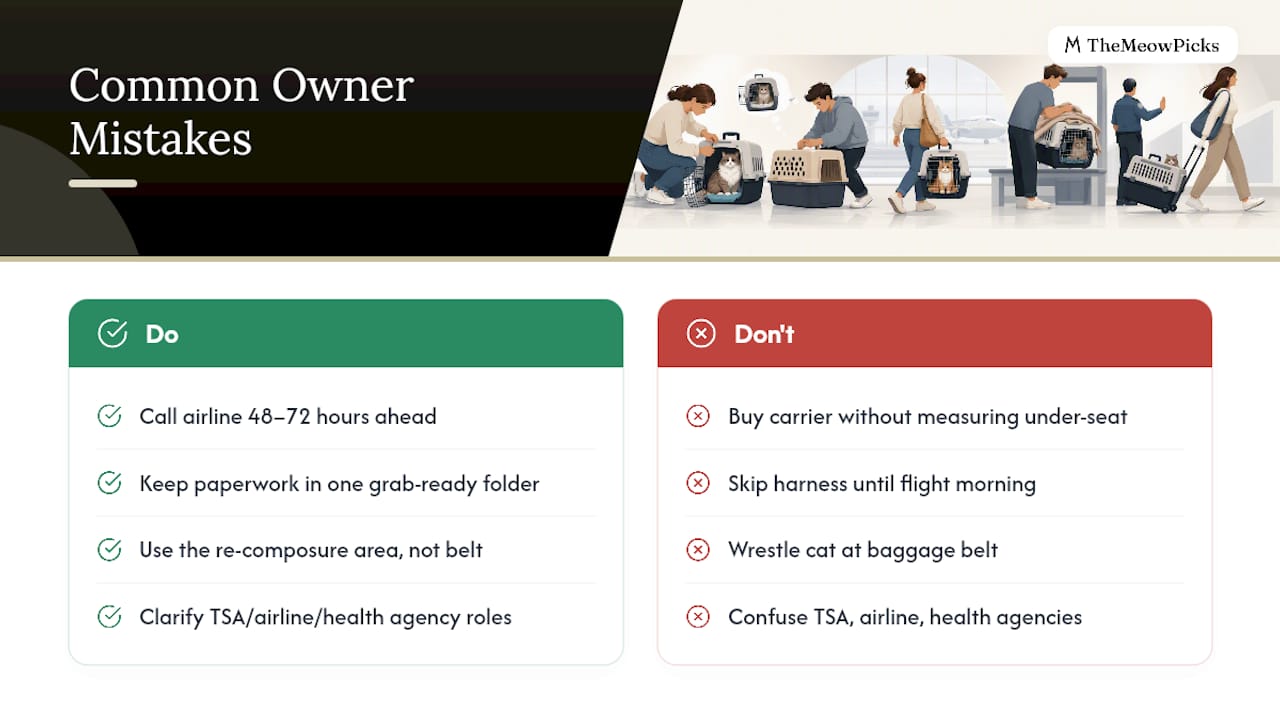
The mistakes we see repeated aren’t really about the rules. They’re about timing. Owners buy a carrier without measuring their airline’s under-seat space first, then find out at the gate that it doesn’t fit. Owners skip the harness until the morning of the flight, then wonder why their cat is fighting the checkpoint line.
The fix is almost always the same: call your airline 48 to 72 hours ahead, keep your paperwork in one folder you can grab without digging, and use the re-composure area instead of wrestling your cat back into the carrier at the belt. Keep the three authorities straight in your head. TSA handles security screening. Your airline sets cabin policy. State and federal agencies handle health paperwork. Confuse those roles and you’ll end up calling the wrong office at the worst time.
— TheMeowPicks Team
Carriers Built for the Checkpoint and the Cabin
This site offers carriers sized and built for air travel routines rather than general-purpose bags. The catalog includes products from independent makers, with some portion of orders supporting cat rescue.

The Nooee Ash Cat Carrier suits owners who want a low-profile, easy-to-open bag for quick checkpoint handling. The Nooee Finn Cat Carrier is a lightweight, quilted option with a cushioned interior for cats who need extra comfort on longer routes. The Nooee Oliver Cat Carrier rounds out the lineup as a quilted travel bag built for everyday handling as much as flight days.
Before you buy any of these, compare the published dimensions against your specific airline’s under-seat requirements. Visit each product page for exact measurements, or browse the full carrier and travel gear catalog to see everything currently available.
Sources
- Small Pets | Transportation Security Administration - TSA
- Flying with Pets | Federal Aviation Administration
FAQ
What is the maximum size for a TSA-approved cat carrier?
TSA doesn’t set a maximum carrier size. Your airline sets the size limits based on under-seat cabin space, so check your specific airline’s published dimensions rather than assuming any carrier is universally accepted.
Do I have to take my cat out of the carrier at TSA?
Yes. TSA requires you to remove your cat from the carrier at the checkpoint, send the empty carrier through the X-ray machine, and carry or walk your cat through the metal detector.
Can you bring a cat carrier on a plane?
Yes, as long as it meets your airline’s carry-on pet policy. The FAA confirms that airlines decide whether to allow cabin pets and require the carrier to stow under the seat during taxi, takeoff, and landing.
Can I take two cats in one carrier on a plane with American Airlines?
Airline policies on multiple pets per carrier vary and change, so confirm directly with American Airlines before booking. Most carriers built for air travel, including options in The Meow Picks catalog, are sized for one cat per carrier to meet standard under-seat requirements.
What happens if my cat resists screening at the checkpoint?
You can request a private screening room, an option TSA has confirmed is available for owners worried about their pet bolting or resisting inspection. Practicing harness and carrier routines at home beforehand makes this scenario far less likely.