Independent cat brands are companies that operate outside the handful of corporations that own most supermarket cat food, usually family owned, privately held, or founder led, and often producing in smaller batches. Before you buy one, check for an AAFCO adequacy statement, a clearly named meat protein as the first ingredient, and a company site that tells you who owns the brand. The rest of this guide walks through exactly how to do that.
TL;DR:
- Independent cat brands should have a clear ownership history verified through official business registries and founder transparency, not just marketing claims.
- Look for a specific AAFCO adequacy statement and a named protein as the first ingredient to ensure the food is nutritionally complete and suitable for your cat’s needs.
- Brands with a clean recall history and state-of-origin for manufacturing are generally more trustworthy; high pricing reflects small-batch quality, not necessarily better nutrition.
- Verify the brand’s sourcing and production details before purchasing, especially when shopping through marketplaces, to avoid red flags like unverifiable claims and suspiciously low prices.
- Don’t rely on founder stories alone; confirm nutritional standards through lab certifications, feeding trials, and transparency to protect your cat’s long-term health.
Table of Contents
- What “Independent” Actually Means for Cat Food Brands
- A Practical Checklist to Evaluate Independent Cat Food Brands
- Where to Find Credible Independent Cat Brands and Avoid Red Flags
- How The Meow Picks Curates Independent Brands
- Nutritional Completeness Beyond the AAFCO Minimum
- Comparing Independent Brands by Cat Health Needs
- Our Take: Verification Matters More Than the Founder Story
- Where to Shop for Design-Forward Cat Furniture on The Meow Picks
- Sources
- FAQ
What “Independent” Actually Means for Cat Food Brands
“Independent” gets used loosely in pet food marketing, so it helps to know what it actually describes. An independent cat brand is one that isn’t owned by a handful of the largest pet food conglomerates. That’s the baseline. Beyond that, ownership structures vary quite a bit.
Some independent brands are family owned and run by the same people who founded them decades ago. Others are founder led startups, often built because someone couldn’t find a food that worked for their own cat’s allergies or health issue. Still others are privately held but backed by outside investors, which changes the incentives even if the branding still leans on a founder story.
Weruva is a good example of a company that leads with its family ownership and keeps that story front and center on its own site. That kind of transparency is worth something, but it’s also a marketing choice, not proof of quality on its own.
Common traits you’ll see among genuinely independent brands include:
- Direct-to-consumer sales channels alongside specialty retail, rather than exclusive big-box distribution
- Small-batch production runs, sometimes freeze-dried, which brands like Grandma Lucy’s use to justify premium pricing
- Public-facing founder stories and sourcing pages, similar to what Fussie Cat publishes about its quality checks
- Active community engagement, the kind of direct feedback loop that brands like POP Cats build around events and small-batch releases
None of these traits guarantees good nutrition. A charming founder story doesn’t replace a proper adequacy statement. Treat these as context, not verification.
To verify ownership yourself, start with the “About” page and look for names, not just adjectives like “family owned.” Cross-check the company name against your state’s business registry if you want to go further, and search the founder’s name to see if they show up in any trade press or industry interviews. If a site is vague about who runs it and where the food is made, that’s worth noting before you add anything to your cart.
Pro Tip: Search the brand name plus “recall” before you search anything else. A clean recall history combined with a clear ownership story tells you more in five minutes than an hour of scrolling product pages.
A Practical Checklist to Evaluate Independent Cat Food Brands
Once you’ve found a brand that looks promising, run it through a short label and provenance check before you commit to a bag or case. This is the part most buyers skip, and it’s the part that actually protects your cat.
- Look for the AAFCO adequacy statement. Every complete and balanced cat food should state that it meets Association of American Feed Control Officials nutrient profiles for a specific life stage. No statement, no complete diet, full stop.
- Check the first ingredient. It should be a named protein, such as chicken, salmon, or turkey, not a vague term like “meat” or “animal protein.”
- Read the guaranteed analysis. This tells you minimum protein and fat percentages and maximum fiber and moisture, useful for comparing brands on more than marketing copy.
- Scan for vague preservatives or heavy fillers. Terms like “animal digest” or “mixed tocopherols” aren’t automatically bad, but a long list of unnamed additives is a signal to dig deeper.
- Search the brand’s recall history. Review platforms that track ingredient quality and recall records rate independent brands like KatKin, Carna4, and Caru highly in part because they have clean histories on this front.
- Confirm the manufacturing facility location. Reputable brands state where the food is made, even if it’s co-packed rather than produced in-house.
- Look for third-party testing or certificates. Not every independent brand has these, but when they do, it’s usually posted prominently, not buried in an FAQ.
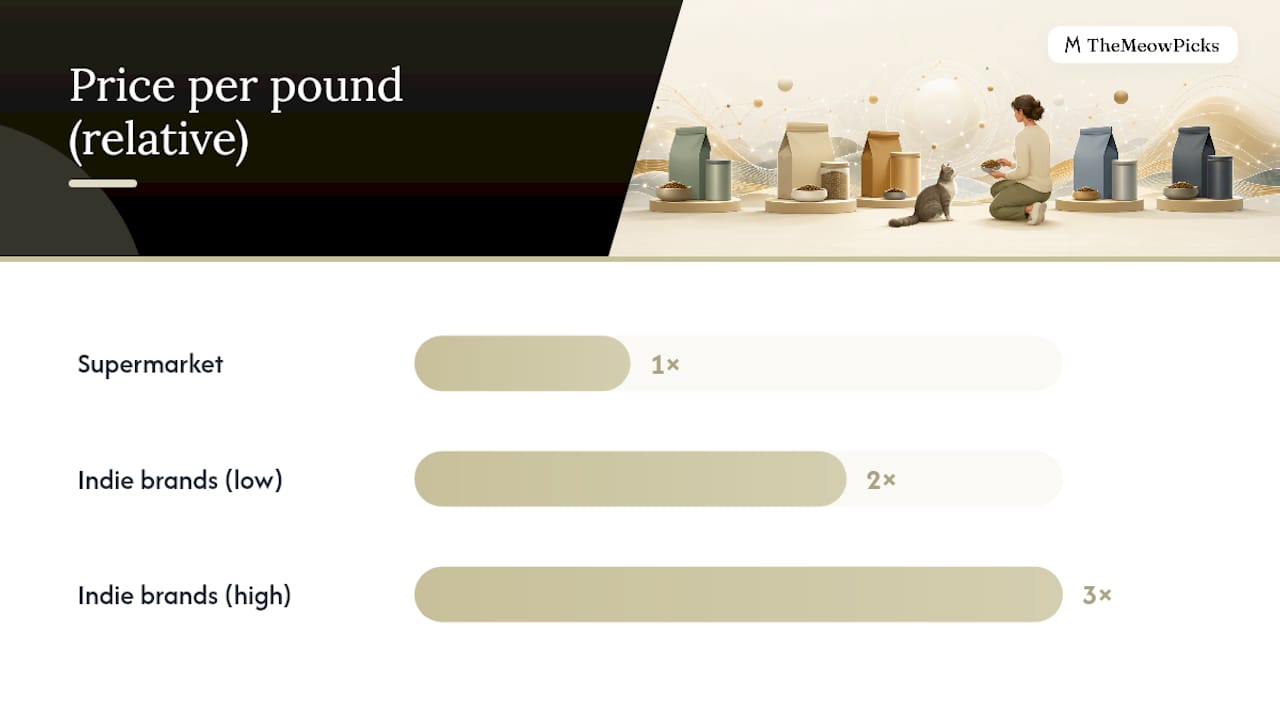
On pricing, expect independent and small-batch foods to run noticeably higher than supermarket brands, sometimes two to three times as much per pound, largely because of smaller production runs and higher-quality proteins. That’s not automatically a red flag. It is a reason to trial before you commit.
Statistic to know: brands that maintain top ratings on independent review platforms tend to share two traits: no recent recall history and consistent ingredient sourcing, which is exactly what this checklist is designed to surface.
When you’re ready to try something new, buy the smallest available bag or a sample pack first, and mix it gradually with your cat’s current food over seven to ten days. Inspect the label the moment the package arrives, not after you’ve already opened it, since return policies on opened pet food are typically limited.
Where to Find Credible Independent Cat Brands and Avoid Red Flags
The safest places to buy independent cat food are the brand’s own website, specialty pet retailers that curate their own supplier lists, and marketplaces that vet the makers they list. Each of these gives you a clearer line back to the manufacturer than a random third-party seller does.
Buying direct from the brand’s site has one big advantage: you’re looking at the same ingredient panel and lot information the company controls, not a repost that might be outdated. Specialty retailers add value when their staff actually know the suppliers, rather than just stocking whatever has the widest margin.
Marketplace listings need a closer look. Check that:
- Product photos show a legible ingredient panel and lot number, not a stock image with the label cropped out
- The seller name matches the brand or an authorized distributor, not a generic storefront
- Customer questions get answered by someone who sounds like they work for the company, not a copy-paste bot
Red flags on third-party listings include prices that look too low for a premium small-batch product, missing manufacturer contact information, and reviews that all read like they were written the same week. If a listing has no way to reach the actual brand for a question about ingredients, treat that as reason enough to look elsewhere.
For your first purchase, order the smallest size offered, check the label against what the site described the moment it arrives, and save the customer support contact info before you need it, not after.
Pro Tip: If a brand’s customer support email bounces or goes unanswered for more than two business days, that’s a bigger warning sign than anything on the label itself.
How The Meow Picks Curates Independent Brands
The Meow Picks built its marketplace around independent makers on purpose, not as an afterthought. That focus applies mainly to furniture, gadgets, and lifestyle pieces rather than food, but the curation logic is the same one this guide has walked through: verify who makes the thing before you decide it’s worth a spot in your home.
Every listing on the site goes through a check for maker transparency and build quality before it’s added, and a portion of every order supports cat rescue organizations, a detail baked into how the business operates rather than a seasonal promotion.
That curation process reduces some of the guesswork buyers face on open marketplaces, since you’re not sorting through anonymous third-party sellers. It doesn’t replace doing your own homework. If you’re evaluating a cat food brand rather than a cat tree, the checklist above still applies in full, because ingredient panels and recall records aren’t something any marketplace can vet for you at a glance.
- Curated selection focused on independent makers, not mass-market brands
- Rescue support tied to every order, not a limited time offer
- Design and function reviewed before a product gets listed
Nutritional Completeness Beyond the AAFCO Minimum
AAFCO’s adequacy statement is the floor, not the ceiling. It confirms a food meets minimum nutrient requirements for a life stage, but it doesn’t tell you much about ingredient quality, digestibility, or how well a formula matches your specific cat’s needs.
Veterinary nutrition guidance, including standards promoted by the World Small Animal Veterinary Association, pushes brands to go further with things like feeding trials, consistent quality control across batches, and formulation oversight from a qualified nutritionist rather than just a recipe that technically clears the AAFCO bar on paper.
Independent brands vary a lot here. Some publish detailed formulation credentials and commission real feeding trials. Others meet the legal minimum and stop there, leaning on ingredient marketing instead. Ask a brand directly whether their formulas are AAFCO tested through feeding trials or only formulated to meet the profile on paper. The two are not the same, and a brand confident in its nutrition science usually answers that question without hesitation.
If your cat has a chronic condition, a formula that clears AAFCO’s minimum still might not be the right fit, and that’s a conversation worth having with your veterinarian before switching foods, especially for kidney, urinary, or diabetic diets where the margin for error is thin.
Comparing Independent Brands by Cat Health Needs
Independent brands increasingly build recipes around specific life stages and sensitivities, which is worth knowing before you assume one formula fits every cat in your house.
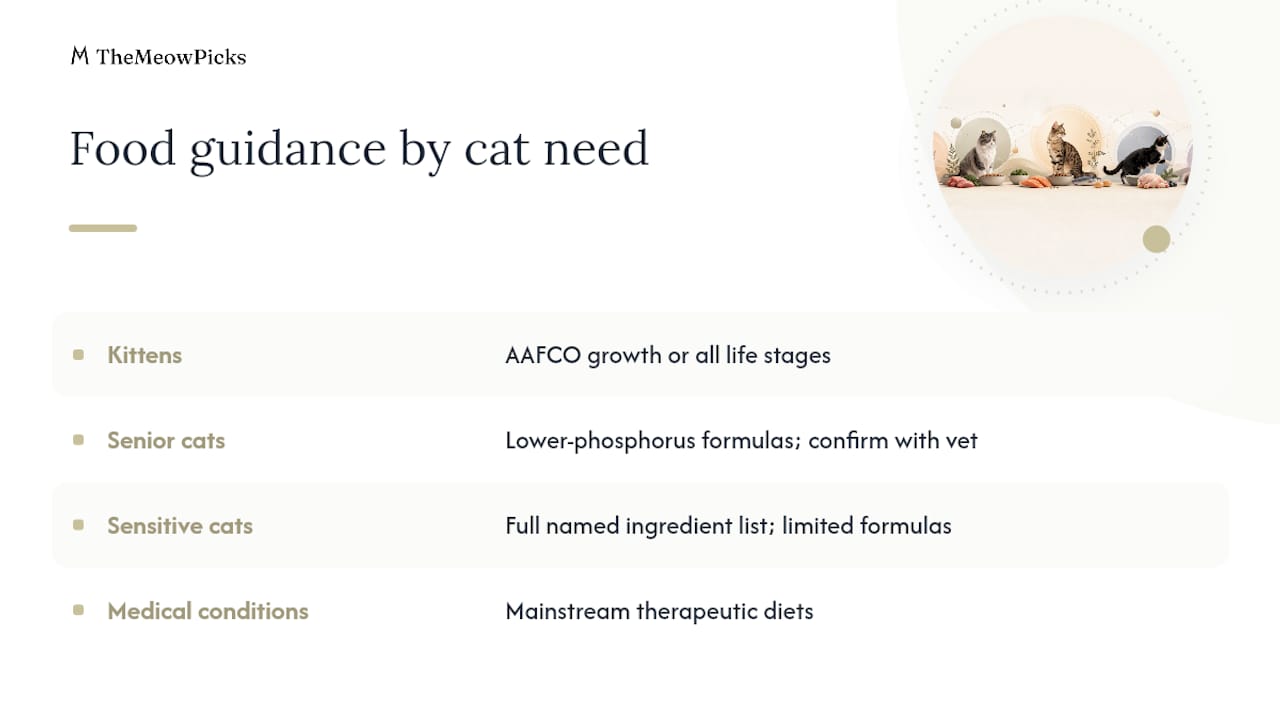
For kittens, look for a food explicitly labeled for growth or “all life stages” on the AAFCO statement, since adult-formula foods often fall short on the calorie and calcium density kittens need. For senior cats, some independent brands offer lower-phosphorus formulas aimed at supporting aging kidneys, though this should be confirmed with a veterinarian rather than assumed from marketing copy.
Cats with food sensitivities benefit most from brands that publish a full, named ingredient list with no vague catch-all terms, since eliminating a suspected allergen only works if you actually know what’s in the bag. Limited-ingredient formulas from smaller makers tend to be more useful here than broad “sensitive stomach” labels, which can still contain a dozen different protein sources.
For cats with diagnosed medical conditions, mainstream clinical brands like those commonly recommended in veterinary settings still play a role that most independent brands aren’t formulated to replace, since therapeutic diets require specific nutrient restrictions verified through clinical research. Independent doesn’t mean better for every situation. It means worth evaluating on its own merits, case by case.
Our Take: Verification Matters More Than the Founder Story
The pet food industry has trained buyers to trust a good origin story, and that’s exactly backward. A founder who switched their cat to a new recipe after a health scare tells you why a brand exists, not whether the recipe is nutritionally sound. Conventional advice leans hard on that emotional signal because it’s easy to market and hard to fact-check.
What actually holds up under scrutiny is boring: the AAFCO statement, the named protein, the clean recall record, a real person you can reach if something goes wrong. Independent brands that pass those checks deserve your trust more than ones that just photograph well. The ones that fail them deserve skepticism no matter how good the packaging looks.
Our advice: read the label before you read the “About” page. Verify first, get charmed by the story second. That order protects your cat far better than the reverse.
— TheMeowPicks Team
Where to Shop for Design-Forward Cat Furniture on The Meow Picks
The site curates furniture, technology, and lifestyle pieces from independent makers, with a portion of every order supporting cat rescue organizations. If you’ve just switched your cat to a new independent food brand, the next logical upgrade is often the furniture and gear around it. The same “know who makes it” standard applies there too.
A few pieces worth a look from the current catalog:
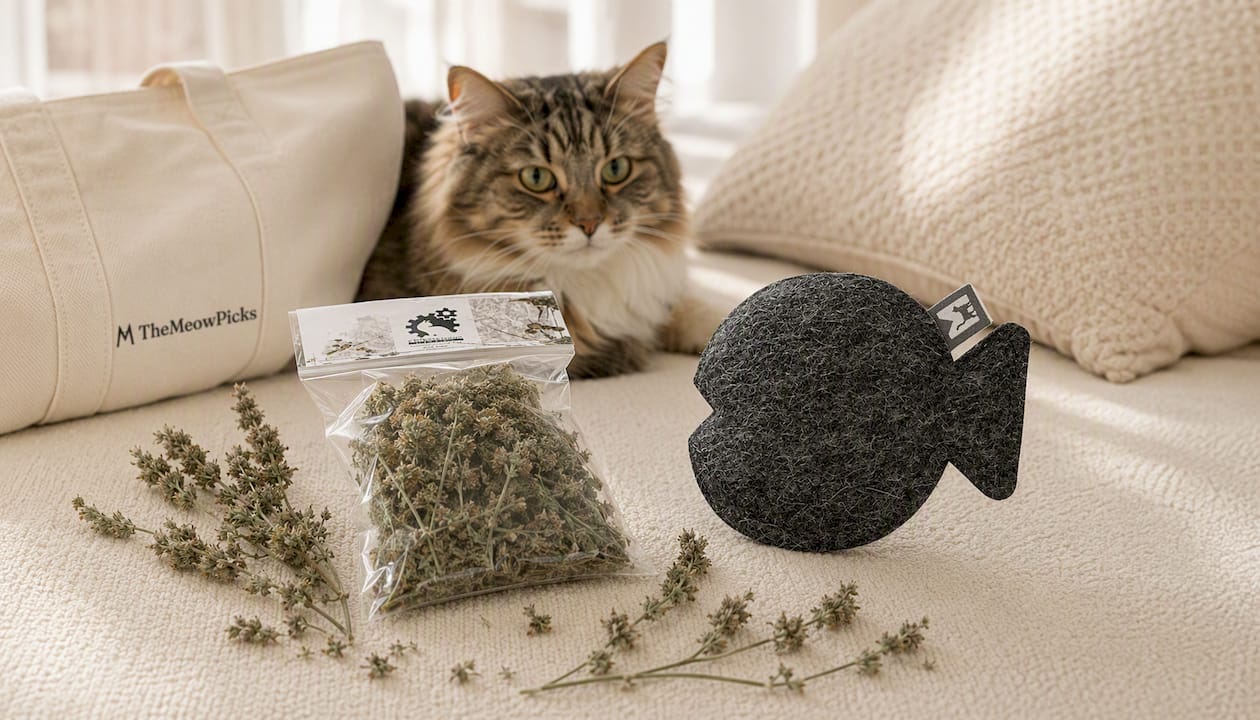
The Apawtment Cat House works well for owners who want a self-contained piece that doubles as a design object in a small living room. The Canyon is built for multi-cat households that need vertical space without a bulky footprint. The Cat Wall Maze mounts directly to the wall, a good option if floor space is tight. The Perla Cat Cave gives a shy or senior cat a covered, low-stimulation retreat. The Unica Fleece Blanket is a simple, soft add-on for any bed or perch. Torre Cat Tower suits homes that need one tall centerpiece rather than several smaller pieces. The Grotto fits apartments and smaller rooms where a full-height tree won’t work. The Gardens brings a decorative, plant-inspired look for owners who want furniture that doubles as decor.
Check current shipping and returns details before you order, and browse the full catalog to compare pieces side by side before you decide.
Sources
FAQ
Which cat breeds are independent?
Breeds like the Norwegian Forest Cat, Russian Blue, and British Shorthair are often described as independent in temperament, but this refers to personality, not the cat food brand category discussed in this guide.
What is the 3-3-3 rule for cats?
The 3-3-3 rule describes a general adjustment timeline for a new cat entering a home: roughly 3 days to decompress, 3 weeks to settle into a routine, and 3 months to feel fully at home. It’s not related to food brand evaluation.
What are some good independent cat food brands?
Review platforms rate brands like KatKin, Carna4, and Caru highly based on ingredient quality and clean recall records, and companies like Weruva stand out for transparent, family-owned operations.
What is a silent killer for cats?
Chronic kidney disease is often called a silent killer for cats because symptoms frequently don’t appear until the disease has progressed significantly, which is one reason senior cats benefit from regular veterinary checkups alongside any diet changes.
Does The Meow Picks sell cat food?
The Meow Picks focuses on curated cat furniture, technology, and lifestyle products from independent makers rather than food, though current offerings and prices are always listed on the site.