If your cat tree rocks or leans under a firm push, or it’s tall and shared by a large cat or several cats, treat it as unsafe right now. Tighten every fastener, move the tree into a corner, and fit a wall-anchor strap or a weighted plywood base before your cat climbs it again. Those three moves fix most wobbling in under an hour.
TL;DR:
- Ensuring the shorter side of the base measures at least a third of the tree’s height minimizes tipping risk, especially for taller and multi-cat setups.
- Tightening hardware, anchoring into studs, and adding weight to the base can resolve most wobbling issues immediately.
- Posts should be at least 4 inches in diameter for cats over 15 pounds, with thicker posts recommended for larger or heavier cats.
- Applying about 20 to 30 pounds of lateral force at the top perch during a push test effectively assesses a tree’s stability before use.
- Cheaper trees with particleboard bases and no hardware for anchoring tend to loosen quickly and are less safe for active or large cats.
Table of Contents
- What Makes a Cat Tree Stable in the First Place?
- Measure Your Cat and Your Tree Before You Buy or Fix Anything
- Quick, Safety-First Fixes You Can Do Today
- Repairing Compressed Posts, Stripped Holes, or Thin Bases
- How to Anchor and Test Stability the Right Way
- What to Prioritize When Buying a Stable Cat Tree
- The Meow Picks Perspective on Stable, Design-Forward Cat Furniture
- Recommended Meow Picks Products That Meet These Stability Standards
- Sources
- FAQ
What Makes a Cat Tree Stable in the First Place?
Cat tree stability isn’t about weight limits printed on a box. It’s a moment problem: force times height. A cat leaping onto a top perch generates far more tipping force the taller that perch sits, even if the cat weighs the same as one lounging on a lower shelf. That’s why a 6-foot tower with a narrow base fails long before its stated weight capacity comes into play.
The most useful rule you’ll find is the one-third rule from WebVet: the shorter side of the base should measure roughly a third of the tree’s total height. Run the arithmetic before you buy or before you decide whether to anchor.
A few things reduce tipping risk beyond base width:
- Low overall mass concentrated near the floor, not stacked at the top
- Perches positioned directly over the base rather than cantilevered outward
- A rigid, flat bottom panel instead of thin particleboard that flexes under load
Ratio to remember: shorter base side ÷ total height.
Measure Your Cat and Your Tree Before You Buy or Fix Anything
Grab a tape measure before you shop for a replacement or evaluate what you already own. Stand your cat up and measure from floor to fingertip when it stretches, since a scratching post should exceed a cat’s full standing stretch, and long-bodied breeds often need posts near 36 inches to get a genuine full-body stretch.
Record these numbers for any tree you’re considering:
- Total height and the shorter base side (calculate the ratio above)
- Post diameter at the widest point
- Perch diameter and depth for the top platform
- Your cat’s weight, and the weight of every cat that will use it
For post thickness, size matters more than most buyers expect. Posts under 3.5 inches flex noticeably under a large cat’s weight; aim for 4 inches if your cat weighs 15 to 19 pounds, and closer to 4.5 inches for cats over 20 pounds. If your household has a large or heavy climber, our guide to cat furniture for large cats covers sizing in more depth.
Quick, Safety-First Fixes You Can Do Today
Most wobble complaints come from loose hardware, not a design flaw. Here’s the order to work through:
- Tighten every fastener. Cardboard and particleboard compress during the first weeks of use, so re-tightening screws after break-in resolves a large share of wobble complaints. Add washers where metal meets metal to keep bolts from backing out again.
- Move it into a corner. Two walls bracing the tree on adjacent sides eliminate most side-to-side rocking instantly, and it costs you nothing.
- Add mass to the base. A cut plywood board screwed under the existing base, weighted with a sandbag or paver, lowers the center of gravity. Skip loose heavy objects that can shift or become a hazard themselves.
- Fit a wall-anchor strap or L-bracket. Most trees ship with a strap that owners never actually install, which is a shame, since anchoring is the cheapest safety upgrade you can make.
- Check your flooring. A deep-pile rug lets one corner sink and creates a rocking motion that looks like a structural problem but isn’t. Slide a rigid board under the base if your tree sits on thick carpet.
Pro Tip: Skip adhesive-only wall anchors and short drywall screws. They hold static weight fine but shear loose the first time a cat leaps and lands hard, which is exactly the moment you need the anchor to work.
Repairing Compressed Posts, Stripped Holes, or Thin Bases
Older trees develop specific failure points, and each has a fix that doesn’t require replacing the whole unit.
- Compressed cardboard tubes: Slide an internal dowel or a length of PVC pipe inside the tube to stiffen it, securing the ends where you can reach hardware.
- Stripped screw holes: Pack the hole with wood glue and a wooden dowel plug, let it cure fully, then re-drill and re-screw into solid material.
- Worn sisal wrapping: Re-wrap the post once the rope thins, since sisal outlasts carpet on posts and grips screw threads more reliably when the underlying post is solid wood rather than particleboard.
- Loose platform connections: Add L-brackets or corner braces underneath any platform that flexes when your cat lands on it.
How to Anchor and Test Stability the Right Way
Anchoring beats every retrofit on this list for one reason: it removes the tipping moment entirely instead of just shifting it. Cat trees over roughly 48 inches should be anchored because drywall-only fasteners fail under repeated jumping loads, even when they hold fine on day one.
- Find studs first. Lag screws into wall studs hold far better than any drywall anchor. Use a stud finder and mark both sides before drilling.
- Use rated toggle anchors only when studs aren’t reachable. These distribute load across a wider area of drywall, but they’re a fallback, not a first choice.
- Add a second anchor point for tall or heavy-use trees. A single top strap works for a 4-foot tree with one cat; a 6-foot tree in a multi-cat household needs a mid-level anchor too.
- Run the push test. Apply about 20 to 30 pounds of lateral force at the top perch, roughly what a determined shove delivers. Movement beyond an inch means you need another anchor point or a base retrofit.
- Recheck monthly. Fasteners loosen with vibration and use. A quick wiggle test on platforms and a glance at anchor straps takes thirty seconds.
What to Prioritize When Buying a Stable Cat Tree
Shopping for a new tree instead of retrofitting an old one? Prioritize in this order:
- A wide, heavy base first. Check the shorter side against total height using the one-third ratio before anything else.
- Thick posts sized for your cat’s actual weight, not the smallest cat in the marketing photo.
- Anchoring hardware included in the box, with mounting instructions that name stud placement, not just drywall clips.
- Solid wood or plywood construction rather than particleboard, since thread retention differs sharply by material and particleboard is the main reason cheaper trees loosen within months.
If a tall freestanding tower doesn’t fit your space or your cat’s climbing style, our roundup of cat tree and tower alternatives covers lower-profile formats worth a look.
The Meow Picks Perspective on Stable, Design-Forward Cat Furniture
TheMeowPicks Team runs every curated piece through the same questions this guide walks you through: base ratio, post diameter, and whether anchoring hardware is actually included, not just implied. Good design and structural safety aren’t a trade-off. A well-built designer tree can hold its shape for years precisely because the maker used solid wood joinery instead of cutting corners on the frame. If you want pieces that already clear this bar, our cat wall shelves built for large cats are a good place to start browsing.
— TheMeowPicks Team
Recommended Meow Picks Products That Meet These Stability Standards
Compare shorter side to total height before you buy anything, then check whether anchor hardware ships in the box. That’s the whole test.
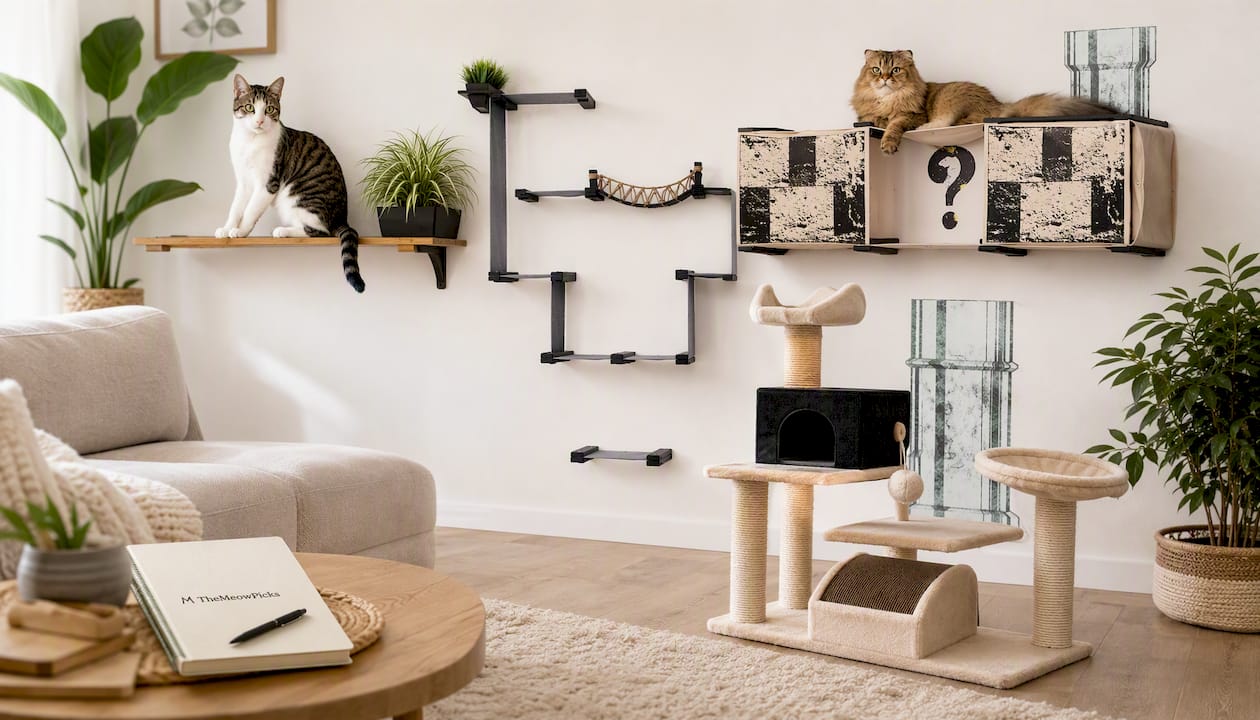
The Meow Picks curates pieces where that math was already considered by the maker, not left for you to fix later. The Torre Cat Tower and the Oak Cat Tree and Scratcher use solid wood posts that hold screw threads far longer than particleboard builds. If height itself worries you more than any retrofit could fix, the Apawtment Cat House and The Grotto keep your cat’s climbing low and inherently stable, while a wall-mounted Cat Wall Maze removes the tipping moment from the equation entirely once it’s properly anchored into studs. Every purchase also puts a portion of the sale toward cat rescue organizations. Check the dimensions listed on any product page against your own measurements from this guide, then pick the piece that fits both your cat’s size and your wall.
Sources
- How to make a cat tree more stable, Catster
- Cat trees for large cats, WebVet
- How to anchor a cat tree to the wall, AvailPet
FAQ
How can I stabilize my cat tree?
Tighten all fasteners, move the tree into a corner, and add weight low on the base. If the tree is tall or serves a large cat, fit a wall-anchor strap into wall studs rather than relying on drywall alone.
What is the 3-3-3 rule for cats?
The 3-3-3 rule refers to how cats settle into a new home over 3 days, 3 weeks, and 3 months, not cat tree design. It isn’t related to the one-third base-to-height ratio used for stability.
How do cat trees not fall over?
A stable tree keeps its base footprint close to a third of its total height and centers most of its weight low, near the floor. Trees taller than about 48 inches typically need a wall anchor secured into studs to stay upright under jumping loads.
How do I make my cat tree less wobbly?
Re-tighten every screw first, since loose hardware causes most wobble complaints after the first few weeks of use. If wobbling continues, check whether the base footprint is too narrow for the tree’s height and add an anchor strap or weighted plywood base.
How much force should a cat tree withstand before it’s considered unstable?
A simple push test works well: apply about 20 to 30 pounds of lateral force at the top perch. Movement beyond roughly an inch means the tree needs another anchor point or a base retrofit before your cat uses it again.