The PetKit Pura Max is the best overall Litter-Robot alternative for most U.S. households. It delivers near-silent ~35 dB operation, a brushless motor, and a polished health-tracking app at roughly half the price of the Litter-Robot 4. For multi-cat homes, the Catlink Scooper Pro stands out with its 13L waste drawer and per-cat weight tracking. Cat owners with anxious or large cats should look at the Neakasa M1, whose open-top layout speeds acclimation considerably. Budget shoppers can start with the Meowant SC02 for under $200, accepting some trade-offs on app quality and warranty. The Meow Picks carries several of these options alongside curated cat furniture that pairs well with any litter setup.
- 1–2 cats, quiet home: PetKit Pura Max — near-silent, smart app, brushless motor
- 3+ cats or large drawer needed: Catlink Scooper Pro — 13L drawer, per-cat tracking
- Anxious or large cat, apartment: Neakasa M1 — open-top, corner-friendly footprint
- Tightest budget: Meowant SC02 — functional auto-sifting, minimal extras
Table of Contents
- How do Litter-Robot alternatives compare on price and specs?
- Which alternative is right for your household?
- What do you actually trade when you skip the Litter-Robot?
- How to choose the right alternative for your household
- How we evaluated these alternatives
- What most buyers miss about noise, sensors, and maintenance
- Why the Litter-Robot costs more (and when it’s actually worth it)
- Key Takeaways
- What owners wish they had known before buying
- Where to find these picks and what pairs well with them
- Useful sources for deeper research
How do Litter-Robot alternatives compare on price and specs?
The table below covers the seven automatic litter boxes most worth considering in 2026, plus the Litter-Robot 4 as the benchmark. The Meow Picks also carries designer cat furniture that complements any litter setup. The Apawtment Cat House, Torre Cat Tower, and Perla Cat Cave are worth pairing with a new litter box to give your cat a comfortable, private space nearby.
| Model | Street Price | Best For | Drawer/Capacity | Noise | Key Failure Modes | Smart Features | Maintenance | Warranty (US) | Safety Sensors | Footprint |
|---|---|---|---|---|---|---|---|---|---|---|
| PetKit Pura Max | $160–$400 | 1–2 cats, quiet homes | ~15L globe | ~35 dB | Load sensor drift | App + health tracking | Weekly drawer; monthly deep clean | 1 year | Weight + IR | Medium globe |
| Catlink Scooper Pro | $160–$400 | 3+ cats | 13L drawer | ~40 dB | Motor wear at high use | Per-cat weight tracking | Weekly drawer; monthly clean | 1 year | Weight + IR | Tall tower |
| Neakasa M1 | under $200 | Anxious/large cats, corners | ~12L | ~35 dB | Drum balance on uneven floors | Basic app | Weekly; easy open-top access | 1 year | IR | Corner-friendly |
| Meowant SC02 | ~$150–$200 | Budget buyers, 1 cat | ~8L | ~45 dB | Brushed motor longevity | Minimal app | Frequent; smaller drawer | 6 months | IR only | Compact |
| PetSnowy Snow+ | $300–$550 | Multi-cat, large interior | 83L interior | ~35 dB | Sensor calibration | App + TiO2 odor | Weekly; moderate complexity | 1 year | Multi-stage | Large dome |
| PetSafe ScoopFree | $15–$20 | 1 cat, crystal litter users | Disposable tray | ~35 dB | Tray cost accumulation | No app | Tray swap every 20–30 days | 1 year | IR rake stop | Compact flat |
| Litter-Robot 4 | ~$699 | 3–4+ cats, XL breeds | Large globe | ~40 dB | Globe motor, weight sensor | Mature app + per-cat analytics | Weekly drawer; monthly deep clean | 3 years (US) | Radar + weight | Large globe |
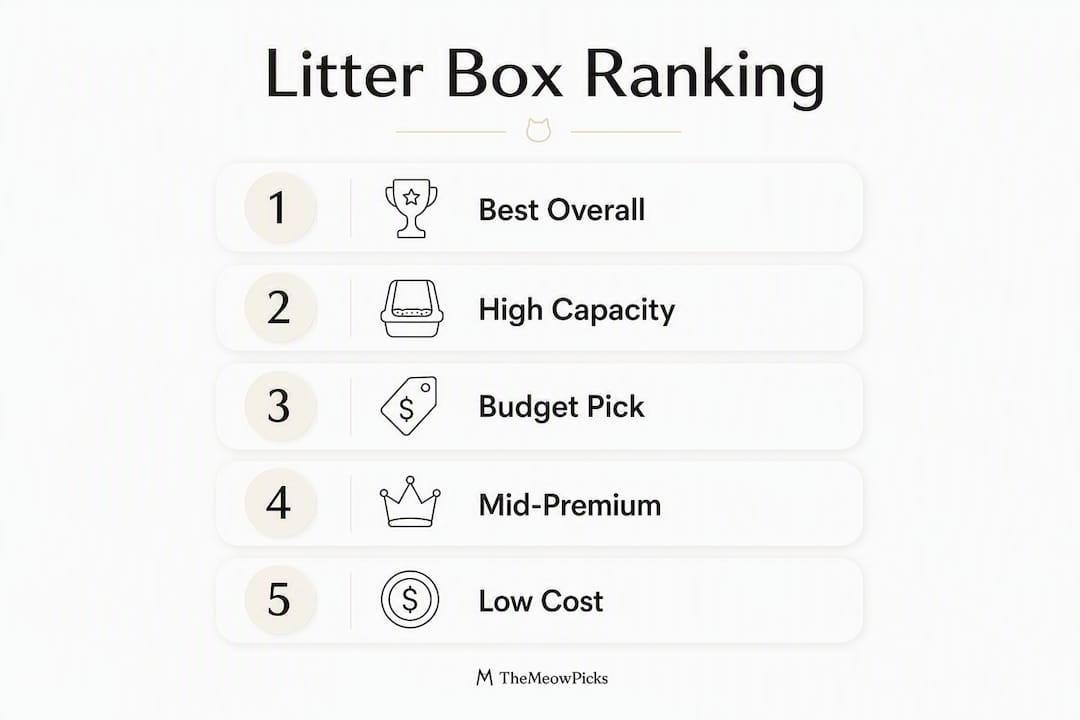
Price callout: The gap between the Litter-Robot 4 at ~$699 and most alternatives is real. In 2026 you can get app tracking and safety sensors for $160–$400, which covers the PetKit Pura Max, Catlink Scooper Pro, and Neakasa M1 comfortably. The PetSafe ScoopFree has the lowest entry price, but disposable crystal trays add up quickly for households with more than one cat.
Pros of choosing an alternative:
- Significantly lower upfront cost (often $300–$550 less than LR4)
- Comparable core sifting and odor control for 1–2 cat homes
- Lighter weight and smaller footprints in most models
Cons to accept:
- Shorter warranties (typically 6 months to 1 year vs. LR4’s 3-year US coverage)
- Less mature app ecosystems and fewer firmware update cycles
- Radar-based safety layers are rare outside the Litter-Robot 4
Which alternative is right for your household?
PetKit Pura Max — best overall mid-tier pick
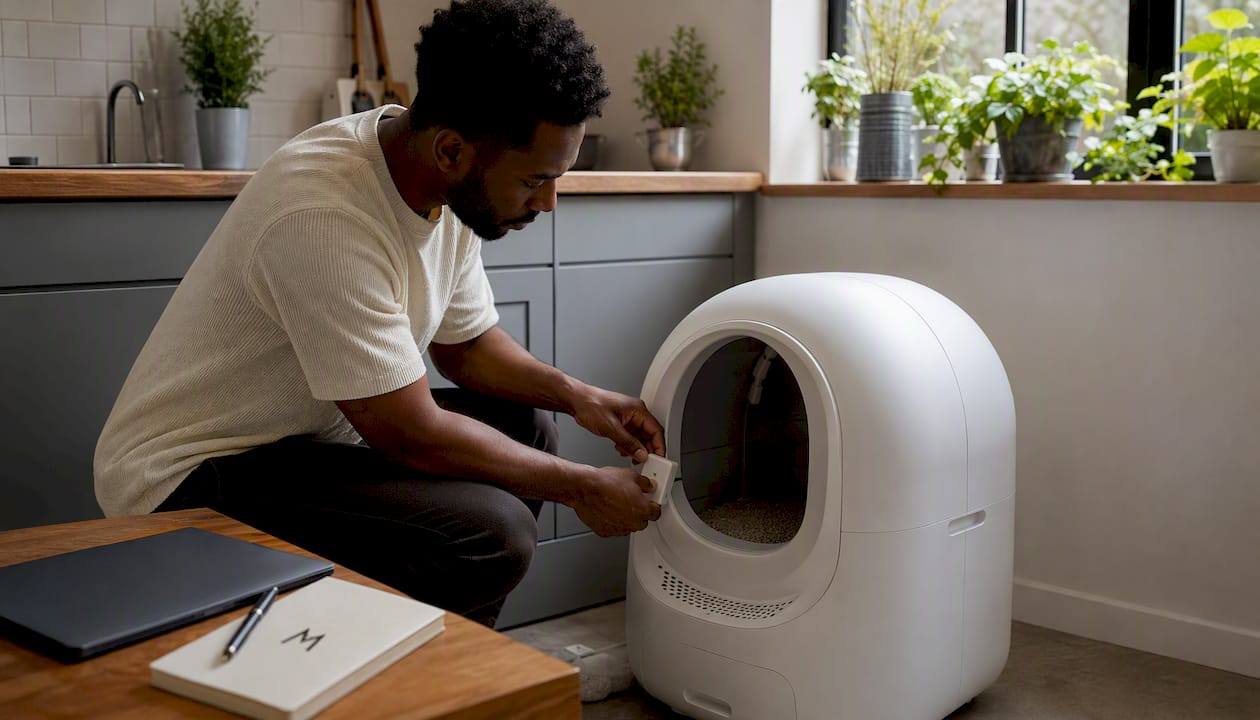
The Pura Max earns its top-pick status on three things: a brushless motor that runs quietly, a genuinely useful companion app, and consistent odor control. Multiple recent reviews list it as the top mid-tier alternative, and its low noise means it can sit in a bedroom or open living area without disturbing anyone. The app tracks litter usage per cat and flags unusual patterns, which is more than most alternatives offer at this price.
- Best for: 1–2 cat households who want smart features without paying LR4 prices
- Standout: Near-silent cycle and a mature app for the price point
- Real caveat: Load sensor drift can cause occasional false stops after 12+ months; a firmware reset usually fixes it
- Skip if: You have 3+ cats and need a larger drawer
You can find the Petkit Puramax 2 at The Meow Picks.
Catlink Scooper Pro — high-capacity pick for multi-cat homes
The 13L waste drawer is the headline here. For a three-cat household, that means emptying the drawer roughly twice a week instead of daily. Per-cat weight tracking adds a layer of health monitoring that most alternatives at this price skip entirely. The tower-style design does take up vertical space, so measure your ceiling clearance before ordering.
- Best for: 3+ cats, or any household that hates frequent drawer emptying
- Standout: 13L drawer and per-cat tracking at a mid-tier price
- Real caveat: Motor wear increases at high daily cycle counts; plan for a motor check at the 18-month mark
- Skip if: You have one small cat and limited floor space
Neakasa M1 — open-top pick for anxious or large cats
Owner reports consistently note faster acclimation for anxious cats with open-top designs, and the M1 is the clearest example of that principle in practice. There is no dome to squeeze through, which matters for Maine Coons, Ragdolls, or any cat that flat-out refuses an enclosed globe. The corner-friendly shape also helps in tight apartments where every square foot counts.
- Best for: Cats that reject enclosed boxes, large breeds, corner placements
- Standout: Open-top layout that removes the biggest acclimation barrier
- Real caveat: Open tops scatter litter more than enclosed models; a mat underneath is non-negotiable
- Skip if: Odor control is your top priority — enclosed designs contain smell better
Meowant SC02 — budget pick under $200
The SC02 does one thing well: it sifts automatically so you are not scooping by hand every day. Budget models like this are functional but come with shorter warranties and noisier motors, and the SC02 is no exception. The app is minimal, the drawer is small (~8L), and the 6-month warranty is the shortest on this list. For a single-cat household on a tight budget, those trade-offs are manageable.
- Best for: Budget-conscious buyers with one cat who want basic auto-sifting
- Standout: Lowest upfront price for functional automatic sifting
- Real caveat: Brushed motor longevity is a known concern; budget for a replacement unit at the 18–24 month mark
- Skip if: You have two or more cats, or you want reliable app features
PetSnowy Snow+ — mid-premium pick
The Snow+ sits between the mid-tier alternatives and the Litter-Robot 4 in both price and capability. Its 83L interior and multi-stage safety architecture are credible at this price point, and the TiO2 odor control system is a genuine differentiator. If you have two or three cats and want a large interior without paying LR4 prices, this is the most logical step up from the Pura Max.
- Best for: Multi-cat homes wanting a large interior and advanced safety
- Standout: 83L interior capacity and TiO2 odor control
- Real caveat: Sensor calibration can need adjustment after firmware updates
- Skip if: You want the longest US warranty and most established parts network — that still belongs to the LR4
PetSafe ScoopFree — low-cost crystal tray option
The ScoopFree is the simplest machine on this list. A rake moves waste into a covered trap, and you swap the disposable crystal tray every 20–30 days. No drawer to empty, no litter to scoop. The catch is ongoing cost: crystal trays run roughly $15–$20 each, which adds up for multi-cat homes. For a single-cat household already using crystal litter, it is a low-effort, low-drama option.
- Best for: 1 cat, crystal litter users who want zero-contact disposal
- Standout: Lowest initial price and genuinely hands-off daily maintenance
- Real caveat: Tray costs make it expensive over 12 months with two or more cats
- Skip if: You want an app, health tracking, or a reusable waste system
Litter-Robot 4 — the benchmark (and when it’s worth the price)
The LR4 remains the standard everything else is measured against. Head-to-head testing consistently shows it leads on warranty length, parts availability, and app maturity. The 3-year US warranty alone is worth something real when you are spending $699. Radar-based safety sensing reduces false stops more reliably than IR-only systems, and the per-cat analytics have gone through enough firmware cycles to be genuinely trustworthy.
- Best for: 3–4+ cats, XL breeds, owners planning 5+ years of use
- Skip if: You have one cat and a limited budget — the PetKit Pura Max covers 90% of the same ground for half the price
What do you actually trade when you skip the Litter-Robot?
The savings are real, but so are the trade-offs. Here is what changes when you move from the LR4 to a mid-tier or budget alternative:
- Warranty: LR4 covers 3 years in the US. Most alternatives offer 1 year; the Meowant SC02 gives you 6 months. Parts availability after warranty expiry is also more limited for newer brands.
- Safety sensors: The LR4 uses radar plus weight sensing. Most alternatives rely on IR sensors alone, which produce more false positives and occasionally miss a cat that sits very still.
- Motor type: Brushless motors (PetKit Pura Max, LR4) last longer and run quieter than brushed motors (Meowant SC02). Motor type is the single best predictor of long-term reliability.
- App maturity: The LR4’s app has gone through years of firmware updates. Alternatives like the Pura Max are catching up, but budget models often have apps that are buggy or rarely updated.
- Odor control architecture: The LR4 and Snow+ use multi-layer odor systems. Mid-tier models rely primarily on the sealed drawer; budget models offer minimal odor management beyond the litter itself.
On failure modes: The most common reasons automatic litter boxes fail within 12–18 months are motor burnout (especially brushed motors under heavy use), load sensor drift causing false stops, and drum balance issues on uneven floors. Checking the motor type and sensor spec before buying is the fastest way to filter out fragile options.
A simple reliability indicator used in evaluating these picks runs from 1 (high failure risk) to 5 (proven long-term reliability). The LR4 scores 5. The PetKit Pura Max and Catlink Scooper Pro sit at 4. The Meowant SC02 is a 2, reflecting its brushed motor and short warranty.
How to choose the right alternative for your household
Work through this in order and you will have a shortlist in under five minutes.
- Count your cats. One cat: almost any model works. Two cats: you need at least a 12L drawer and a brushless motor. Three or more: the Catlink Scooper Pro or PetSnowy Snow+ are the practical choices.
- Check your cat’s size and temperament. A Maine Coon or a cat that refuses enclosed spaces needs the Neakasa M1’s open-top design. Anxious cats acclimate faster without a dome.
- Set your noise tolerance. Apartments and light sleepers need a model at or below 40 dB. The PetKit Pura Max (~35 dB) and PetSafe ScoopFree (~35 dB) are the quietest. The Meowant SC02 (~45 dB) is noticeably louder.
- Measure your floor space. Tower-style units like the Catlink Scooper Pro are tall and narrow. Globe units need clearance on all sides. The Neakasa M1 fits into corners that other models cannot.
- Factor in consumable costs. The PetSafe ScoopFree’s crystal trays cost $15–$20 each. Proprietary deodorizer pods and specialized liners on some models add $50–$100 per year. Check what the model requires before you buy.
Questions to ask on any product page before purchasing:
- Is the motor brushless or brushed?
- What is the drawer capacity in liters?
- What is the minimum cat weight for the safety sensor to trigger?
- Does it use radar, weight, or IR sensing?
- What is the warranty length, and does the brand have US-based support?
- Is the app free, or are health-tracking features behind a paywall?
Red flags to walk away from:
- No independent safety layer (IR-only with no weight backup)
- Motor type not specified anywhere in the product listing
- Warranty under 6 months or no US support contact listed
- Drawer capacity listed in vague terms rather than liters
- App features described as “coming soon” or locked behind a subscription with no free tier
How we evaluated these alternatives
The picks in this article draw on owner reports collected over 6–18 months of real-world use, third-party noise measurements, warranty and support checks, and consumable cost modeling. Wirecutter’s methodology emphasizes hands-on testing and reliability over flashy features, and that same weighting shaped the evaluation here.
Criteria and weighting:
- Reliability and safety (high weight): Motor type, sensor architecture, known failure modes, and warranty length. A model with a brushed motor and 6-month warranty starts at a disadvantage regardless of other features.
- Capacity and consumables (medium weight): Drawer size in liters, litter compatibility, and annual consumable cost. Hidden costs (trays, pods, proprietary litter) factor into the total-cost-of-ownership score.
- App features and health tracking (lower weight): Useful but not decisive unless you specifically want per-cat health monitoring. App maturity matters more than feature count.
- Noise level (medium weight): Measured in dB where available; apartment suitability depends heavily on this.
- Footprint and design (lower weight): Relevant for small spaces and corner placements, but secondary to reliability.
What most buyers miss about noise, sensors, and maintenance
Noise is the most underestimated factor in automatic litter box purchases. Models operating in the 30–40 dB range are close to a quiet library; you can place them in a bedroom or living room without disruption. Units running louder than 45 dB are noticeable in a small apartment, especially during a 2 AM cycle. The PetKit Pura Max’s ~35 dB operation is one of the main reasons it earns the top mid-tier spot.
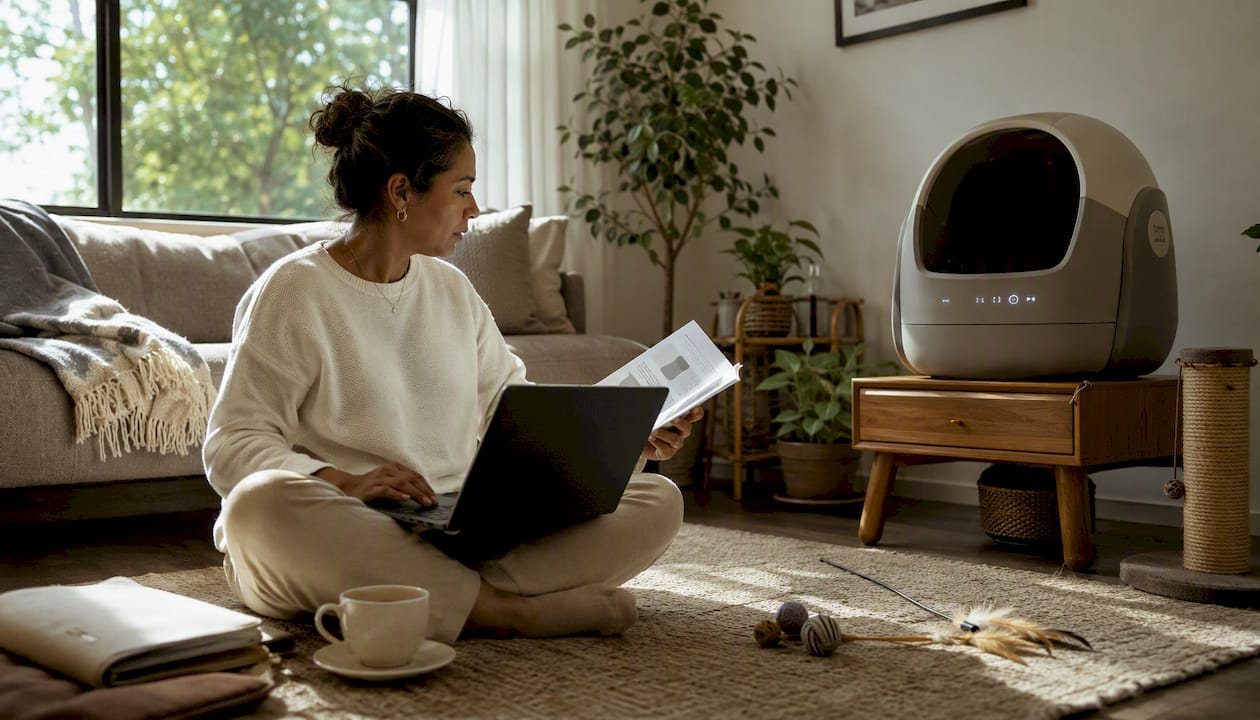
Sensor type predicts false-positive rates more reliably than brand reputation. IR-only sensors can be fooled by litter dust, steam from nearby appliances, or a cat sitting very still near the entry. Radar plus weight sensing (as in the LR4) cross-checks two independent signals before stopping a cycle, which is why its false-stop rate is lower in long-term use. For most single-cat households, IR-only is fine. For a three-cat home where the box cycles 15–20 times a day, the difference becomes meaningful.
Pro Tip: Deep-clean the drum and sensors every 3–6 months, not just the drawer. Clump buildup on sensor lenses is the leading cause of false stops and missed cycles. A soft cloth and a small amount of isopropyl alcohol on the sensor window takes two minutes and prevents the most common service calls.
Two patterns show up repeatedly in long-term owner reports:
- Owners who cleaned only the drawer and ignored the sensors started seeing false stops around the 8–10 month mark. A sensor wipe fixed the issue immediately.
- Owners who placed their unit on a slightly uneven floor reported drum balance errors within weeks. A rubber mat or a quick level check at setup prevents this entirely.
Why the Litter-Robot costs more (and when it’s actually worth it)
The LR4’s price premium breaks down into four real components, not marketing.
- Warranty and parts network: Three years of US coverage with an established service network. Replacement parts are available and documented. Most alternatives offer one year, and some brands have limited US repair infrastructure.
- Radar-based safety: The LR4’s radar layer detects a cat entering the globe even if the weight sensor is fooled by litter buildup. That redundancy matters in a home with young children or cats that move unpredictably.
- App ecosystem maturity: The LR4’s app has gone through more firmware cycles than any alternative, which means fewer bugs, more reliable health alerts, and per-cat analytics that have been validated over time.
- Interior capacity for large cats: The globe interior accommodates XL breeds that struggle in most alternatives.
When the LR4 is genuinely worth the price:
- You have 4 or more cats and need a box that cycles reliably 20+ times a day
- You own an XL breed (Maine Coon, Norwegian Forest Cat, Ragdoll) that does not fit comfortably in mid-tier globes
- You plan to use the box for 5+ years and want parts and support to be available throughout
- Per-cat health tracking is a medical priority, not just a nice-to-have
For a single cat or a two-cat household on a budget, the PetKit Pura Max covers the core needs at roughly half the cost. The LR4’s premium is rational for heavy, long-term use. It is harder to justify for lighter use cases.
Key Takeaways
The PetKit Pura Max is the best Litter-Robot alternative for most U.S. households, offering near-silent operation, a brushless motor, and smart health tracking at a price significantly lower than the Litter-Robot 4.
| Point | Details |
|---|---|
| Best overall alternative | PetKit Pura Max (~35 dB, brushless motor, smart app) suits most 1–2 cat households at roughly half the LR4 price. |
| Multi-cat households | Catlink Scooper Pro’s 13L drawer and per-cat tracking make it the practical choice for 3+ cats. |
| Anxious or large cats | Neakasa M1’s open-top design speeds acclimation and fits corner placements better than any enclosed globe. |
| LR4 is worth it when | 4+ cats, XL breeds, or 5+ year ownership plans justify the 3-year US warranty and radar safety layer. |
| The Meow Picks | Carries the Petkit Puramax 2 and curated cat furniture (Apawtment Cat House, Torre Cat Tower, Perla Cat Cave) to pair with any litter setup. |
What owners wish they had known before buying
The regrets that come up most often in long-term owner discussions are not about the machines themselves. They are about the decisions made before the box arrived.
Underestimating consumable costs is the most common one. A model that looks affordable at $200 can cost $150–$200 per year in crystal trays, proprietary pods, or brand-specific litter. Before you buy, look up the annual consumable cost, not just the sticker price. The Cassava and Corn Clumping Cat Litter from The Meow Picks works with most clumping-compatible automatic boxes and is worth checking for compatibility before committing to a model.
Ignoring noise is the second. Owners who placed a louder unit (~45 dB) in a bedroom or small apartment often moved it within weeks, sometimes to a location that made the cat reluctant to use it. Noise level deserves the same attention as drawer size.
Skipping the warranty check is the third. A 6-month warranty on a $180 machine means you are essentially buying a disposable appliance. If the motor fails at month 8, you are buying again. Checking warranty length and whether the brand has a US support contact takes 60 seconds and can save you real money.
One action for each: calculate the 12-month consumable cost before checkout, check the noise spec against your placement plan, and look up the brand’s US support page before you finalize the order.
Where to find these picks and what pairs well with them
If you are ready to shop, The Meow Picks carries a curated selection of automatic litter boxes and the cat furniture that makes them work better long-term. The litter box collection includes options across price points, from compact apartment-friendly units to advanced multi-cat setups.
A litter box works best when your cat feels comfortable in the space around it. Pairing a new automatic box with a private retreat nearby — like the Apawtment Cat House or the Perla Cat Cave — gives anxious cats a safe zone close to the box, which speeds acceptance noticeably. The Torre Cat Tower adds vertical space in small apartments where floor real estate is tight.
Every purchase at The Meow Picks supports cat rescue organizations. Products ship from independent makers worldwide, and the orders and shipping page has current delivery details for US customers. Browse the full litter and accessories range at themeowpicks.com/collections/litter to find the right setup for your home.
The Meow Picks is a curated marketplace. A portion of every order goes directly to cat rescue.
Useful sources for deeper research
- Litter-Robot Alternatives: What Owners Actually Think After 6–18 Months — Long-form owner-tested roundup with noise measurements and multi-cat use notes
- Best Automatic Cat Litter Boxes 2026 — Wirecutter — Lab-tested picks with reliability-first methodology
- Best Automatic Litter Boxes 2026 — Forbes Vetted — Multi-cat household testing with hands-on notes