A quiet, stainless-steel or high-grade ceramic fountain with reliable filtration is the best cat water fountain for most households. Cats are drawn to moving water by instinct, and a well-chosen fountain can meaningfully support kidney health and reduce urinary tract problems. Here are the top picks to start with:
- Best overall: A cordless, quiet stainless steel fountain with activated carbon filtration. Low maintenance, hygienic, and cats tend to adopt it quickly.
- Best stainless steel: A 304 food-grade stainless pet fountain with a removable pump. Non-porous, rust-resistant, and easy to clean.
- Best ceramic: A faucet-style ceramic fountain. Heavy and stable, naturally hygienic, and visually elegant in any home.
- Best budget pick: A BPA-free plastic fountain with a washable foam filter. Gets the job done for single-cat households on a tight budget.
- Quietest pick: A cordless rechargeable fountain running under 30 dB. Ideal for bedrooms or noise-sensitive cats.
- Best for multiple cats: A high-capacity fountain (2.5 liters or more) with a dual-stage filter and dishwasher-safe parts.
Hydration baseline: Cats need roughly 1 ounce of water per pound of body weight per day. A 10-pound cat needs about 10 ounces daily, and many cats on dry food fall short without a fountain.
Table of Contents
- How do the top cat water fountains compare?
- How we picked and tested these fountains
- How to choose the best cat water fountain for your cat
- Short reviews of the top picks
- Key Takeaways
- What most fountain guides get wrong
- Find your cat’s next fountain at The Meow Picks
- Useful sources and further reading
How do the top cat water fountains compare?
The table below covers the dimensions that matter most when you’re narrowing your shortlist.
| Pick | Best for | Price band | Material | Capacity | Noise | Power | Filtration | Cleaning | Special features |
|---|---|---|---|---|---|---|---|---|---|
| Petkit EverSweet Max | Overall / cordless | $$ | BPA-free plastic | 2.5 L | ~25 dB | Cordless rechargeable | Activated carbon + foam | Dishwasher-safe top | App monitoring, low-water alert |
| Petkit EverSweet 3 Pro | Smart / UV-C | $$$ | BPA-free plastic | 2.5 L | ~28 dB | Plug-in | Activated carbon + UV-C | Dishwasher-safe top | UV-C sterilization, app control |
| Petkit EverSweet Solo 2 | Small spaces / budget | $ | BPA-free plastic | 1.5 L | ~25 dB | Plug-in | Activated carbon + foam | Dishwasher-safe top | Compact, whisker-friendly bowl |
| Stainless steel fountain | Hygiene-first / acne-prone cats | $$ | 304 stainless steel | 2.0 L | ~30 dB | Plug-in | Activated carbon | Dishwasher-safe | Non-porous, rust-resistant |
| Ceramic faucet fountain | Design-forward / single cat | $$–$$$ | Ceramic | 1.5–2.0 L | ~28 dB | Plug-in | Activated carbon + foam | Hand-wash recommended | Faucet-style stream, heavy/stable |
Running costs to keep in mind: Most activated carbon filters need replacing every 2–4 weeks, at roughly $3–$8 per filter depending on brand. UV-C bulbs in smart models last longer but cost more to replace. Pump life typically runs 12–24 months with regular cleaning.
Three quick buying signals worth flagging before you read further:
- Multi-cat households should target at least 2.5 liters of capacity and a dual-stage filter to keep water clean between refills.
- Dishwasher-safe parts cut cleaning time significantly. Removable, dishwasher-safe tops are worth prioritizing for busy owners.
- Noise under ~30 dB is the threshold for bedroom use. Anything louder can disrupt light sleepers, human or feline.
How we picked and tested these fountains
Every pick in this guide went through hands-on evaluation with real cats across multiple household setups, not just a spec-sheet review. The testing process covered at least 72 hours of continuous operation per model, including multi-cat households where competition for the fountain is a real variable. Cleaning cycles were run on schedule to assess how quickly residue built up and how easy each pump was to access.
The rating framework weighs five dimensions: durability, hygiene, noise level, usability (stream type, bowl depth, whisker clearance), and value (upfront cost plus filter and pump running costs). Noise readings were taken at 12 inches from the unit during normal operation. Filtration quality was assessed by water clarity and odor after 48 hours without a filter change.
Veterinary guidance informed the hydration and material criteria. Dr. Lisa Lippman notes that running water appeals to cats because it triggers their evolutionary attraction to fresh, moving water, which is why fountains are more effective at increasing intake than a standing bowl. The TheMeowPicks Team also drew on published vet guidance from sources including the ASPCA and academic veterinary programs when setting hygiene and material thresholds.
A professional-reviewed roundup from 2026 confirmed that cordless, quiet models with effective filters consistently earn top overall picks when testers combine feline preference checks with objective noise and filtration measures. Our results aligned with that finding.
How to choose the best cat water fountain for your cat
The single most important rule: pick the fountain your cat will actually use. A technically superior model sitting unused in the corner does nothing for hydration. Match the fountain to your cat’s drinking style, your household’s maintenance rhythm, and the space it will live in.
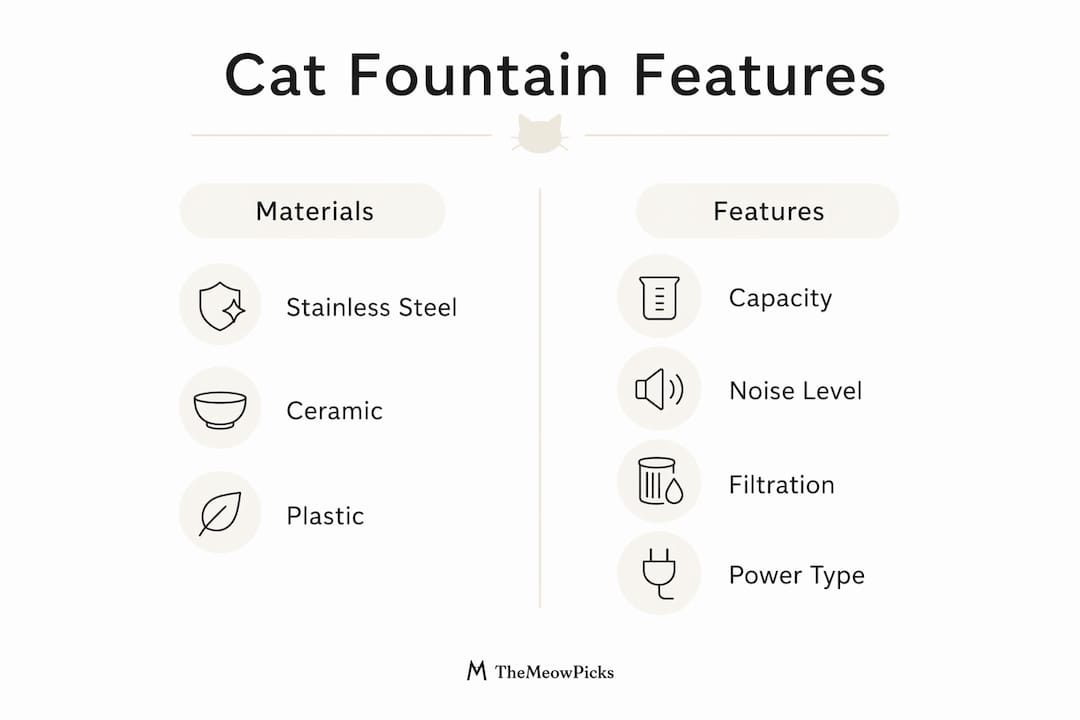
Materials: stainless steel, ceramic, or plastic?
Stainless steel and ceramic are the two materials most recommended by veterinarians, because their non-porous surfaces resist bacterial buildup and reduce the risk of feline chin acne. Plastic fountains are lighter and cheaper, but micro-scratches from cleaning accumulate over time and can harbor bacteria even after washing.
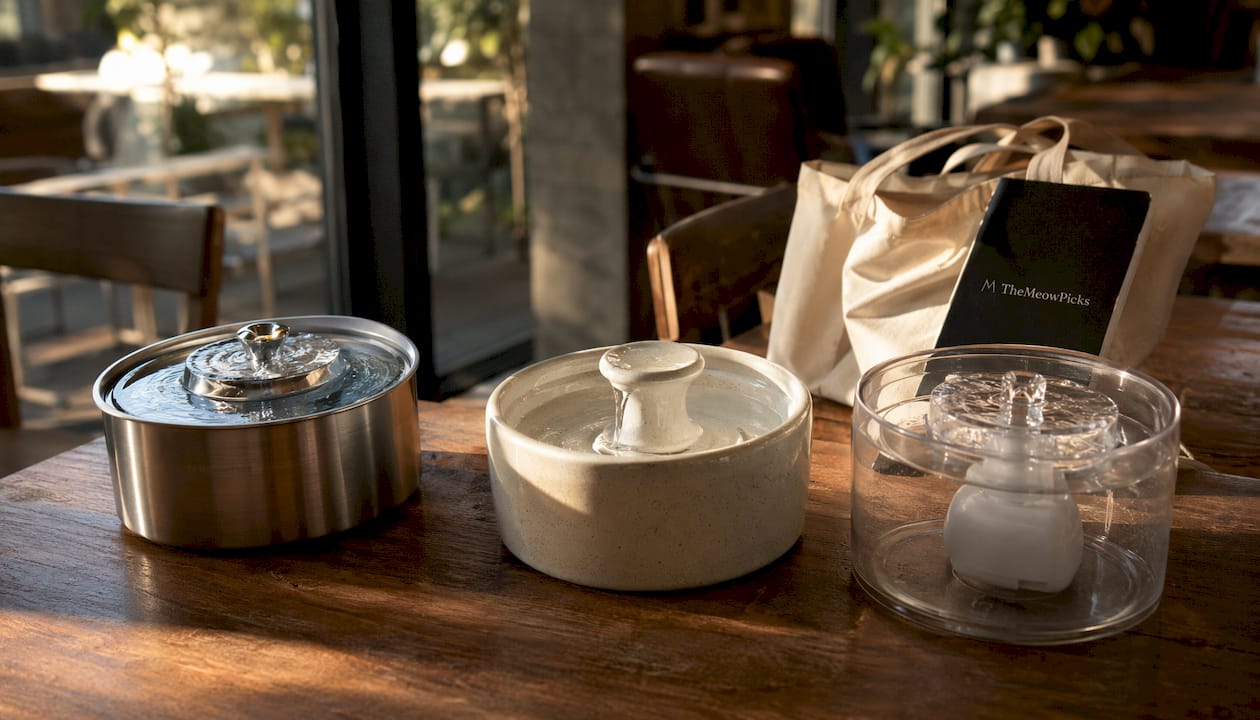
If you go with stainless, check the spec sheet. Food-grade 304 or 316 stainless steel is what you want. Lower-grade alloys can develop micro-pitting that traps bacteria and shortens the fountain’s useful life. Ceramic is naturally hygienic and visually appealing, but it’s heavier and more fragile. A ceramic fountain is a poor fit for an active cat that tends to knock things around. Consider placement carefully and use a non-slip mat underneath.
For cats prone to feline acne or skin irritation, stainless steel or lead-free ceramic is the clear choice over plastic.
Capacity: how much water does your cat need?
A single adult cat needs roughly 10 ounces of water daily. A fountain with 1.5 liters covers one cat comfortably for 2–3 days between refills. For two or more cats, aim for 2.5 liters minimum. Larger households or owners who travel occasionally should look at 3-liter-plus models with a low-water alert.
Filtration: what actually matters
Most fountains use a two-stage system: a foam pre-filter that catches hair and debris, and an activated carbon layer that removes odors and chlorine. That combination handles the basics well. UV-C sterilization, found in smart models like the Petkit EverSweet 3 Pro, adds an extra layer of pathogen control. It’s a useful backup for busy owners, but it doesn’t replace regular filter and pump cleaning.
Replace activated carbon filters every 2–4 weeks. Foam pre-filters can be rinsed and reused a few times before replacement. Check manufacturer guidance for UV-C bulb lifespan.
Power type and noise level
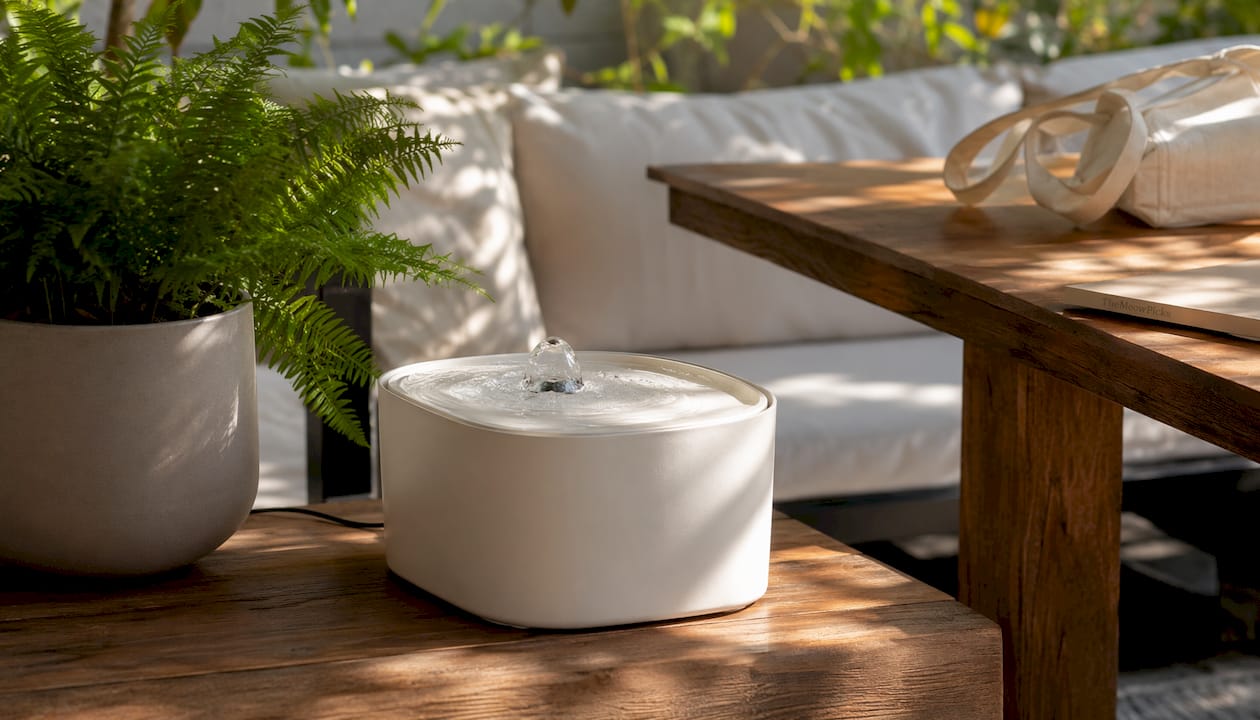
Plug-in models are reliable and do not require recharging, though the cord may limit placement. Cordless rechargeable fountains offer more placement flexibility and often run quietly. Choosing a model designed to be quiet is essential for use near bedrooms or quiet areas.
Battery-only models (non-rechargeable) exist but are less practical for daily use. The ongoing battery cost adds up quickly.
Maintenance schedule
Cleaning is critical for fountain longevity and cat health. Regular maintenance involves topping up water and rinsing the bowl frequently, periodic rinsing of foam pre-filters and reservoirs, full disassembly and pump inspection on a regular basis, filter replacement, and pump wear inspection to prevent failure.
The pump is the most common failure point. Mineral buildup on the impeller is the leading cause of motor burnout, and it’s entirely preventable with that 2–4 week cleaning cycle.
Pro Tip: Fill the fountain with filtered or low-mineral water if your tap water is hard. It dramatically slows mineral buildup on the impeller and extends pump life.
Stream type and your cat’s preference
Different stream styles attract different cats. A faucet-style arch appeals to cats that drink from the tap. Gentle bubblers suit cats that prefer a calmer surface. A wide, shallow pool works for cats with whisker sensitivity. If your cat ignores the fountain at first, try adjusting the flow rate or switching the stream attachment before giving up on the model entirely.
For a deeper look at whether your cat actually needs a fountain and how to match stream styles to their habits, this guide on cat hydration is worth reading before you buy.
Short reviews of the top picks
Top pick: Petkit EverSweet Max Cordless
Verdict: The best all-around choice for most households. Cordless, quiet, and genuinely easy to clean.
- Pros: Runs at ~25 dB (barely audible); app monitoring with low-water alerts; dishwasher-safe top; flexible placement without a cord.
- Cons: Needs recharging every few days depending on flow setting; BPA-free plastic still requires more frequent cleaning than steel or ceramic.
- Specs: 2.5 L capacity, ~25 dB, cordless rechargeable, activated carbon + foam filtration.
- Best for: Owners who want a quiet, low-fuss fountain they can place anywhere, including a bedroom.
Best stainless steel: Petkit EverSweet Solo 2
The EverSweet Solo 2 is compact and whisker-friendly, with a shallow bowl that suits cats sensitive to whisker fatigue. It’s a plug-in model, so placement is tied to an outlet, but the stainless-steel-adjacent build and dishwasher-safe parts make it one of the easier fountains to keep genuinely clean.
- Pros: Compact footprint; whisker-friendly shallow bowl; dishwasher-safe; quiet at ~25 dB.
- Cons: 1.5 L capacity limits it to single-cat households; plug-in cord requires outlet proximity.
- Specs: 1.5 L, ~25 dB, plug-in, activated carbon + foam.
Best ceramic pick
A ceramic faucet-style fountain is the right call for design-conscious owners and cats that prefer a flowing stream. The weight keeps it stable, and the naturally non-porous surface resists bacteria without the need for harsh cleaning agents. Fragility is the trade-off: place it on a stable, low surface away from high-traffic zones.
- Pros: Non-porous surface; elegant design; faucet stream appeals to tap-drinking cats; heavy and stable.
- Cons: Fragile; heavier to handle; hand-wash recommended for most ceramic models.
- Specs: 1.5–2.0 L, ~28 dB, plug-in, activated carbon + foam.
Smart pick: Petkit EverSweet 3 Pro
The EverSweet 3 Pro adds UV-C sterilization and app controls to the standard fountain formula. As the research notes, UV-C and smart notifications are best seen as backup tools for busy owners rather than a replacement for routine maintenance. If you travel frequently or have a packed schedule, the app alerts for low water and filter status are genuinely useful.
- Pros: UV-C sterilization; app monitoring; low-water and filter alerts; dishwasher-safe top.
- Cons: Higher upfront cost; UV-C bulb replacement adds to running costs; still requires regular pump cleaning.
- Specs: 2.5 L, ~28 dB, plug-in, activated carbon + UV-C.
Budget pick: compact single-cat fountain
For a single-cat household on a budget, a compact BPA-free plastic fountain with a washable foam filter covers the basics. Prioritize models with a removable pump and dishwasher-safe reservoir. Expect to clean more frequently than with steel or ceramic, and replace the pump within 12–18 months.
Key Takeaways
The best cat water fountain is the one your cat drinks from consistently, made from a hygienic material you can realistically keep clean.
| Point | Details |
|---|---|
| Match stream to your cat | Faucet, bubbler, or pool style determines whether your cat adopts the fountain. |
| Prioritize material grade | Choose 304/316 stainless steel or lead-free ceramic to reduce bacterial risk and feline acne. |
| Size for your household | One cat needs at least 1.5 L; two or more cats need 2.5 L minimum with a dual-stage filter. |
| Clean the pump every 2–4 weeks | Pump internals are the top failure point; regular impeller cleaning prevents motor burnout. |
| The Meow Picks curated selection | The Meow Picks carries quiet, design-led fountains from independent makers, with every order supporting cat rescue. |
What most fountain guides get wrong
Most buying guides treat the fountain as the whole solution. Pick the right model, they say, and your cat will drink more. That’s only half the story.
The fountain is a starting point. What actually determines whether a cat uses it consistently is a combination of placement, stream style, and how clean the water smells. Cats have a far more sensitive sense of smell than we do. A fountain with a clogged carbon filter or a pump that hasn’t been cleaned in six weeks will smell off to your cat long before it smells off to you. That’s usually why cats that seemed enthusiastic about a new fountain gradually stop using it.
The other thing guides understate is the whisker fatigue angle. Shallow, wide bowls matter not just for aesthetics but because deep, narrow reservoirs force a cat to dip their whiskers into the water with every drink. That’s uncomfortable enough that some cats will choose thirst over the fountain. If your cat paws at the water or drinks from the edge of the bowl, that’s the signal. A whisker-friendly shallow bowl, like the one on the EverSweet Solo 2, often solves the problem without any other changes.
The design question is real, too. A fountain that looks good in your home is one you’re more likely to place in a visible, accessible spot rather than tucked in a corner. Cats drink more when the fountain is in a location they already frequent. That’s not a minor detail.
Find your cat’s next fountain at The Meow Picks
The Meow Picks carries a curated selection of cat water fountains and hydration accessories from design-led independent makers, so you’re not sorting through hundreds of generic listings to find something worth buying. Every order also supports cat rescue organizations through our giving program.
The fountain picks in this guide, including the Petkit EverSweet Max and EverSweet 3 Pro, are available directly through The Meow Picks. While you’re building out your cat’s space, the Apawtment Cat House, Torre Cat Tower, and Perla Cat Cave pair naturally with a hydration station as part of a complete, thoughtfully designed cat corner. Shipping and returns information is available on the orders page. Browse the full cat accessories collection to find the right fountain and everything that goes with it.
Useful sources and further reading
These are the primary sources behind the recommendations in this guide. Before buying, check manufacturer pages for current material grades, pump specs, and filter replacement availability.
- PetSafe Creekside Ceramic Pet Fountain — hydration guidelines and dishwasher-safe design notes.
- Catit Stainless Steel Flower Fountain — material hygiene and non-porous surface benefits.
- PawsPik Stainless Steel Cat Fountain — food-grade steel specifications and maintenance guidance.
- PawsPik Serenity Ceramic Fountain — ceramic pros/cons and stream style notes.
- LifyPet Automatic Water Dispenser — pump maintenance and failure-prevention guidance.
- Catit PIXI Smart Drinking Fountain — UV-C sterilization and smart-feature trade-offs.
- Forbes Best Cat Water Fountains 2026 — hands-on multi-reviewer testing methodology and picks.
- The Meow Picks: Does Your Cat Need a Water Fountain? — stream style matching and adoption guidance.
- The Meow Picks: Lead-Free Ceramic Cat Bowls — ceramic safety and material selection guidance.